• HOME
  • NEWS
  • EXPLORE
    • CAREER
      • Companies
      • Jobs
    • EVENTS
    • iGEM
      • News
      • Team
    • PHOTOS
    • VIDEO
    • WIKI
  • BLOG
  • COMMUNITY
    • FACEBOOK
    • INSTAGRAM
    • TWITTER
Sunday, July 12, 2026
BIOENGINEER.ORG
No Result
View All Result
  • Login
  • HOME
  • NEWS
  • EXPLORE
    • CAREER
      • Companies
      • Jobs
        • Lecturer
        • PhD Studentship
        • Postdoc
        • Research Assistant
    • EVENTS
    • iGEM
      • News
      • Team
    • PHOTOS
    • VIDEO
    • WIKI
  • BLOG
  • COMMUNITY
    • FACEBOOK
    • INSTAGRAM
    • TWITTER
  • HOME
  • NEWS
  • EXPLORE
    • CAREER
      • Companies
      • Jobs
        • Lecturer
        • PhD Studentship
        • Postdoc
        • Research Assistant
    • EVENTS
    • iGEM
      • News
      • Team
    • PHOTOS
    • VIDEO
    • WIKI
  • BLOG
  • COMMUNITY
    • FACEBOOK
    • INSTAGRAM
    • TWITTER
No Result
View All Result
Bioengineer.org
No Result
View All Result
Home NEWS Science News Chemistry

Manipulating atoms to make better superconductors

Bioengineer by Bioengineer
March 3, 2020
in Chemistry
Reading Time: 2 mins read
0
IMAGE
Share on FacebookShare on TwitterShare on LinkedinShare on RedditShare on Telegram

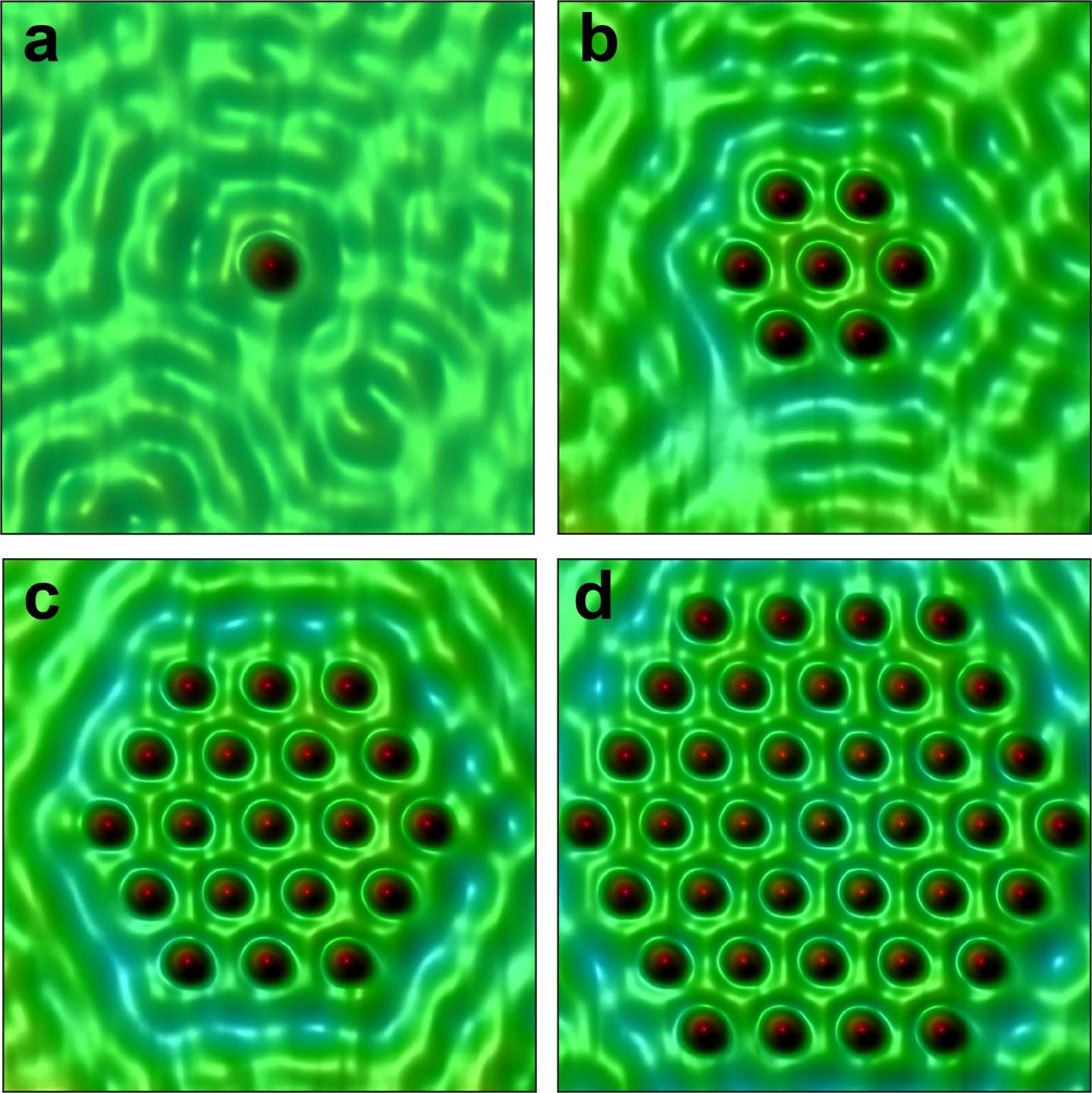
Researchers experiment with collective dynamics
IMAGE

Credit: Dirk Morr


Scientists have been interested in superconductors – materials that transmit electricity without losing energy – for a long time because of their potential for advancing sustainable energy production. However, major advances have been limited because most materials that conduct electricity have to be very cold, anywhere from -425 to -171 degrees Fahrenheit, before they become superconductors.

A new study by University of Illinois at Chicago researchers published in the journal Nature Communications shows that it is possible to manipulate individual atoms so that they begin working in a collective pattern that has the potential to become superconducting at higher temperatures.

“This successful proof of concept opens unprecedented opportunities to engineer new smart materials, and ultimately, a room-temperature superconductor,” said Dirk Morr, corresponding author and UIC professor of physics in the College of Liberal Arts and Sciences.

Morr and his colleagues, including Stanford University’s Hari Manoharan, used a technique known as atomic manipulation, to place single cobalt atoms on a metallic copper surface in a perfectly ordered hexagonal pattern, called a Kondo droplet.

“We had theoretically predicted that for certain distances between the cobalt atoms, this nanoscopic system should start to exhibit collective behavior, while for other distances, it should not,” Morr said.

The predictions were confirmed by experiments that showed that collective behavior appears in Kondo droplets containing as little as 37 cobalt atoms.

“This is an important step forward, as the creation of collective behavior is the fundamental building block from which superconductivity emerges. It allows us to move one step closer to developing the theory that describes the process of how materials could become superconducting at room temperature,” Morr said. “This work is an example of thinking outside of the box and using principles from other research fields to promote innovation. We hope this discovery will lead to new superconductors and improve sustainable energy systems.”

###

Jeremy Figgins from UIC and Laila Mattos, Warren Mar and Yi-Ting Chen from Stanford are co-authors on the paper.

This work was supported by the U.S. Department of Energy (DE-FG02-05ER46225 and DE-AC02-76SF00515).

Media Contact
Jackie Carey
[email protected]
312-996-8277

Original Source

https://today.uic.edu/manipulating-atoms-to-make-better-superconductors

Related Journal Article

http://dx.doi.org/10.1038/s41467-019-13446-1

Tags: Chemistry/Physics/Materials Sciences
Share12Tweet8Share2ShareShareShare2

Related Posts

Blue Light and Chemistry Simplify Complex Drug Production Steps

Blue Light and Chemistry Simplify Complex Drug Production Steps

July 10, 2026
New Discovery Promises Brighter, More Energy-Efficient Digital Displays

New Discovery Promises Brighter, More Energy-Efficient Digital Displays

July 10, 2026

New Crystalline 3D Frameworks Linked by Spiroborates Developed

July 10, 2026

IBEC Joins Major European Grant on Living Matter Physics

July 10, 2026
Please login to join discussion

POPULAR NEWS

  • Detection of EDCs in Breast Milk and Infant Urine Up to Six Months Highlights Early Exposure Risks

    77 shares
    Share 31 Tweet 19
  • New Drug Candidate Developed at McMaster Shows Potential for Treating Brain Cancer

    58 shares
    Share 23 Tweet 15
  • KTU Researchers Explore Ultrasound’s Role in Enhancing Blood Flow Beyond Diagnostics

    53 shares
    Share 21 Tweet 13
  • 高齢者の骨粗鬆症治療の持続性比較

    51 shares
    Share 20 Tweet 13

About

We bring you the latest biotechnology news from best research centers and universities around the world. Check our website.

Follow us

Recent News

TP53 Mutation Triggers CD8+ T Cell Exhaustion Causing Therapy-Resistant Urothelial Cancer

Transient Simulation Advances in Bioresorbable Flexible Electronic Circuits

Evaluating Geriatric Assessment and Interventions for Prostate Cancer Patients on ADT

Subscribe to Blog via Email

Enter your email address to subscribe to this blog and receive notifications of new posts by email.

Join 85 other subscribers
  • Contact Us

Bioengineer.org © Copyright 2023 All Rights Reserved.

Welcome Back!

Login to your account below

Forgotten Password?

Retrieve your password

Please enter your username or email address to reset your password.

Log In
No Result
View All Result
  • Homepages
    • Home Page 1
    • Home Page 2
  • News
  • National
  • Business
  • Health
  • Lifestyle
  • Science

Bioengineer.org © Copyright 2023 All Rights Reserved.