EMBARGOED: NOT FOR RELEASE UNTIL 3:00 P.M. U.S. EASTERN TIME ON JANUARY 22, 2024
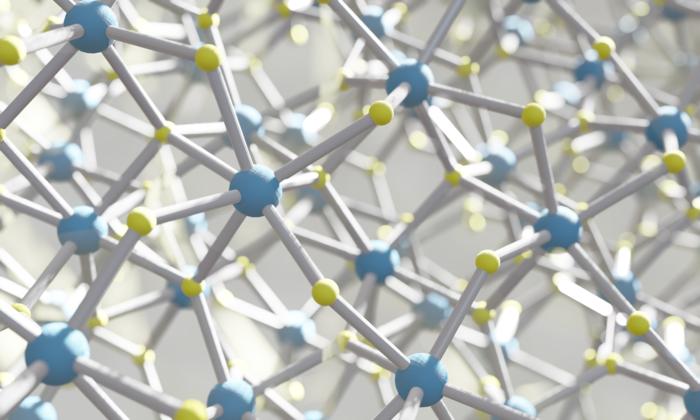
Credit: University of Rochester illustration / Michael Osadciw
EMBARGOED: NOT FOR RELEASE UNTIL 3:00 P.M. U.S. EASTERN TIME ON JANUARY 22, 2024
Scientists and engineers have been pushing for the past decade to leverage an elusive ferroelectric material called hafnium oxide, or hafnia, to usher in the next generation of computing memory. A team of researchers including the University of Rochester’s Sobhit Singh published a Proceedings of the National Academy of Sciences study outlining progress toward making bulk ferroelectric and antiferroelectric hafnia available for use in a variety of applications.
In a specific crystal phase, hafnia exhibits ferroelectric properties—that is, electric polarization that can be changed in one direction or another by applying an external electric field. This feature can be harnessed in data storage technology. When used in computing, ferroelectric memory has the benefit of non-volatility, meaning it retains its values even when powered off, one of several advantages over most types of memory used today.
“Hafnia is a very exciting material because of its practical applications in computer technology, especially for data storage,” says Singh, an assistant professor in the Department of Mechanical Engineering. “Currently, to store data we use magnetic forms of memory that are slow, require a lot of energy to operate, and are not very efficient. Ferroelectric forms of memory are robust, ultra-fast, cheaper to produce, and more energy-efficient.”
But Singh, who performs theoretical calculations to predict material properties at the quantum level, says that bulk hafnia is not ferroelectric at its ground state. Until recently, scientists could only get hafnia to its metastable ferroelectric state when straining it as a thin, two-dimensional film of nanometer thickness.
In 2021, Singh was part of a team of scientists at Rutgers University that got hafnia to stay at its metastable ferroelectric state by alloying the material with yttrium and rapidly cooling it. Yet this approach had some drawbacks. “It required a lot of yttrium to get to that desired metastable phase,” he says. “So, while we achieved what we were going for, at the same time we were hampering a lot of the material’s key features because we were introducing a lot of impurities and disorder in the crystal. The question became, how can we get to that metastable state with as little yttrium as possible to improve the resulting material’s properties?”
In the new study, Singh calculated that by applying significant pressure, one could stabilize bulk hafnia in its metastable ferroelectric and antiferroelectric forms—both of which are intriguing for practical applications in next-generation data and energy storage technologies. A team led by Professor Janice Musfeldt at the University of Tennessee, Knoxville, carried out the high-pressure experiments and demonstrated that, at the predicted pressure, the material converted into the metastable phase and remained there even when pressure was removed.
“This is as an excellent example of experimental-theoretical collaboration”, says Musfeldt.
The new approach required only about half as much yttrium as a stabilizer, thereby considerably improving the quality and purity of the grown hafnia crystals. Now, Singh says that he and the other scientists will push to use less and less yttrium until they figure out a way for producing ferroelectric hafnia in bulk for widespread use.
And as hafnia continues to draw increasing attention due to its intriguing ferroelectricity, Singh is organizing an invited focus session on the material at the upcoming American Physical Society’s March Meeting 2024.
Journal
Proceedings of the National Academy of Sciences
DOI
10.1073/pnas.2312571121
Article Title
Structural phase purification of bulk HfO2:Y through pressure 62 63 cycling
Article Publication Date
22-Jan-2024