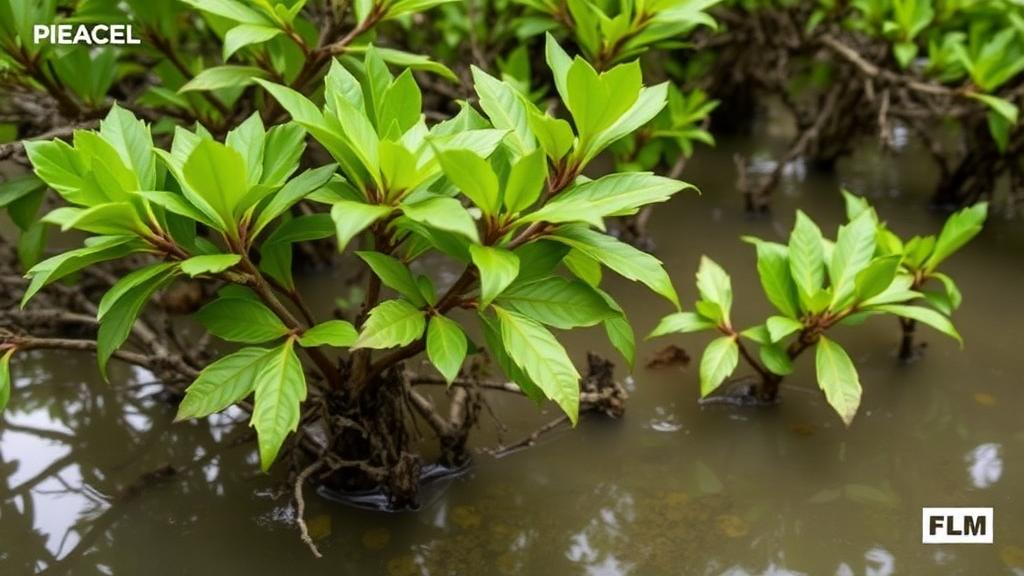
Mangrove forests are famous as nurseries for fish, buffers against storms and champions of carbon storage, but a new study from subtropical Australia suggests they deserve equal fame for something far less glamorous: quietly locking toxic metals into the mud. Researchers from Griffith University surveyed four common mangrove species across four sites in Queensland’s Moreton Bay and found that the trees act less like metal pumps and more like metal traps, keeping potentially dangerous elements sequestered in sediments rather than shuttling them into leaves where they could enter food webs.
The study, published in the journal Plant and Soil, examined the grey mangrove Avicennia marina, the river mangrove Aegiceras corniculatum, the stilted mangrove Rhizophora stylosa and the orange mangrove Bruguiera gymnorrhiza. These species dominate the intertidal fringes of Moreton Bay, a rapidly growing metropolitan region that receives runoff from five major catchments covering more than 21,000 square kilometres, including the Brisbane River, which flows directly through Queensland’s capital city. Urban development, agriculture, aquaculture and grazing all contribute contaminants to the bay, making its mangroves a natural laboratory for studying how coastal forests handle pollution.
Trace metals are a double-edged sword for plants. Elements such as manganese, iron, zinc, copper, molybdenum and cobalt are essential micronutrients, vital for enzyme function and photosynthesis, yet they become toxic at high concentrations. Others, including chromium, arsenic, lead, cadmium and mercury, have no known biological role and are generally poisonous. In mangrove sediments, low oxygen and low redox conditions slow the decomposition of organic matter and favour the precipitation of metals into stable mineral phases such as pyrite and iron oxides, creating a reservoir from which metals can be released only slowly.
The research team sampled surface sediments from zero to fifteen centimetres deep, the biologically active layer that receives recent contamination, particularly after floods. They measured pH, electrical conductivity, particle size, total organic carbon and acid-volatile sulphides, and used weak acid extraction followed by inductively coupled plasma mass spectrometry to quantify metal concentrations. Leaves were collected from healthy trees at each site, freeze-dried, ground and digested for the same elemental analysis. From these paired measurements the team calculated bioconcentration factors, the ratio of metal in leaves to weak acid-extractable metal in sediment, where values below one indicate that a plant excludes rather than accumulates an element.
The most striking result was how little of the sediment metal made it into the foliage. Median bioconcentration factors were below one for every species and every one of the eleven analysable elements. The highest values belonged to essential micronutrients: copper in A. marina reached a median of 0.92, while molybdenum in B. gymnorrhiza and manganese in R. stylosa reached 0.52 and 0.46 respectively. In sharp contrast, the non-essential and potentially toxic elements vanadium, lead and iron were strongly excluded, with median factors of 0.015 or less. The trees, in other words, selectively acquire the nutrients they need while barring the door to the poisons.
Species identity, not sediment chemistry, emerged as the primary driver of leaf metal concentrations. Leaf concentrations differed significantly among the four species for ten of the eleven elements after statistical correction for multiple testing. A. marina, the grey mangrove that makes up roughly three-quarters of the mangrove community in Moreton Bay, accumulated the highest concentrations of most non-essential elements, with leaf arsenic exceeding that of the other species by one to two orders of magnitude. Manganese and molybdenum, both essential, peaked instead in B. gymnorrhiza and R. stylosa. Crucially, the comparison between A. marina and A. corniculatum, which grow side by side at all four sites, was significant for seven elements, confirming that the species signal is real rather than an artefact of where each tree happens to grow.
Why would one species hoard arsenic in its leaves while its neighbours do not? The answer likely lies in divergent evolutionary strategies for coping with salt and waterlogged soils. A. marina sports extensive pneumatophores, the snorkel-like roots that poke above the mud, and salt-excreting glands on its leaves, features that may also facilitate greater metal uptake and translocation through higher transpiration rates and a fine-root network. R. stylosa lacks salt glands entirely and instead relies on root-level exclusion through its prop-root system, promoting metal retention below ground. B. gymnorrhiza deploys biochemical detoxification, ramping up production of proline, glutathione and phytochelatins that neutralise metal-induced oxidative stress. The authors caution, however, that they did not measure these physiological traits directly, so the mechanisms remain plausible rather than proven.
The sediment itself tells an equally important story. In all twelve sampling plots, the molar sum of simultaneously extracted metals was far lower than the pool of acid-volatile sulphides, with ratios between 0.02 and 0.08. That enormous excess of reactive sulphide means divalent metals are expected to be bound up as sparingly soluble sulphide phases, essentially chemically handcuffed and unavailable for biological uptake. Principal component analysis showed the sites were arranged along a gradient from organic-rich, fine-grained sediments to sandier ones, and fine particles, organic matter and sulphides are all well known to promote metal sorption and immobilisation. Geochemistry and physiology thus conspire to keep metals out of the canopy.
These findings carry practical consequences for how we monitor coastal pollution. Because leaf chemistry reflected species identity and limited bioavailability rather than sediment contamination, the authors conclude that sediment chemistry provides a more reliable indicator of trace metal contamination than leaf tissues in these low-contamination, sulphidic mangrove environments. The results also reframe the ecological role of mangroves: rather than phytoextractors that pull metals into harvestable biomass, these species appear to function as phytostabilisers, retaining metals within the sediment matrix and limiting their transfer to above-ground tissues, which may in turn reduce metal cycling through leaf litter and the food web.
The researchers are careful to note the limits of their study. The sites spanned a relatively narrow contamination gradient, so little within-species variation in sediment metal remained once site effects were accounted for, limiting the statistical power to detect sediment-leaf relationships; the absence of such relationships should not be read as proof they never exist. Only leaves were sampled, so the fate of metals retained in roots, where much of the exclusion happens, could not be assessed directly. And a single field campaign captures one snapshot of a system where seasonal shifts in salinity, redox conditions and plant physiology may alter both bioavailability and uptake. Even so, the message is clear and quietly remarkable: in these subtropical forests, the mud holds the poison, the trees decide what gets through, and the leaves tell us more about the tree than about the pollution below.
Subject of Research: Species-specific trace metal accumulation and sediment-leaf relationships in subtropical Australian mangrove forests
Article Title: Sediment–leaf trace metal relationships across four mangrove species in subtropical Australia
Article References: Sumudumali, I., Sievers, M., Bennett, W. W., & Adame, M. F. (2026). Sediment–leaf trace metal relationships across four mangrove species in subtropical Australia. Plant and Soil. https://doi.org/10.1007/s11104-026-09025-1
Image Credits: AI Generated
DOI: 10.1007/s11104-026-09025-1
Keywords: mangroves, trace metals, Moreton Bay, phytostabilisation, sediment geochemistry, bioconcentration factor, Avicennia marina, Rhizophora stylosa, acid-volatile sulphide, biomonitoring, coastal contamination, Australia
News Source: Alan Morgan. (October 11, 2026). Mangroves Keep Toxic Metals Locked in the Mud, Not in Their Leaves. Scienmag.