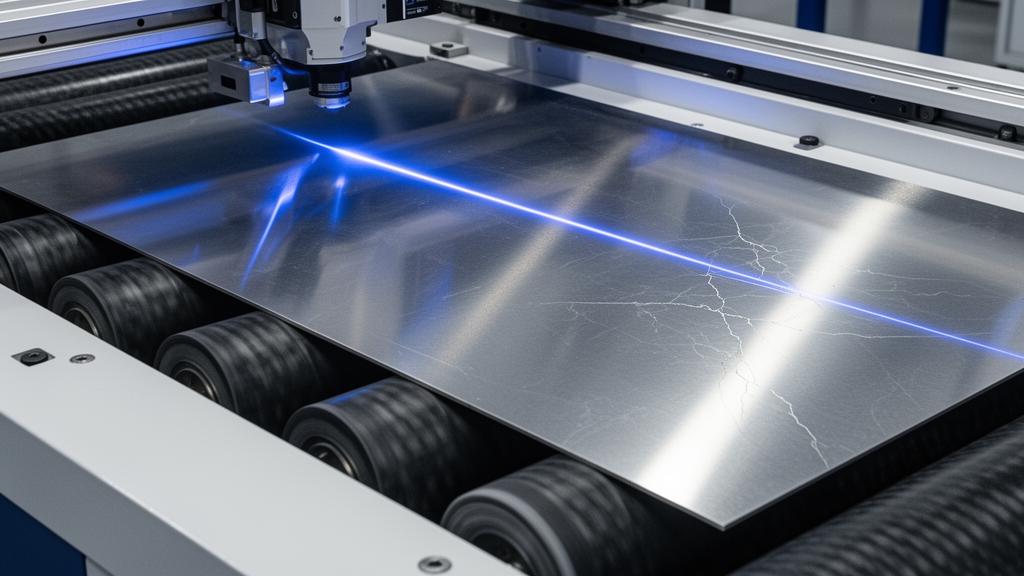
A research team led by Dianlong Chen, Tengbin Liu, Zisheng Xu, and Chao Tao from China Yangtze Power Co., Zhejiang Dahua Technology Co., and Hangzhou Dianzi University has developed a novel deep learning framework called the Multi-Information Perception-Enhanced Mamba UNet, or MPMNet, designed specifically for industrial surface defect detection. When manufacturing equipment or environmental fluctuations cause flaws to emerge on product surfaces, automated vision systems must detect them with high precision to prevent structural failures and safeguard human operations. While modern automated inspection relies heavily on computer vision methods, existing deep learning models encounter persistent trade-offs between contextual modeling capacity and computational overhead when deployed on fine-grained visual tasks.
Over the past decade, convolutional neural networks established the primary foundation for automated surface inspection, yet their fixed receptive fields consistently restrict their capacity to capture broad, long-range contextual relationships across large industrial images. Because convolutional kernels operate locally, they often fail to integrate global contextual cues that help differentiate subtle surface flaws from complex background textures. To overcome these receptive field constraints, subsequent researchers integrated Vision Transformers into defect inspection pipelines, leveraging self-attention mechanisms to effectively model long-range structural dependencies across entire image planes. These architectural trade-offs motivated the researchers to explore alternative sequence modeling paradigms capable of reconciling global receptive fields with linear computational complexity.
To resolve the operational constraints of both convolutional and Transformer models, the researchers introduced the visual state space model derived from VMamba into their encoder-decoder architecture. The resulting MPMNet framework employs Visual State Space blocks as fundamental structural units within both its encoder and decoder pipelines. Due to their selective scanning mechanism, Visual State Space blocks model extensive, long-range spatial dependencies across input images while maintaining strictly linear computational complexity relative to image dimensions. This linear scaling allows the network to process global geometric relationships across defect images without the severe computational overhead characteristic of self-attention mechanisms. However, the researchers observed that relying solely on global state-space feature propagation can inadvertently retain redundant background noise and may fail to adequately emphasize small, irregular, or low-contrast local defect structures, necessitating dedicated complementary processing modules.
The encoder of MPMNet is structured into five distinct hierarchical stages designed to transform raw input photographs into multi-level feature representations. In the initial stage, an input image resized to 384 by 384 pixels passes into a patch embedding layer that segments the image into non-overlapping four-by-four patches, projecting them into a primary feature representation with 96 channels at a spatial resolution of 96 by 96. The subsequent four stages incorporate pairs of consecutive Visual State Space blocks, where the second through fourth stages utilize patch merging operations to progressively downsample spatial resolution while expanding channel dimensions. Within each Visual State Space block, normalized input features split into two parallel processing branches: one passing through linear projections and activation functions, and the second integrating depthwise separable convolutions and a two-dimensional selective scan mechanism before recombining through element-wise operations and residual pathways.
To eliminate background interference introduced during global scanning, the engineering team designed a Residual Attention module positioned directly behind each Visual State Space block across the first four encoder stages. Because the deepest fifth-stage feature map possesses a compact spatial resolution containing refined location information, residual attention filtering is specifically concentrated across the preceding four stages. The Residual Attention module routes intermediate features into a channel attention block comprising global average pooling, an initial three-by-three convolution, and two successive one-by-one convolutions to compute an adaptive channel weight vector. Multiplying the input features by this vector yields channel-enhanced features, which subsequently pass into a spatial attention block that derives spatial weighting maps. By sequentially multiplying and adding these calibrated representations back to the original input, the module filters redundant background noise while preserving critical defect cues.
To capture fine-grained spatial boundaries and localized surface textures, the researchers integrated a Split Context Interaction module targeting the low-level encoder representations from the initial three stages. Conventional multi-scale feature extractors often rely on atrous spatial pyramid pooling, which concatenates parallel dilated convolutions but fails to model direct interactions between distinct receptive fields while significantly inflating model parameters. In contrast, the Split Context Interaction module evenly splits input feature channels into four distinct sub-groups along the channel dimension, applying three-by-three convolutions with dilation rates of two, four, and six to generate enhanced multi-scale features. These partitioned representations then enter receptive field interaction blocks where matrix multiplication, dimensional transposition, softmax normalization, and learnable weight matrices facilitate direct spatial interaction across different receptive fields before channel and spatial attention suppress residual noise.
To optimize localization accuracy in deeper network layers, MPMNet applies a Semantic-Aware Interaction module to the high-level features extracted from the fourth and fifth encoder stages. This module leverages a dual optimization strategy consisting of mutual optimization and common feature optimization to focus feature responses directly onto genuine defect areas. In the mutual optimization phase, channel attention operations containing global average pooling, one-by-one convolutions, and sigmoid activation functions generate distinct weight vectors that modulate the paired high-level features through combined addition and multiplication. Following this step, the module merges both feature streams through element-wise multiplication and addition to capture shared semantic properties, passing the unified representation through an additional channel attention block. The resulting common feature vector recalibrates both feature maps, aligning semantic classification with precise spatial localization across ambiguous boundary regions.
In the decoding phase, MPMNet utilizes four consecutive Visual State Space blocks to integrate the refined semantic representations and detailed spatial features, generating high-resolution detection maps through patch expansion layers. Model training is supervised through a composite fusion loss function combining four distinct objective terms: binary cross-entropy loss to evaluate pixel-level classification, boundary intersection-over-union loss to penalize contour discrepancies, F-measure loss to optimize balanced precision and recall, and structural similarity loss to preserve overall spatial coherence across the predicted surface maps.
The researchers implemented MPMNet in PyTorch and conducted empirical evaluations using an experimental workstation equipped with an Intel Xeon Silver 4110 central processing unit operating at 2.1 gigahertz, 32 gigabytes of random-access memory, and an NVIDIA GeForce RTX 4080 graphics processing unit. During training, input images were standardized to 256 by 256 pixels and subjected to random cropping to 224 by 224 pixels, with optimization handled by the RMSprop algorithm using a batch size of eight, initial learning rate of 0.0001, and convergence reached across 300 epochs. Performance assessments were carried out across four benchmark collections: a road defect dataset containing 3,368 annotated images, a steel surface defect dataset comprising 2,520 images spanning scratch, patch, and inclusion categories, a magnetic tile defect dataset consisting of 392 images across five defect types, and the synthetic DAGM2007 dataset containing 2,100 textured defect images.
Extensive ablation studies on the steel surface defect dataset confirmed the quantitative contribution of each proposed component within the MPMNet pipeline. Removing the Residual Attention module caused the mean absolute error to increase from 0.0180 to 0.0182, alongside observable drops across F-measure, weighted F-measure, and E-measure scores. Omitting the Split Context Interaction module elevated mean absolute error to 0.0183, while removing the Semantic-Aware Interaction module increased it to 0.0185. Comparative backbone evaluations demonstrated that MPMNet substantially outperformed traditional CNN backbones; relative to a standard ResNet-18 baseline, MPMNet reduced mean absolute error by 37.9 percent from 0.0290 to 0.0180 while improving F-measure from 0.7195 to 0.8538 and weighted F-measure from 0.7937 to 0.8844.
When compared against fourteen established saliency and defect detection algorithms, including BASNet, CorrNet, GATE, F3, ADMNet, MEANet, AEP, PGA, MC, SMINet, VST, A3Net, LEIS-Net, and IFIFusion, MPMNet demonstrated competitive performance across all benchmarks. On the steel surface defect dataset, MPMNet recorded the lowest mean absolute error at 0.0180, outperforming top-ranking alternatives such as IFIFusion at 0.0205 and BASNet at 0.0217. On the road defect dataset, the proposed model achieved an error of 0.0292 and an F-measure of 0.7166, outperforming SMINet and MEANet. On the synthetic DAGM2007 dataset, MPMNet recorded a mean absolute error of 0.0041, an F-measure of 0.8776, and an E-measure of 0.9684. The authors noted that on low-contrast magnetic tile samples, MPMNet produced moderate scores including a mean absolute error of 0.0198 and F-measure of 0.7871, highlighting an ongoing technical need for specialized noise-suppression techniques in extreme low-contrast settings.
In visual comparisons, the network demonstrated superior boundary delineation on elongated scratches and intricate pavement cracks where competing models produced incomplete segmentations or false detections due to background interference. By coupling selective visual state-space scanning with targeted residual attention, multi-scale context splitting, and semantic interaction mechanisms, the authors established an efficient architectural framework that advances automated visual inspection across varied manufacturing environments.
Subject of Research: Deep learning architectures for automated industrial surface defect detection
Article Title: MPMNet: multi-information perception-enhanced Mamba UNet for surface defect detection
Article References: Chen, D., Liu, T., Xu, Z., & Tao, C. (2026). MPMNet: multi-information perception-enhanced Mamba UNet for surface defect detection. Frontiers in Artificial Intelligence, 9, Article 1991892. https://doi.org/10.3389/frai.2026.1991892
Image Credits: AI Generated
DOI: 10.3389/frai.2026.1991892
Keywords: surface defect detection, visual state space, VMamba, Mamba UNet, MPMNet, computer vision, residual attention, split context interaction, semantic aware interaction, industrial quality control, steel defect detection, dilated convolution, receptive field interaction, feature fusion, deep learning, saliency detection, cross-level connections
News Source: Blake Davidson. (November 19, 2026). Mamba UNet Architecture Improves Surface Defect Detection Across Industrial Materials. Scienmag.