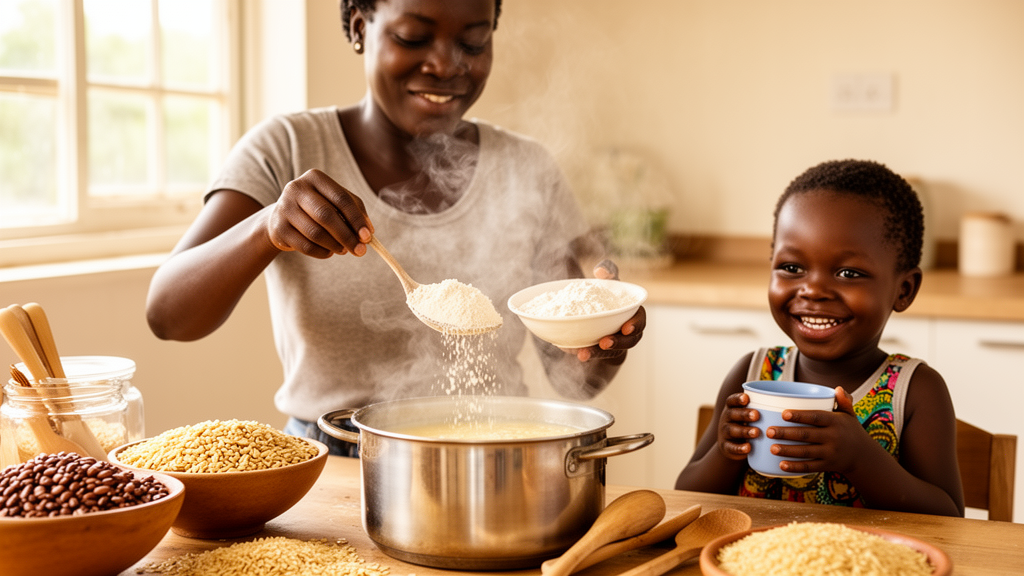
Researchers in Northern Uganda have developed a complementary food from broken rice and an iron-rich bean variety, and found that malting the beans before blending changed the flour’s nutritional profile, functional behaviour and acceptability among local caregivers. The community-based experimental study, conducted in the Acholi sub-region districts of Nwoya and Amuru, blended malted and unmalted flour from the NARO Bean 3 variety with broken rice in several proportions, then asked mothers and caregivers of children aged 6 to 24 months to rate the resulting porridges and took the best-liked formulations to the laboratory for chemical analysis. The work addressed a region where iron and zinc deficiencies are described as a major public health concern among children in the 6 to 24 month age window, linked largely to complementary foods made from inadequately processed local ingredients that contain anti-nutritional factors impairing micronutrient absorption.
The scale of the underlying problem is considerable. In Uganda, nearly half of children aged 6 to 59 months suffer from iron-deficiency anemia, and zinc deficiency is similarly widespread, according to the background cited in the study. Diets during the complementary feeding phase, the transition from exclusive breastfeeding to solid foods, are frequently low in diversity and dominated by starchy staples, contributing to stunting, wasting, underweight, weakened immunity and recurring illness. Commonly consumed complementary foods in the country often lack adequate amounts of iron, zinc, calcium, selenium and essential vitamins. The researchers chose their raw materials with this gap in mind: NARO Bean 3, a variety developed by the National Agriculture Research Organization, is rich in protein and contains substantial iron at 34 to 89 milligrams per kilogram and zinc at 21 to 54 milligrams per kilogram, while rice ranks fourth among Uganda’s cereal crops, with upland varieties accounting for over 70 percent of cultivation.
Broken rice itself is usually treated as a waste stream. Substandard milling practices, particularly in northern Uganda, produce large volumes of broken grain that are typically underutilized or discarded because of low market value, despite nutritional and economic potential. Combining it with iron-rich beans offered the team a way to enhance complementary foods while reducing post-harvest losses. The catch is that both cereals and legumes contain phytates, tannins and trypsin inhibitors, compounds that inhibit mineral absorption. Processing methods such as soaking, boiling, germination, extrusion and especially malting have been shown to reduce these anti-nutrients and improve nutrient bioavailability. Malting is considered particularly advantageous because it activates endogenous enzymes including phytases and amylases, degrading phytate and improving mineral and protein bioavailability while remaining cost-effective and suitable for low-resource settings.
The practical work followed a carefully documented sequence. Sixty kilograms of NARO Bean 3 from a farmer attached to the National Crops Resources Research Institute beans programme and 60 kilograms of broken Nylon-variety rice were procured from local farmers and millers in Purongo Sub-County in Nwoya and Palema Sub-County in Amuru during the November to December 2020 harvest season. Malting was carried out traditionally with caregivers in the community, while roasting, grinding, extrusion and milling took place at Kawanda Agricultural Research Institute. For the malted portion, beans were soaked at a 1:3 bean-to-water ratio for 12 hours, germinated for 48 hours at approximately 70 percent ambient humidity, sun-dried for about five days at 28 to 30 degrees Celsius, then roasted at 200 degrees Celsius for one hour. The unmalted portion skipped germination and served as a comparison. Blends were milled, extruded at a barrel temperature of 120 degrees Celsius with a screw speed of 60 revolutions per minute and a residence time of roughly three minutes, re-milled, sieved through a 0.5 millimetre mesh and packed for storage.
Nine formulations were prepared in total: four malted, four unmalted and one control of 100 percent rice. Blending ratios were calculated using the HarvestPlus Food Composition Table for Central and Eastern Uganda and targeted the Recommended Dietary Allowance of 9.3 milligrams of iron and 4.1 milligrams of zinc per day for children aged 6 to 24 months. Sensory evaluation involved 124 caregivers, recruited through multistage sampling that moved from purposively selected districts down through randomly chosen sub-counties, parishes and villages, with eight caregivers per village enrolled with the help of Local Council One leaders. Although the Fischer formula based on a 71 percent regional prevalence of iron deficiency yielded a computed sample size of 351, the team argued that smaller panels are methodologically appropriate for sensory evaluation, noting that 124 participants falls within the recommended range of 30 to 150 for such panels.
During four sensory sessions, porridge was prepared uniformly from 400 grams of flour mixed into 1600 millilitres of boiling water and served in labelled white disposable cups to avoid bias. Caregivers rated colour, aroma, texture, thickness, taste and overall acceptability on a five-point hedonic scale running from dislike very much to like very much, with clean water provided for palate cleansing between samples. The results split by child age. For children aged 6 to 11 months, the most preferred formulation was the unmalted Composite E, containing 30 percent unmalted beans and 70 percent rice, while for children aged 12 to 24 months the malted Composite C, with 40 percent malted beans and 60 percent rice, was most acceptable. In the older group, Composite C scored significantly higher than its unmalted counterpart and the control in aroma, taste, texture and overall acceptability, whereas in the younger group the unmalted options consistently drew higher ratings.
The laboratory phase analysed the five most preferred formulations in duplicate under a completely randomized design, with malting as the main treatment factor. Moisture, crude protein, crude fat, crude fiber, ash and carbohydrate were measured by standard AOAC and ISO methods, minerals were quantified by Microwave Plasma-Atomic Emission Spectroscopy after acid digestion, and in-vitro bioavailability was assessed using simulated gastric and pancreatic digestion, expressed as the proportion of dialyzable mineral relative to total content. Composite A, with 30 percent malted beans, and Composite G, with 40 percent unmalted beans, recorded moisture contents of 2.3 percent and 3.0 percent respectively, with G significantly higher. Composite E showed the highest water absorption capacity, while malting reduced oil absorption capacity and bulk density. Ash content was higher in the malted samples, at 1.45 percent for A and 2.28 percent for C, than in the unmalted E at 1.52 percent and G at 1.76 percent. Carbohydrate levels were broadly consistent but highest in the 100 percent rice control at 91.71 percent.
The mineral and anti-nutrient findings were mixed in instructive ways. Malting increased zinc, calcium, iron, magnesium, potassium and fiber, and reduced phytates and trypsin inhibitors, though polyphenols and tannins slightly increased, possibly because roasting releases bound phenolic compounds and generates Maillard reaction products. In the older age group, the malted Composite C showed significantly higher levels of zinc, calcium, iron, magnesium and potassium than the unmalted Composite G and the control. Protein digestibility was higher in the malted samples, at 33.16 percent for A and 12.35 percent for C, and zinc bioavailability was highest in C at 4.14 percent. Yet the picture was not uniformly favourable: for children aged 6 to 11 months, the malted Composite A had significantly lower bioavailable zinc than the unmalted E and the control, apparently because polyphenols and tannins formed or released during germination bind zinc and reduce its solubility. Calcium remained most bioavailable in the rice control, likely owing to its lower levels of chelating compounds and simpler food matrix. Notably, the plain rice control achieved the highest in-vitro protein digestibility of all, at 95.29 percent, which the authors attribute to its simpler protein matrix and minimal anti-nutritional interference.
The authors are explicit that these are laboratory measurements, not clinical outcomes. The mineral figures represent concentrations per 100 grams of product rather than actual dietary intake, so their contribution to recommended daily allowances depends on assumed consumption levels and bioavailability. Because the findings rest on in-vitro analyses, they may not fully reflect nutrient absorption in children, and the study did not examine longer-term outcomes such as growth or hemoglobin status. Acceptability was based on caregiver feedback rather than child consumption, only malting was assessed without comparison to other processing methods, and laboratory analyses were run in duplicate because of limited resources, which the authors acknowledge may slightly reduce statistical precision. They state that the nutritional benefits in children require confirmation through well-designed clinical feeding trials, and call for future work on in-vivo bioavailability, feeding studies, growth monitoring and haemoglobin assessment.
Within those limits, the study offers a concrete, low-cost template for improving complementary foods in a region where they are badly needed. Malting improved nutritional quality, functional properties and, for the older age group, acceptability, and the authors conclude that Composite A is suitable for children aged 6 to 11 months while Composite C suits those aged 12 to 24 months. They recommend promoting iron-rich bean composites through caregiver education, practical demonstrations and Infant and Young Child Feeding counselling, and suggest combining the composite with zinc- and calcium-rich foods such as groundnuts, sesame seeds, silver fish and dark green leafy vegetables. They also flag that the microbial safety of the formulations should be further evaluated. Turning milling waste and a locally bred bean into an acceptable, nutrient-dense porridge will not by itself solve micronutrient deficiency, but as a piece of the complementary feeding puzzle it is a pragmatic, testable step, now awaiting the human feeding trials that would show whether the laboratory gains translate into better iron status and growth in children.
Subject of Research: Effects of malting iron-rich bean flour blended with broken rice on the nutrition and acceptability of complementary foods for children in Northern Uganda
Article Title: Effect of malted iron-rich beans flour inclusion on nutritional and sensory properties of broken rice-based complementary food: a community-based experimental study
Article References: Atibo, C., Oyet, S. M., Muggaga, C., & Mugonola, B. (2026). Effect of malted iron-rich beans flour inclusion on nutritional and sensory properties of broken rice-based complementary food: a community-based experimental study. Food, Nutrition and Health, 3(1), Article 33. https://doi.org/10.1007/s44403-026-00080-1
Image Credits: AI Generated
DOI: 10.1007/s44403-026-00080-1
Keywords: malting, complementary feeding, iron-rich beans, broken rice, NARO Bean 3, Uganda, micronutrient deficiency, anti-nutritional factors, protein digestibility, zinc bioavailability, sensory evaluation, infant nutrition
News Source: Alan Morgan. (October 29, 2026). Malted Bean and Broken Rice Flour Shows Nutritional Promise for Young Children in Uganda. Scienmag.