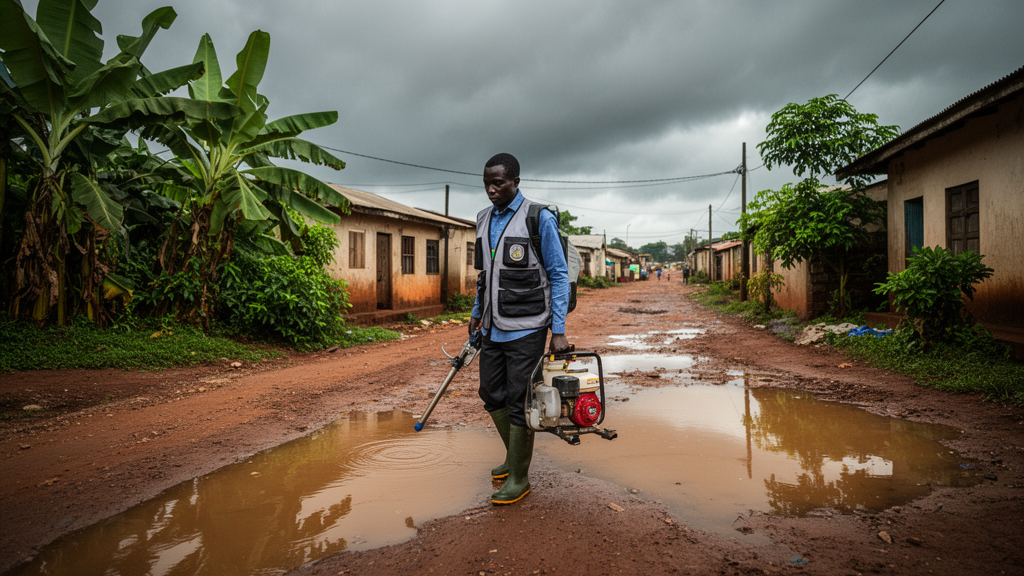
In a recent exploratory qualitative study published in Discover Public Health, researchers examined how district malaria focal persons in Dar es Salaam, Tanzania, perceive the operational challenges posed by climate variability and change to local malaria control efforts. The study, conducted between November and December 2024, involved semi-structured key informant interviews with all five district malaria focal persons in the region. These officials are responsible for implementing and coordinating malaria control strategies at the local level, including vector control, case management, surveillance, and community education. The research aimed to document their perspectives on how weather and climate-related conditions influence malaria transmission and disrupt control activities, filling a gap in understanding how local health managers translate climate perceptions into operational decisions.
Dar es Salaam, Tanzania’s largest city, is located along the southwestern coast of the Indian Ocean and has an estimated population of approximately 5.4 million people. The region experiences a warm, humid tropical climate with average temperatures of approximately 26 degrees Celsius, a long rainy season from March to May, and a short rainy season from October to December. This climatic context is significant for local mosquito ecology and malaria-control operations. The study was selected for this setting due to its history of urban malaria transmission and its vulnerability to climate-related events such as flooding and heavy rainfall. Participants in the study were key informants directly involved in malaria surveillance and planning, providing context-specific operational insights into how weather conditions are perceived to affect control activities.
The interviews were conducted in Swahili, audio-recorded, transcribed verbatim, and translated into English. Data were analyzed using inductive thematic analysis guided by Braun and Clarke’s framework with the aid of NVivo version 14 software. Three major themes emerged from the analysis: trends and the current situation of malaria transmission, awareness and perceived influence of climate change and changing weather patterns on malaria transmission, and malaria control strategies and operational challenges associated with weather- and climate-related conditions. The study emphasized that participants’ descriptions of irregular rainfall, unusual temperatures, and other weather events were treated as reported perceptions and experiences rather than independent evidence of long-term climatic trends.
Regarding the current situation of malaria transmission, participants reported a substantial decline in malaria cases over the past decade. This reduction was consistently attributed to the scale-up of multiple malaria control interventions, including larviciding, distribution of long-lasting insecticide-treated nets, provision of preventive treatment for pregnant women, and community education initiatives. However, despite the overall declining trend, participants noted persistent malaria transmission in specific ecological and geographical settings. These hotspots were commonly described in peripheral urban areas located on the outskirts of the city, far from health facilities, as well as in low-lying settlements characterized by poor drainage systems and stagnant water accumulation. Densely populated informal settlements with poor drainage systems consistently recorded higher case numbers during routine surveillance, with some areas reporting around 10 to 20 cases per month.
Participants also identified occupational exposure and human mobility as factors influencing malaria transmission. Individuals engaged in nighttime occupations, particularly security personnel, were described as being at increased risk of exposure during peak mosquito biting hours. Additionally, imported malaria cases were reported among individuals travelling from high-transmission regions. These cases were more frequently observed in commercial and high-traffic urban settings that attract migrants, traders, and other visitors, potentially contributing to continued local transmission.
All five participants demonstrated awareness of climate change and its potential health impacts, framing their understanding around observed weather patterns such as irregular rainfall and temperature extremes. Participants consistently identified rainfall as an important weather-related factor influencing malaria transmission. They described a perceived relationship in which rainfall was associated with stagnant water formation, creating mosquito breeding sites and potentially increasing malaria cases. One participant noted that malaria cases tend to rise during rainy seasons and decrease when the rains subside, as breeding sites diminish. Temperature was also perceived as an important factor influencing vector development, with participants explaining that higher temperatures could accelerate mosquito development. One participant stated that in Dar es Salaam, mosquito development from egg to adult takes about 10 days due to the warm conditions, a timeframe consistent with laboratory studies showing that Anopheles gambiae development takes approximately 10 to 14 days at 25 to 28 degrees Celsius.
A key operational finding was the reported weakening of collaboration between district malaria programmes and the Tanzania Meteorological Authority (TMA). Focal persons described earlier connections associated with the initiation of larviciding programmes in 2004, but reported that these formal links had since lapsed. In the absence of formal data-sharing mechanisms, participants reported relying on public weather information such as radio broadcasts rather than tailored forecasts for operational planning. This lack of integration limits the ability of district teams to use short-term weather forecasts for operational decisions and seasonal climate information for preparedness. The study highlights the need for anticipatory capacity and formal climate-health interoperability to strengthen local preparedness.
Participants also described significant operational challenges associated with heavy rainfall. All five participants described heavy rainfall as disrupting larviciding activities, with some reporting that applied treatments were washed away by rain, potentially reducing their effectiveness. One participant stated that during heavy rains, larviciding processes must be stopped, and in some cases, treatments are washed away by the rain. Another explained that they stop larviciding when heavy rains come because the chemicals are wasted, describing it as a complete loss of resources. A third participant added that after heavy rain, they have to wait for the water to recede before they can apply larvicide again, which can take several days. By then, mosquitoes may have already bred, indicating that vector-control operations are vulnerable to heavy-rainfall events.
Community-related challenges were also frequently reported. Participants described low levels of community engagement in environmental management, with some residents perceiving drainage maintenance as solely a government responsibility rather than a shared duty. Misconceptions regarding bed net use were also noted, including beliefs that insecticide-treated nets may affect male fertility, while some nets were reportedly diverted to alternative uses such as fishing or gardening.
Finally, chronic funding constraints were identified as a cross-cutting challenge affecting all aspects of malaria control. Limited financial resources were reported to restrict the procurement of insecticides, reduce the frequency of larviciding activities, and limit the scope of surveillance activities such as school-based malaria monitoring programmes. One participant highlighted the cost of insecticides, noting that it is particularly prohibitive and limits the scale and frequency of larviciding activities. Another participant mentioned that while school-based malaria surveillance is conducted biennially to monitor prevalence and bed net usage, funding constraints prevent more frequent assessments and limit the geographic coverage of interventions. These financial limitations hinder the ability of district teams to maintain consistent and comprehensive malaria control efforts.
The study has several strengths, including the inclusion of all district malaria focal persons in Dar es Salaam, providing complete coverage of the eligible target population and capturing perspectives across all five districts. The qualitative design enabled an in-depth exploration of perceptions and experiences that may not be captured through quantitative approaches. However, several limitations should be considered when interpreting the findings. The study relied on participants’ self-reported perceptions and experiences, and although steps were taken to minimize social desirability bias, participants’ accounts may not fully represent all operational experiences or interpretations. In addition, the study did not analyze long-term meteorological records or link weather and climate data with malaria surveillance records. Consequently, it cannot empirically distinguish short-term climate variability from long-term climate change, verify participants’ descriptions of unusual weather against meteorological observations, or establish causal relationships between climate change and malaria transmission.
Based on these findings, the study proposes several recommendations for policy and practice. First, formal collaboration between the National Malaria Control Programme and the Tanzania Meteorological Authority should be strengthened and institutionalized at district level to support the regular sharing of short-term weather forecasts and seasonal climate outlooks for malaria preparedness and vector control planning. Second, malaria control strategies, particularly larviciding activities, should account for observed weather conditions and potential operational interruptions during heavy rainfall. District teams should assess local conditions and follow relevant technical guidance when deciding whether treatments require reapplication or whether alternative application windows are appropriate. Third, community health education programmes should address malaria-prevention practices and explain how seasonal weather conditions may influence local malaria risk, without presenting individual weather events as proof of climate change. These recommendations aim to improve operational preparedness and strengthen the integration of climate information into malaria control planning.
Future research should extend to rural and peri-urban settings for comparative analysis and combine long-term meteorological data with malaria-surveillance records to examine climatic trends and possible associations with malaria transmission. Studies should also evaluate the feasibility and performance of locally relevant early-warning models and assess whether integrating weather forecasts and seasonal climate information into district planning improves preparedness, resource allocation, and the implementation of vector-control activities.
Subject of Research: Climate variability and change as an emerging operational challenge to malaria control among district malaria focal persons in Dar es Salaam Tanzania
Article Title: Climate variability and change as an emerging operational challenge to malaria control among district malaria focal persons in Dar es Salaam Tanzania
Article References: Mapande, I., Mohamed, H., Protas, E., Punguti, O., Msemakweli, J. G., & Tesha, N. (2026). Climate variability and change as an emerging operational challenge to malaria control among district malaria focal persons in Dar es Salaam Tanzania. Discover Public Health, 23(1), Article 1739. https://doi.org/10.1186/s12982-026-03212-2
Image Credits: AI Generated
DOI: 10.1186/s12982-026-03212-2
Keywords: Climate, variability, change, emerging, operational, challenge, malaria, control, district, focal, persons, Salaam
News Source: Ophelia Keating. (November 11, 2026). Malaria Control in Dar es Salaam Faces Weather-Driven Operational Hurdles. Scienmag.