• HOME
  • NEWS
  • EXPLORE
    • CAREER
      • Companies
      • Jobs
    • EVENTS
    • iGEM
      • News
      • Team
    • PHOTOS
    • VIDEO
    • WIKI
  • BLOG
  • COMMUNITY
    • FACEBOOK
    • INSTAGRAM
    • TWITTER
Sunday, August 30, 2026
BIOENGINEER.ORG
No Result
View All Result
  • Login
  • HOME
  • NEWS
  • EXPLORE
    • CAREER
      • Companies
      • Jobs
        • Lecturer
        • PhD Studentship
        • Postdoc
        • Research Assistant
    • EVENTS
    • iGEM
      • News
      • Team
    • PHOTOS
    • VIDEO
    • WIKI
  • BLOG
  • COMMUNITY
    • FACEBOOK
    • INSTAGRAM
    • TWITTER
  • HOME
  • NEWS
  • EXPLORE
    • CAREER
      • Companies
      • Jobs
        • Lecturer
        • PhD Studentship
        • Postdoc
        • Research Assistant
    • EVENTS
    • iGEM
      • News
      • Team
    • PHOTOS
    • VIDEO
    • WIKI
  • BLOG
  • COMMUNITY
    • FACEBOOK
    • INSTAGRAM
    • TWITTER
No Result
View All Result
Bioengineer.org
No Result
View All Result
Home NEWS Science News

Making sense of flexible sensor systems

Bioengineer by Bioengineer
January 28, 2020
in Science News
Reading Time: 3 mins read
0
IMAGE
Share on FacebookShare on TwitterShare on LinkedinShare on RedditShare on Telegram

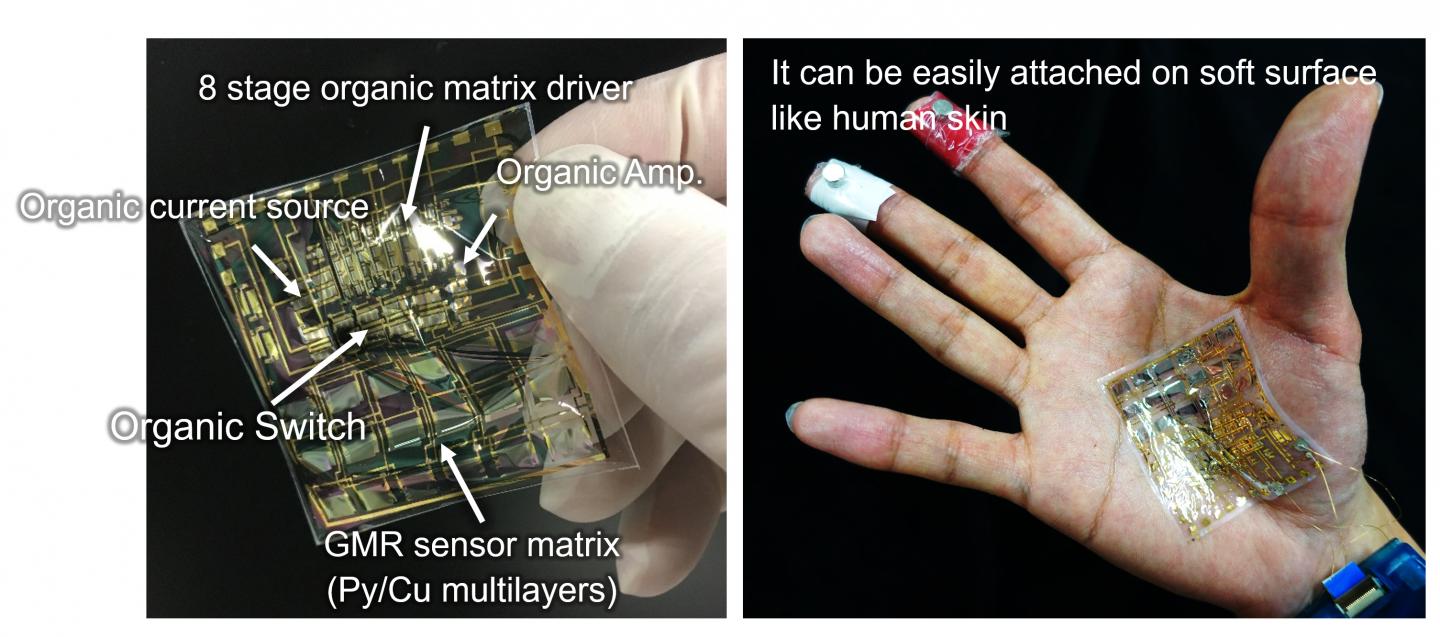
Flexible sheet-type magnetic sensor systems developed with tenfold improvement in sensitivity
IMAGE

Credit: Osaka University


A team of researchers from Osaka University and Leibniz Institute for Solid State and Materials Research developed the world’s thinnest and lightest magnetic sensor matrix sheet system that visualizes the two-dimensional distribution of magnetism on various surfaces.

Conventional magnetic sensor circuits consist of silicon-based hard electronic elements integrated on a substrate with a hardness similar to that of glass, meaning they can be only placed on flat surfaces.

Conversely, flexible soft magnetic sensors have also been developed, but there is no device integrating a driving circuit, sensor scanning mechanism, signal processing circuit, and wireless measurement unit, all of which are required to form a system. “This is because the fabrication of a flexible magnetic sensor element is difficult. Furthermore, it is hard to integrate the fabrication process with circuit technology,” explains lead author Masaya Kondo.

Now, this joint research team has developed a thin and soft (“skin-like”) magnetic sensor matrix sheet system by integrating flexible electronic elements called organic transistors and giant magnetoresistive elements on a 1.5-μm-thick plastic film. This imperceptible circuit fabricated on a thin plastic film can be attached onto the skin of a person without causing discomfort and can function properly even when folded (Fig. 1).

The magnetic sensor matrix sheet system, with a sensitivity ten times higher than that of conventional systems, not only detects and amplifies weak magnetic signals, but also visualizes the two-dimensional distribution of magnetism in real time by automatically scanning magnetic sensor elements arranged in a matrix pattern (Fig. 2).

Among physical information, magnetic information obtained via a two-dimensional sheet-type magnetic sensor system is much more precise than electrical information because magnetic sensors have high spatial resolution due to the high permeability of magnetism in substances. A sheet-type sensor provides high-precision physical information as it can be adhered to a variety of objects regardless of shape.

“Attaching our sheet-type sensor to a reinforced structure identifies the precise locations of damage by mapping the distortion of magnetism caused by deteriorated reinforcing steel bars. Also, once the sensitivity of the sensor is improved further, higher precision cardiac diagnosis will be achieved by magnetic mapping than by conventional electrocardiography,” says Prof. Sekitani, who led the study.

###

The article, “Imperceptible magnetic sensor matrix system integrated with organic driver and amplifier circuits,” was published in Science Advances at DOI: https://doi.org/10.1126/sciadv.aay6094.

About Osaka University

Osaka University was founded in 1931 as one of the seven imperial universities of Japan and now has expanded to one of Japan’s leading comprehensive universities. The University has now embarked on open research revolution from a position as Japan’s most innovative university and among the most innovative institutions in the world according to Reuters 2015 Top 100 Innovative Universities and the Nature Index Innovation 2017. The university’s ability to innovate from the stage of fundamental research through the creation of useful technology with economic impact stems from its broad disciplinary spectrum.

Website: https://resou.osaka-u.ac.jp/en/top

Media Contact
Saori Obayashi
[email protected]
81-661-055-886

Original Source

https://resou.osaka-u.ac.jp/en/research/2020/20200123_1

Related Journal Article

http://dx.doi.org/10.1126/sciadv.aay6094

Tags: Electrical Engineering/ElectronicsTechnology/Engineering/Computer Science
Share12Tweet8Share2ShareShareShare2

Related Posts

Buy or outsource? What drives German farmers toward field robots

Buy or outsource? What drives German farmers toward field robots

August 30, 2026
Emerging contaminants found in Vietnam’s water sources and urban systems, review shows

Emerging contaminants found in Vietnam’s water sources and urban systems, review shows

August 30, 2026

Electroacupuncture protects mouse brains from stroke via lactylation-driven ZIP14 expression

August 30, 2026

Orthogonal silver nanorods enable terahertz polarization conversion, simulations show

August 30, 2026
Please login to join discussion

POPULAR NEWS

  • Buy or outsource? What drives German farmers toward field robots

    29 shares
    Share 12 Tweet 7
  • Emerging contaminants found in Vietnam’s water sources and urban systems, review shows

    29 shares
    Share 12 Tweet 7
  • Electroacupuncture protects mouse brains from stroke via lactylation-driven ZIP14 expression

    29 shares
    Share 12 Tweet 7
  • Orthogonal silver nanorods enable terahertz polarization conversion, simulations show

    29 shares
    Share 12 Tweet 7

About

We bring you the latest biotechnology news from best research centers and universities around the world. Check our website.

Follow us

Recent News

Buy or outsource? What drives German farmers toward field robots

Emerging contaminants found in Vietnam’s water sources and urban systems, review shows

Electroacupuncture protects mouse brains from stroke via lactylation-driven ZIP14 expression

Subscribe to Blog via Email

Enter your email address to subscribe to this blog and receive notifications of new posts by email.

Join 85 other subscribers
  • Contact Us

Bioengineer.org © Copyright 2023 All Rights Reserved.

Welcome Back!

Login to your account below

Forgotten Password?

Retrieve your password

Please enter your username or email address to reset your password.

Log In
No Result
View All Result
  • Homepages
    • Home Page 1
    • Home Page 2
  • News
  • National
  • Business
  • Health
  • Lifestyle
  • Science

Bioengineer.org © Copyright 2023 All Rights Reserved.