• HOME
  • NEWS
  • EXPLORE
    • CAREER
      • Companies
      • Jobs
    • EVENTS
    • iGEM
      • News
      • Team
    • PHOTOS
    • VIDEO
    • WIKI
  • BLOG
  • COMMUNITY
    • FACEBOOK
    • INSTAGRAM
    • TWITTER
Friday, December 5, 2025
BIOENGINEER.ORG
No Result
View All Result
  • Login
  • HOME
  • NEWS
  • EXPLORE
    • CAREER
      • Companies
      • Jobs
        • Lecturer
        • PhD Studentship
        • Postdoc
        • Research Assistant
    • EVENTS
    • iGEM
      • News
      • Team
    • PHOTOS
    • VIDEO
    • WIKI
  • BLOG
  • COMMUNITY
    • FACEBOOK
    • INSTAGRAM
    • TWITTER
  • HOME
  • NEWS
  • EXPLORE
    • CAREER
      • Companies
      • Jobs
        • Lecturer
        • PhD Studentship
        • Postdoc
        • Research Assistant
    • EVENTS
    • iGEM
      • News
      • Team
    • PHOTOS
    • VIDEO
    • WIKI
  • BLOG
  • COMMUNITY
    • FACEBOOK
    • INSTAGRAM
    • TWITTER
No Result
View All Result
Bioengineer.org
No Result
View All Result
Home NEWS Science News Biology

Maintaining normal serum potassium levels in peritoneal dialysis may reduce risk of peritonitis

Bioengineer by Bioengineer
May 18, 2022
in Biology
Reading Time: 2 mins read
0
Potassium Supplementation in Hypokalemic Patients Receiving Peritoneal Dialysis
Share on FacebookShare on TwitterShare on LinkedinShare on RedditShare on Telegram

This prospective, multicenter, randomized controlled trial published in the American Journal of Kidney Diseases (AJKD) demonstrated that, compared with a reactive strategy of potassium supplementation when serum potassium fell below 3.5 mEq/L, a protocol-based potassium supplementation strategy to maintain serum potassium in the target range of 4-5 mEq/L resulted in a longer time (90 days) to the first peritonitis episode, a lower hazard ratio of peritonitis, and a lesser proportion of free-peritonitis participants.
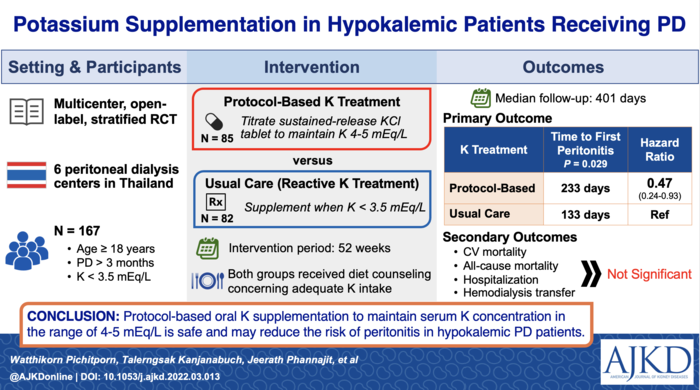
Potassium Supplementation in Hypokalemic Patients Receiving Peritoneal Dialysis

Credit: Pitchitporn et al, AJKD 2022

This prospective, multicenter, randomized controlled trial published in the American Journal of Kidney Diseases (AJKD) demonstrated that, compared with a reactive strategy of potassium supplementation when serum potassium fell below 3.5 mEq/L, a protocol-based potassium supplementation strategy to maintain serum potassium in the target range of 4-5 mEq/L resulted in a longer time (90 days) to the first peritonitis episode, a lower hazard ratio of peritonitis, and a lesser proportion of free-peritonitis participants.

Hypokalemia is commonly found in patients on peritoneal dialysis (PD) and associated with poor outcomes. A multicenter, open-label, prospective, randomized controlled trial was conducted in 167 hypokalemic patients receiving PD. It examined if a protocol-based correction of hypokalemia to maintain serum potassium 4-5 mEq/L (85 participants) could improve PD-related outcomes compared to reactive potassium supplementation administered when serum potassium levels fell below 3.5 mEq/L (82 participants). During the median follow-up time of 401 days, the protocol supplementation appeared safe and significantly reduced the risk of peritonitis. Potassium chloride tablets at the dosage used in this study (25±13 mEq/day) demonstrated promising efficacy and relatively few side effects. Most participants in the study tolerated the medications well, with only a tiny number discontinuing treatment due to adverse effects. Notably, only 4% of participants in the intervention group experienced asymptomatic hyperkalemia. 


TITLE: Efficacy of Potassium Supplementation in Hypokalemic Patients Receiving Peritoneal Dialysis: A Randomized Controlled Trial

AUTHORS: Watthikorn Pichitporn, MD, Talerngsak Kanjanabuch, MD, Jeerath Phannajit, MD, Pongpratch Puapatanakul, MD, Piyatida Chuengsaman, MD, Watanyu Parapiboon, MD, Worapot Treamtrakanpon, MD, Chanchana Boonyakrai, MD, Saraporn Matayart, MD, Pisut Katavetin, MD, Jeffrey Perl, MD, Kearkiat Praditpornilpa, MD, Somchai Eiam-Ong, MD, Kriang Tungsanga, MD, and David W. Johnson, MD

DOI: https://doi.org/10.1053/j.ajkd.2022.03.013


Journal

American Journal of Kidney Diseases

DOI

10.1053/j.ajkd.2022.03.013

Article Title

Efficacy of Potassium Supplementation in Hypokalemic Patients Receiving Peritoneal Dialysis: A Randomized Controlled Trial

Article Publication Date

18-May-2022

Share12Tweet8Share2ShareShareShare2

Related Posts

blank

Rice miRNA: Key Regulator in Fungal Interactions

December 3, 2025
Human Impact Alters Leopard and Ungulate Dynamics

Human Impact Alters Leopard and Ungulate Dynamics

December 3, 2025

Adaptive Microsatellite Variants in Indian Yak Populations

December 2, 2025

Guide to Single-Cell RNA Transcriptomics Unveiled

December 2, 2025

POPULAR NEWS

  • New Research Unveils the Pathway for CEOs to Achieve Social Media Stardom

    New Research Unveils the Pathway for CEOs to Achieve Social Media Stardom

    204 shares
    Share 82 Tweet 51
  • Scientists Uncover Chameleon’s Telephone-Cord-Like Optic Nerves, A Feature Missed by Aristotle and Newton

    121 shares
    Share 48 Tweet 30
  • Neurological Impacts of COVID and MIS-C in Children

    107 shares
    Share 43 Tweet 27
  • MoCK2 Kinase Shapes Mitochondrial Dynamics in Rice Fungal Pathogen

    69 shares
    Share 28 Tweet 17

About

We bring you the latest biotechnology news from best research centers and universities around the world. Check our website.

Follow us

Recent News

Boosting Cancer Immunotherapy by Targeting DNA Repair

Evaluating eGFR Equations in Chinese Children

Metformin-Alogliptin Combo vs. Monotherapy in Diabetes

Subscribe to Blog via Email

Success! An email was just sent to confirm your subscription. Please find the email now and click 'Confirm' to start subscribing.

Join 69 other subscribers
  • Contact Us

Bioengineer.org © Copyright 2023 All Rights Reserved.

Welcome Back!

Login to your account below

Forgotten Password?

Retrieve your password

Please enter your username or email address to reset your password.

Log In
No Result
View All Result
  • Homepages
    • Home Page 1
    • Home Page 2
  • News
  • National
  • Business
  • Health
  • Lifestyle
  • Science

Bioengineer.org © Copyright 2023 All Rights Reserved.