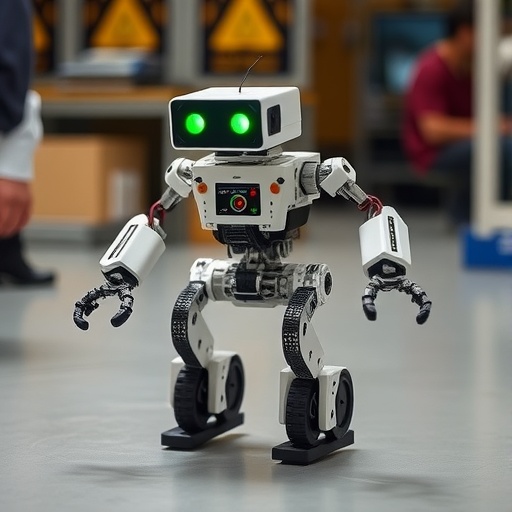
Robots that crawl along steel walls to inspect ships, storage tanks, bridges, and pipelines have long faced a stubborn trade-off: the stronger the magnetic grip that keeps them attached, the harder it becomes for them to lift a wheel or leg over an obstacle. A team of researchers at Wuhan University of Science and Technology in China now reports a design that loosens this knot. By combining a dual-mode locomotion system with a new magnetic dynamic adjustment mechanism, the team has built a magnetic adsorption inspection robot that can climb over obstacles nearly twice as tall as previous designs could manage in passive mode, and can stably step over 70-millimeter vertical protrusions in an active mode—results the researchers say substantially improve both the success rate and the dynamic stability of obstacle crossing on ferromagnetic surfaces.
The work, published in the International Journal of Intelligent Robotics and Applications, was led by Haotian Gao, Yu Hou, Nian Xiong, Hongwei An, and Yuhong Zhong, with Hou serving as corresponding author. The team drew motivation from a persistent shortcoming in the field. Magnetic adsorption robots are prized for industrial inspection because they exert large adhesive forces and do not demand especially clean surfaces, unlike many adhesive-based climbing robots that struggle with dust, rust, or paint. But that same magnetic grip, typically generated by permanent magnets held close to a steel surface, creates powerful resisting forces whenever the robot tries to pivot a wheel or leg away from the surface to clear a bump, weld seam, or flange. As a result, many existing designs suffer from low obstacle-surmounting efficiency, inadequate maximum obstacle height, and worrying instability while crossing.
To break through this limitation, the researchers studied the strengths and weaknesses of two established locomotion families: wheeled robots, which move quickly and efficiently but stumble on tall obstacles, and legged robots, which can step over large irregularities but are slower, more complex, and harder to keep stable on vertical or overhead surfaces. Their answer was a hybrid. The new robot operates in two complementary obstacle-surmounting modes: a passive obstacle-surmounting mode, in which the robot’s wheels and mechanical geometry allow it to roll over small obstacles without any special action, and an active obstacle-surmounting mode, in which the robot uses leg-like motions and a planned gait to climb over larger protrusions. The gait design for the active mode was developed by adapting quadruped-style gait planning to the constrained, magnetically anchored environment of a steel wall.
The central innovation, however, is the magnetic dynamic adjustment (MDA) mechanism. The insight is that a robot does not need the same adhesive force at all times. When it is cruising along a flat surface, strong adsorption maximizes safety margin against peeling or sliding. But when a wheel or leg must rotate up and away from the surface to mount an obstacle, a locally and temporarily reduced magnetic force dramatically lowers the torque the motors must deliver. Conversely, during active leg-based climbing—when only a subset of feet remains attached—the robot actually needs to increase or redistribute its adhesion on the supporting contacts to prevent tipping. The MDA mechanism allows the robot to modulate its magnetic adsorption dynamically, weakening it at the contacts that must lift off and strengthening it at the contacts that must hold, effectively shifting the robot’s balance of forces in real time.
To turn this concept into a quantitative design tool, the team carried out two separate mechanical analyses. For the passive obstacle-surmounting mode, they used the moment equilibrium method, writing out the torques acting on the robot about its contact points as a wheel begins to climb an obstacle. This analysis reveals the critical competition between the driving torque of the motor, the resisting moment produced by magnetic adhesion at the contact patch, and the geometry of the obstacle. By deriving the conditions under which the wheel can rotate over the obstacle edge, the researchers obtained closed-form MDA schemes—prescriptions for how much the magnetic force should be reduced, and when, to maximize the obstacle height the robot can clear. In the active mode, they applied the center of gravity projection method, a standard technique for assessing static stability in legged robotics, to determine how the robot’s supporting polygon changes during a gait and how the magnetic forces at the stance feet should be adjusted to keep the projection of the center of gravity safely inside the support region throughout the crossing.
With the analytical schemes in hand, the team moved to simulation. A kinematics simulation of the full obstacle-crossing sequence was performed to optimize the magnetic dynamic regulation scheme—that is, to fine-tune the timing and magnitude of the adhesion changes in both modes so that the theoretical predictions translated into smooth, stable motion. This simulation-optimization step matters because a purely analytical solution often ignores practical effects such as backlash, imperfect contact, and transient inertial forces; iterating between the mechanical models and kinematic simulation allowed the researchers to converge on regulation parameters that would be robust on a physical prototype.
The experimental campaign then put the design to the test, and the numbers are striking. In the passive obstacle-surmounting mode, the magnetic dynamic adjustment mechanism raised the maximum traversable obstacle height from 17 millimeters to 30 millimeters—an improvement of roughly 76 percent achieved purely by modulating adhesion rather than by adding stronger motors or redesigning the wheel. For context, a 17-millimeter limit means the robot could be defeated by a modest weld bead or bolt head; 30 millimeters allows it to handle many of the seams, ribs, and step features actually found on tank walls and ship hulls. In the active mode, the robot stably negotiated vertical protrusions of 70 millimeters, and the trials showed significant improvements in both the success rate of crossing and the dynamic stability of the robot during the process—meaning less rocking, slipping, or risk of detachment while the gait was underway.
The implications for industrial inspection could be considerable. Large steel infrastructure—oil refineries, cargo ship hulls, storage tanks, offshore wind turbine towers, and thermal power plant water walls—requires regular inspection for corrosion, cracks, and coating degradation, and much of it is still performed by human workers on scaffolding or ropes, which is expensive, slow, and hazardous. Wall-climbing magnetic robots promise to automate these tasks, but only if they can traverse real surfaces, which are littered with weld seams, bolt heads, gratings, and small steps. A robot that halts at every 20-millimeter ridge is of limited use; one that reliably clears 30-millimeter obstacles passively at wheel speed and 70-millimeter obstacles actively via gait can cover far more of a structure without human intervention. The low surface cleanliness requirement of magnetic adsorption also matters in these environments, where dust, oil, and weathering routinely defeat glue, suction cups, and other adhesion technologies.
The research also contributes methodologically to the broader field of climbing and legged robotics. The moment equilibrium analysis for passive climbing and the center-of-gravity projection framework for active climbing are general tools, and the idea of dynamic magnetic regulation—treating adhesion as a controllable variable rather than a fixed property—adds to a growing body of work on switchable and adjustable adhesion mechanisms, including non-contact adjustable magnetic systems and shape-adaptive magnetic arrays explored by other groups in recent years. What distinguishes the present approach is the coupling of the adhesion modulation to the two locomotion modes: the same mechanism that eases wheel lift-off in passive mode also reinforces stance stability in active mode, so a single design feature serves both ends of the obstacle-crossing problem.
The researchers acknowledge financial support from the National Natural Science Foundation of China under grant number 51875418, and the work was carried out at the School of Mechanical Automation at Wuhan University of Science and Technology, with Hou additionally affiliated with the Key Laboratory of Metallurgical Equipment and Control of the Ministry of Education. According to the contribution statement, Gao provided the design ideas, Hou and Xiong performed the theoretical analysis and drafted the manuscript, and Gao, An, and Zhong built the prototype and conducted the experimental verification. The authors declare no conflicts of interest, and the data underlying the study are available from the corresponding author upon request.
Looking ahead, dynamically regulated magnetic adhesion of this kind could influence the next generation of inspection platforms, particularly wheeled-legged hybrids designed for variable-curvature ferromagnetic facades. As industrial operators push toward autonomous, continuous structural health monitoring, the ability to handle geometric imperfections without stopping—or falling—may prove to be one of the decisive factors in whether climbing robots move from demonstration to deployment. With its demonstrated leap from 17 to 30 millimeters of passive clearance and stable active crossing of 70-millimeter steps, the Wuhan team’s robot offers a concrete, experimentally validated answer to one of the field’s most practical obstacles, and suggests that the smartest way to beat a magnet’s grip may simply be to know when to loosen it.
Subject of Research: Design and obstacle-crossing analysis of a dual-mode magnetic adsorption inspection robot with a magnetic dynamic adjustment (MDA) mechanism for improved obstacle-surmounting height and stability on ferromagnetic surfaces
Subject of Research: Technology and Engineering
Article Title: Design and obstacle-crossing analysis of a robot based on magnetic dynamic regulation mechanism
Article References: Gao, H., Hou, Y., Xiong, N., An, H., & Zhong, Y. (2026). Design and obstacle-crossing analysis of a robot based on magnetic dynamic regulation mechanism. International Journal of Intelligent Robotics and Applications. https://doi.org/10.1007/s41315-026-00588-x
Image Credits: AI Generated
DOI: 10.1007/s41315-026-00588-x
Keywords: Magnetic adsorption, Obstacle-surmounting, Dual-mode locomotion, Dynamic adjustment, Wall-climbing robot, Passive obstacle-surmounting mode, Active obstacle-surmounting mode, Moment equilibrium method, Center of gravity projection, Inspection robot, Magnetic dynamic regulation
Cite Scienmag News
APA MLA Chicago
Denise Maddox. (September 4, 2026). Magnetic regulation robot design tackles obstacle-crossing challenges. Scienmag. https://scienmag.com/magnetic-regulation-robot-design-tackles-obstacle-crossing-challenges/
Denise Maddox. “Magnetic regulation robot design tackles obstacle-crossing challenges.” Scienmag, 4 September 2026, https://scienmag.com/magnetic-regulation-robot-design-tackles-obstacle-crossing-challenges/. Accessed 4 September 2026.
Denise Maddox. “Magnetic regulation robot design tackles obstacle-crossing challenges.” Scienmag. September 4, 2026. https://scienmag.com/magnetic-regulation-robot-design-tackles-obstacle-crossing-challenges/
Copy citation Download RIS
Tags: advancements in magnetic robot mobilitychallenge of obstacle negotiation in magnetic robotschallenges in magnetic grip strength and obstacle clearancedual-mode locomotion in inspection robotsdual-mode locomotion systems for robotsenhancement of magnetic robot mobilityferromagnetic surface inspection robotsimprovements in magnetic robot stabilityindustrial inspection robot designindustrial inspection robots with magnetic adhesioninnovative magnetic grip controlintelligent robotics for infrastructure inspectionMagnetic adhesion robot designMagnetic adhesion robot for obstacle crossingmagnetic dynamic adjustment mechanismsobstacle navigation in robotic systemsobstacle-crossing capabilities in inspection robotsobstacle-crossing capabilities of magnetic robotsrobot climbing over vertical protrusionsrobotics for ship and pipeline inspectionstability and success rate in robot obstacle crossingstable climbing over vertical protrusions