


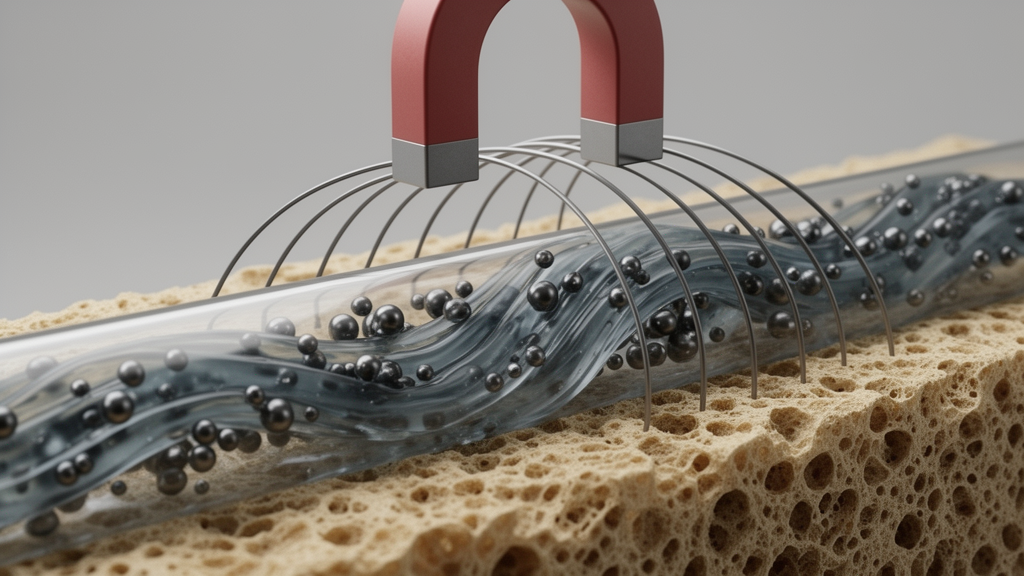
A new computational study published in Discover Nano examines how a micropolar tangent hyperbolic hybrid nanofluid behaves as it flows over a permeable stretching surface in the presence of a magnetic field and an internal heat source or sink. The work, led by Khan Mohsin with co-authors including M. N. Abrar, Amra Al Kenany and Meshal Shutaywi, was published on 22 October 2026 as an open access research article. Rather than reporting laboratory measurements, the study formulates a mathematical boundary layer model and solves it numerically, mapping how each physical parameter reshapes the velocity, temperature and micro-rotation fields that govern such flows.
The fluid at the heart of the model is unusual in two ways. First, it is a tangent hyperbolic fluid, a non-Newtonian material whose viscosity changes under stress and which exhibits shear-thinning behavior and viscoelasticity. Second, it is treated as a micropolar fluid, meaning the suspended particles carry their own internal microstructure and spin. Because of this microstructure, the stress tensor of the fluid is non-symmetric, and the model requires an additional angular momentum equation to track the micro-rotation of particles alongside the ordinary linear momentum and energy equations. The authors combine these features with a hybrid nanofluid approach, in which gold and magnetite nanoparticles are dispersed in water as the base fluid, a strategy intended to raise the thermal conductivity and heat transport performance beyond what a conventional fluid can achieve.
The physical setup is a two-dimensional, steady, incompressible and laminar flow over a linearly stretching wall whose velocity grows with distance along the surface. The wall is permeable, so fluid can be drawn in by suction or pushed out by injection. A uniform magnetic field acts perpendicular to the flow, and a heat source or sink term is included in the energy equation. The surface condition parameter, which describes the concentration of micro-elements near the wall, is set to 0.5, corresponding to partial slip or a weak concentration of micro-elements; the authors identify this weak-concentration case in combination with the hybrid nanoparticles as the principal gap their study addresses. The Prandtl number of the water base fluid is taken as 6.8.
To make the problem tractable, the governing partial differential equations are reduced with suitable similarity transformations to a coupled system of nonlinear ordinary differential equations for the dimensionless velocity, micro-rotation and temperature. Because this system cannot be solved analytically, the authors employ the Runge-Kutta-Fehlberg 45 method together with a shooting technique. They validate their numerical scheme by comparing computed skin friction values against previously published data, reporting excellent agreement, and they also cross-check results against MATLAB’s built-in bvp4c solver.
The first headline finding concerns elasticity. As the Weissenberg number, a dimensionless measure of how strongly elastic effects dominate over viscous effects, is raised through the values 0.0, 0.5 and 1.0, the fluid velocity declines steadily. A larger Weissenberg number signals stronger non-Newtonian character and a longer relaxation time, which increases resistance to deformation and suppresses momentum diffusion within the boundary layer, thinning the momentum boundary layer itself. A parallel reduction in velocity appears as the permeability parameter of the porous medium increases through 0.0, 0.4 and 0.8: the porous matrix acts as an obstacle to the flow, dissipating momentum and shrinking the boundary layer thickness.
Magnetic and suction effects reinforce this slowing trend. Increasing the magnetic number generates a Lorentz force, a resistive electromagnetic force on the electrically conducting fluid, which retards the velocity profile. Raising the suction and injection parameter likewise reduces fluid velocity, and the micro-rotation parameter also produces a noteworthy reduction in linear velocity. In the model’s angular momentum field, however, several parameters push in the opposite direction: the angular velocity profile increases with the permeability parameter, the power-law index, the magnetic number, the surface condition parameter and the micro-rotation parameter, with the authors attributing the magnetic case to the stronger field exerting greater force on fluid particles.
On the thermal side, the temperature profile rises with the magnetic parameter, the Prandtl number and the heat source parameter, but falls as the volume fraction of the hybrid nanoparticles increases. The authors explain the nanoparticle effect through the high surface-to-volume ratio of nanoparticles, which enlarges the surface area available for heat transfer and improves heat dissipation, lowering the overall temperature distribution. The heat source introduces additional energy into the system and elevates temperatures, while higher Prandtl numbers are associated with a reduced ability of the fluid to diffuse heat, so thermal energy mixes more slowly and the temperature profile rises.
Three quantities of engineering interest tie the profiles back to practical design. The skin friction coefficient decreases pronouncedly as the permeability parameter increases, because higher permeability lets fluid pass more easily through the porous medium, weakening the shear force at the wall. The wall couple stress increases with the micro-rotation parameter, since more intense particle rotation raises resistance to angular motion near the wall. The Nusselt number coefficient, which measures the wall heat transfer rate, is enhanced as the heat source parameter increases in combination with variations in the Prandtl number, because a stronger internal heat source steepens the temperature gradients near the wall. The authors also state that the inclusion of gold nanoparticles enhances the thermal performance of the hybrid nanofluid in their model.
The study is explicitly a mathematical and numerical analysis, and its conclusions describe model behavior rather than experimental observations. The authors note that the work could be extended to unsteady and three-dimensional flow configurations, and that thermal radiation, chemical reactions, viscous dissipation, Joule heating, variable thermophysical properties, ternary nanoparticles and non-uniform magnetic fields could be added to build a more comprehensive model. Within its stated scope, the framework offers a way to tune flow and heat transport in systems involving stretching surfaces and porous media, and the authors point to applications of tangent hyperbolic fluids in food processing, polymer technology, oil recovery and blood flow analysis, alongside uses of micropolar models in polymer extrusion, magnetic drug targeting, microelectronic cooling and lubrication.
Subject of Research: Numerical analysis of magnetohydrodynamic micropolar tangent hyperbolic hybrid nanofluid flow over a permeable stretching surface
Article Title: MHD analysis of tangent hyperbolic micropolar fluid flow over a permeable stretching surface
Article References: Mohsin, K., Abrar, M. N., Kenany, A. A., & Shutaywi, M. (2026). MHD analysis of tangent hyperbolic micropolar fluid flow over a permeable stretching surface. Discover Nano, 21(1), Article 545. https://doi.org/10.1186/s11671-026-04964-1
Image Credits: AI Generated
DOI: 10.1186/s11671-026-04964-1
Keywords: magnetohydrodynamics, tangent hyperbolic fluid, micropolar fluid, hybrid nanofluid, stretching surface, porous medium, boundary layer, heat transfer, Runge-Kutta-Fehlberg method, gold nanoparticles, magnetite nanoparticles, skin friction
News Source: Denise Maddox. (October 29, 2026). Magnetic Fields and Porous Surfaces Slow Flow in Hybrid Nanofluid Simulation. Scienmag.



