• HOME
  • NEWS
  • EXPLORE
    • CAREER
      • Companies
      • Jobs
    • EVENTS
    • iGEM
      • News
      • Team
    • PHOTOS
    • VIDEO
    • WIKI
  • BLOG
  • COMMUNITY
    • FACEBOOK
    • INSTAGRAM
    • TWITTER
Sunday, November 29, 2026
BIOENGINEER.ORG
No Result
View All Result
  • Login
  • HOME
  • NEWS
  • EXPLORE
    • CAREER
      • Companies
      • Jobs
        • Lecturer
        • PhD Studentship
        • Postdoc
        • Research Assistant
    • EVENTS
    • iGEM
      • News
      • Team
    • PHOTOS
    • VIDEO
    • WIKI
  • BLOG
  • COMMUNITY
    • FACEBOOK
    • INSTAGRAM
    • TWITTER
No Result
View All Result
Bioengineer.org
No Result
View All Result
Home NEWS Science News Technology

Magnetic Damping Slows Boundary Flow While Joule Heating Boosts Thermal Diffusion

by
November 28, 2026
in Technology
Reading Time: 2 mins read
0
Magnetic Damping Slows Boundary Flow While Joule Heating Boosts Thermal Diffusion

Magnetic Damping Slows Boundary Flow While Joule Heating Boosts Thermal Diffusion

Share on FacebookShare on TwitterShare on LinkedinShare on RedditShare on Telegram

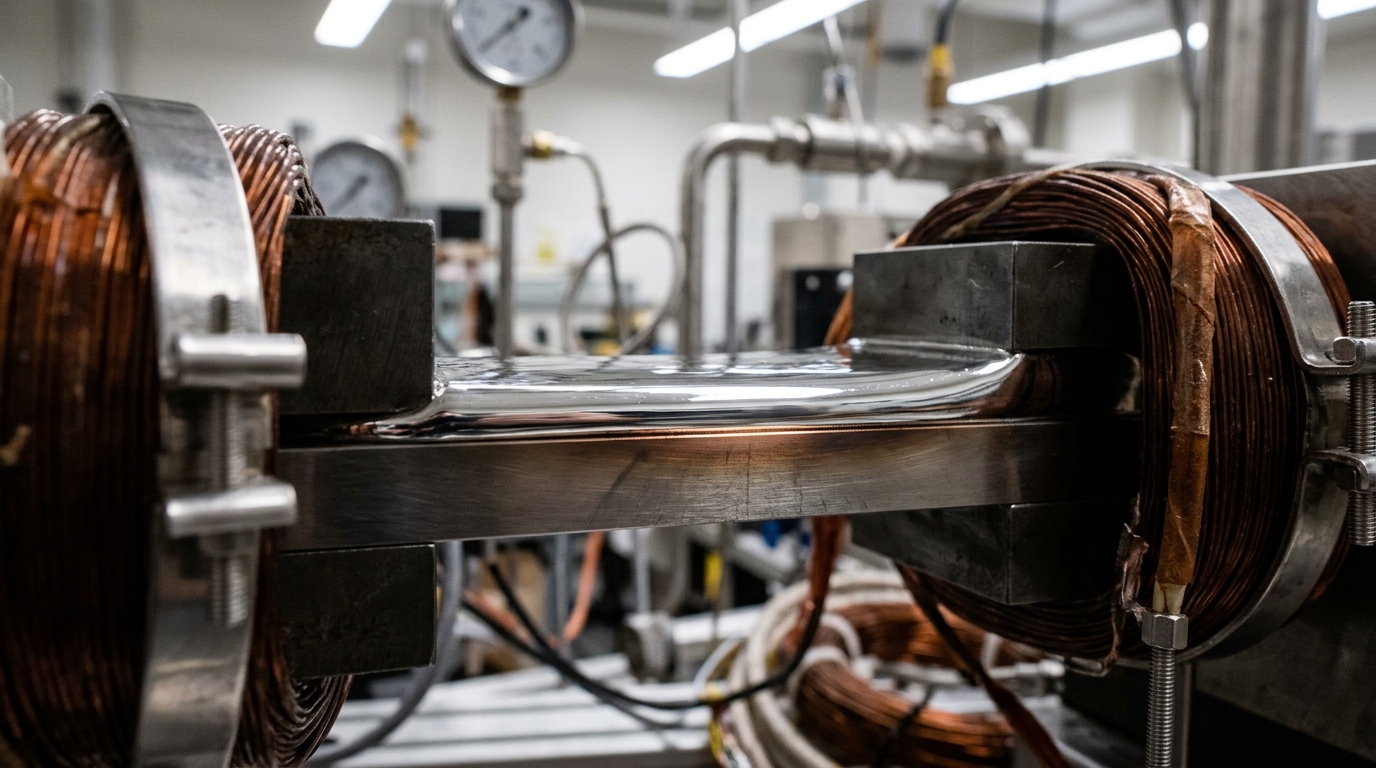
A computational fluid dynamics study shows that magnetic damping suppresses momentum boundary-layer thickness while Joule heating enhances thermal diffusion in a penta-hybrid nanofluid flowing over a stretching vertical cone. The investigation evaluates how coupled electromagnetic, thermal, and non-Newtonian rheological forces interact along the conical boundary.

Researchers analyzed the nonlinear magnetohydrodynamic boundary-layer flow using a Casson–Williamson penta-hybrid nanofluid model. To enhance thermal transport characteristics, the penta-hybrid nanofluid considered in this study consists of copper oxide, aluminum oxide, iron oxide, titanium dioxide, and silicon dioxide nanoparticles in water.

The mathematical formulation incorporates several coupled physical phenomena within a similarity-transformed framework. The governing system accounts for non-Newtonian yield-stress behavior, shear-thinning elasticity, magnetic damping, porous resistance, nonlinear thermal radiation, and entropy generation along the stretching vertical cone geometry.

To evaluate the governing equations, the similarity transformation converted the original system into a set of coupled nonlinear ordinary differential equations. The researchers employed a collocation-based boundary-value solver to numerically solve the coupled nonlinear ordinary differential equations obtained from the transformed governing equations.

In addition to the collocation method, the authors implemented a physics-informed neural network framework as an independent, mesh-free computational approach. Unlike conventional data-driven neural networks, the physics-informed neural network framework embeds the governing physical laws directly into the loss function, enabling a physics-constrained solution of the governing system.

The resulting simulations demonstrate that stronger magnetic interactions significantly suppress fluid velocity and decrease the momentum boundary-layer thickness through Lorentz-force-induced damping. At the same time, Joule heating generated by the magnetic field enhances thermal diffusion across the fluid domain, while the entropy generation profile increases considerably with higher Brinkman numbers.

The study also established that increasing the Casson parameter weakens the non-Newtonian Casson contribution, progressively shifting fluid rheology toward the Newtonian limit and modifying wall shear alongside thermal transport. The independently implemented boundary-value solver and physics-informed neural network approaches provide closely agreeing solutions and characterize the coupled influence of magnetic, rheological, thermal, and geometric effects on the boundary-layer structure.

The computational analysis provides a systematic approach for investigating complex non-Newtonian thermo-fluid systems arising in biomedical transport, polymer processing, and cooling technologies.

Subject of Research: Magnetohydrodynamic penta-hybrid nanofluid flow and heat transfer over a stretching vertical cone

Article Title: Numerical and physics-informed neural network analysis of magnetohydrodynamic Casson–Williamson penta-hybrid nanofluid flow over a stretching vertical cone

Article References: Bhuvana, M., & Durgaprasad, P. (2026). Numerical and physics-informed neural network analysis of magnetohydrodynamic Casson–Williamson penta-hybrid nanofluid flow over a stretching vertical cone. Discover Applied Sciences. https://doi.org/10.1007/s42452-026-09762-z

Image Credits: AI Generated

DOI: 10.1007/s42452-026-09762-z

Keywords: penta-hybrid nanofluid, Casson-Williamson fluid, magnetohydrodynamics, physics-informed neural networks, stretching vertical cone, boundary-layer flow, Lorentz force damping, Joule heating, entropy generation, Brinkman number, copper oxide nanoparticles, aluminum oxide nanoparticles, magnetite nanoparticles, titanium dioxide nanoparticles, silicon dioxide nanoparticles, collocation boundary-value solver, nonlinear thermal radiation, shear-thinning elasticity

News Source: Denise Maddox. (November 28, 2026). Magnetic Damping Slows Boundary Flow While Joule Heating Boosts Thermal Diffusion. Scienmag.


Tags: aluminum oxide nanoparticlesboundary layer flowBrinkman numberCasson-Williamson fluidcollocation boundary-value solvercopper oxide nanoparticlesentropy generationJoule heatingLorentz force dampingmagnetite nanoparticlesmagnetohydrodynamicsnonlinear thermal radiationpenta-hybrid nanofluidphysics-informed neural networksshear-thinning elasticitysilicon dioxide nanoparticlesstretching vertical conetitanium dioxide nanoparticles
Share12Tweet7Share2ShareShareShare1

Related Posts

Study Predicts High-Speed Track Slab Bonding Reliability Drops Sharply Over Sixty Years

Study Predicts High-Speed Track Slab Bonding Reliability Drops Sharply Over Sixty Years

November 29, 2026
Dual-View Ground Rover Records Maize Reproductive Organs Using Tailored Deep Learning

Dual-View Ground Rover Records Maize Reproductive Organs Using Tailored Deep Learning

November 29, 2026

Two-Stage Neural Network Architecture Enhances Human Pose Recognition in Complex Environments

November 28, 2026

Dual-Domain Image Translation and Self-Attention Preserve Facial Identity in Caricature Generation

November 28, 2026

POPULAR NEWS

  • Models Predict Thermophysical Properties and Ice Formation in Freezing Jussara Pulp

    Models Predict Thermophysical Properties and Ice Formation in Freezing Jussara Pulp

    29 shares
    Share 12 Tweet 7
  • Model Projects Five Interventions Could Cut Nigeria Maternal Mortality Seventy Percent

    29 shares
    Share 12 Tweet 7
  • Global Meta-Analysis Finds Obstructive Sleep Apnea Affects Most Diabetes Patients

    29 shares
    Share 12 Tweet 7
  • Dual-View Ground Rover Records Maize Reproductive Organs Using Tailored Deep Learning

    29 shares
    Share 12 Tweet 7

About

We bring you the latest biotechnology news from best research centers and universities around the world. Check our website.

Follow us

Recent News

Study Predicts High-Speed Track Slab Bonding Reliability Drops Sharply Over Sixty Years

Centralised Paediatric Tracheal Surgery Team Linked to Lower Operative Mortality

Models Predict Thermophysical Properties and Ice Formation in Freezing Jussara Pulp

Subscribe to Blog via Email

Enter your email address to subscribe to this blog and receive notifications of new posts by email.

Join 90 other subscribers
  • Contact Us

Bioengineer.org © Copyright 2023 All Rights Reserved.

Welcome Back!

Login to your account below

Forgotten Password?

Retrieve your password

Please enter your username or email address to reset your password.

Log In
No Result
View All Result
  • Homepages
    • Home Page 1
    • Home Page 2
  • News
  • National
  • Business
  • Health
  • Lifestyle
  • Science

Bioengineer.org © Copyright 2023 All Rights Reserved.