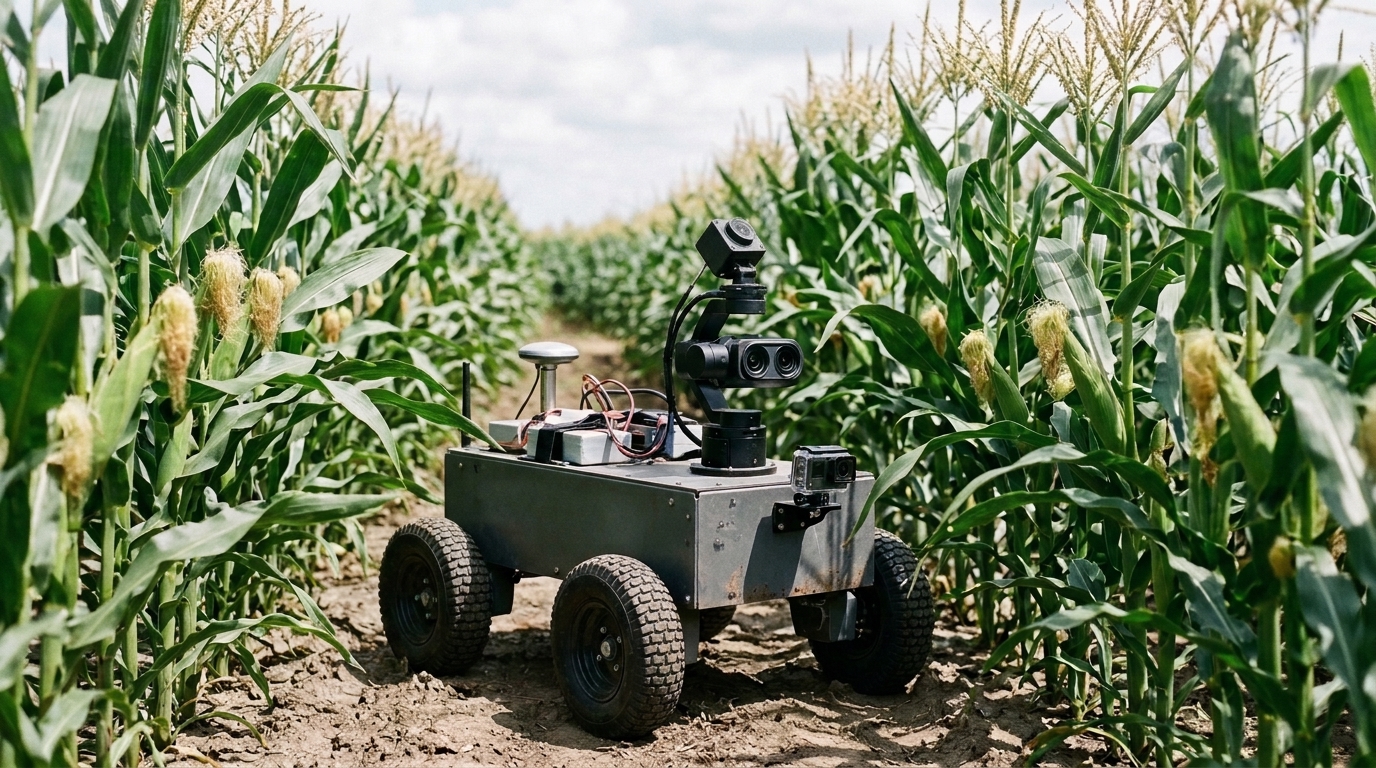
Agricultural engineers and plant scientists have developed an automated mobile phenotyping system that deploys a specialized ring-shaped ground vehicle to record and analyze maize reproductive organs directly within field plots. Maize, or Zea mays L., serves as a cornerstone crop for global food, livestock feed, and industrial processing, yet tracking its reproductive development across extensive breeding trials has traditionally demanded exhausting manual field surveys that remain vulnerable to observer variance and low sampling frequencies. Because reproductive structures such as emerging tassels, mature ears, and delicate silks occupy distinct vertical strata within the canopy, conventional single-perspective imaging platforms often face severe physical limitations. Nadir aerial imagery captured from unmanned aerial vehicles excels at observing exposed tassels extending above the upper foliage but consistently leaves ears and silks obscured beneath dense leaves. Conversely, lateral imaging systems situated beside crop rows can observe lower stalks but miss upper canopy structures. To overcome these geometric constraints without relying on laborious manual surveys, the research team designed a coordinated multi-angle ground vehicle workflow that simultaneously captures downward top-view perspectives and horizontal side-view canopy layers, pairing each perspective with a dedicated, architecture-tailored deep learning pipeline.
The data collection apparatus was constructed around a rigid ring-shaped ground vehicle operating at an approximate ground clearance and top-view mounting elevation of 2.6 meters above the soil surface. Field trials were conducted during August 2025 across experimental plots located in Tumed Right Banner, Baotou, within the Inner Mongolia Autonomous Region of China. For overhead monitoring, researchers installed a top-mounted four-in-one imaging unit equipped with Orbbec Femto Bolt RGB-D cameras aligned ninety degrees vertically downward relative to the horizontal field surface, recording downward color images at a native resolution of 1280 by 720 pixels. The lateral imaging apparatus comprised four Orbbec Astra Pro Plus RGB-D cameras positioned symmetrically with two units mounted on each side of the chassis at elevations of approximately 1.25 meters and 1.65 meters above ground level. These lateral sensors were angled downward between 35 and 60 degrees relative to horizontal to directly target the intermediate and lower growth zones where ears and silks emerge. The vehicle traversed the crop rows at a steady forward velocity of roughly 0.25 meters per second, maintaining an estimated clearance distance of 0.2 to 1.0 meters from the camera lenses to the outer crop canopy depending on foliage density.
Although both camera types incorporate depth-sensing hardware, only their two-dimensional color RGB frames were utilized in the analytical processing pipelines. Examination of logged data records indicated file-saving throughputs averaging approximately one RGB image per second for the downward overhead camera stream and approximately five RGB images per second for the inspected lateral sensors, distinguishing these practical storage rates from the lateral cameras’ manufacturer-rated maximum stream capacity of thirty frames per second. The underlying agronomic field trial incorporated three distinct planting densities established at 60,000, 90,000, and 120,000 plants per hectare, corresponding to local field denominations of 4,000, 6,000, and 8,000 plants per mu. To prevent optimistic evaluation artifacts that occur when adjacent and visually correlated video frames are randomly distributed between training and testing sets, the researchers implemented a strict spatial-block partitioning scheme. Datasets from the two streams were sampled at uniform temporal intervals of 1.5 seconds for top-down sequences and 4.0 seconds for lateral sequences, followed by manual filtering to discard severe blur, extreme overexposure, and near-duplicate frames. Data splits were organized strictly by non-overlapping longitudinal field column groups, with each partition covering all three planting density treatments.
For the tassel detection task, annotators generated 2,806 bounding boxes across 833 training images, 269 boxes across 70 validation images, and 182 boxes across 70 independent test images using LabelImg. The research team adopted the official lightweight YOLO12n architecture as their baseline detector, designated E0, and systematically evaluated the integration of Efficient Multi-scale Attention modules across various neck feature positions to resolve scale variation and leaf occlusion. The grouped coordinate design of Efficient Multi-scale Attention pools directional features along height and width vectors while preserving local texture through parallel 3-by-3 convolutions, recalibrating cross-spatial weights without modifying channel depths. Researchers examined eight distinct architectural topologies denoted E0 through E7, inserting attention modules individually and in combinations following the P3, P4, and P5 neck outputs. In initial screening at random seed 11 on the validation set, placing an attention module exclusively after the 128-channel P4 feature map, termed EMA-P4 or E2, delivered the highest validation recall of 0.8229 and an F1 score of 0.8492, while an all-module configuration, E7, achieved a validation mean average precision at an intersection-over-union of 0.50 of 0.8805.
Because single-seed rankings can reflect initialization fluctuations, the team conducted repeated validation across paired random seeds 11, 22, and 33 for the baseline E0, the single-stage E2, and the composite E7 models under identical AdamW optimization, cosine scheduling, and 200-epoch training protocols. The EMA-P4-YOLO12n model established the highest three-seed mean validation mAP@0.5 of 0.8774 ± 0.0033, outperforming both the triple-module EMA-P3-P4-P5 configuration at 0.8757 ± 0.0042 and the baseline YOLO12n at 0.8696 ± 0.0077. Once frozen and evaluated on the spatially independent 70-image test partition, EMA-P4-YOLO12n attained a test mAP@0.5 of 0.9355 ± 0.0088 compared to 0.9140 ± 0.0073 for standard YOLO12n, representing a 2.15 percentage point improvement. When operating at confidence thresholds selected during validation to maximize pooled F1 scores, EMA-P4 achieved a test precision of 0.8688 ± 0.0392, recall of 0.8828 ± 0.0271, and an F1 score of 0.8749 ± 0.0105. This accuracy gain required minimal computational overhead: EMA-P4 expanded parameter counts by just 0.10 percent from 2.568 million to 2.571 million and computational complexity by 1.04 percent from 6.480 to 6.547 GFLOPs, clocking 9.58 frames per second in end-to-end testing against 8.97 frames per second for baseline YOLO12n on an NVIDIA GeForce RTX 5090 GPU.
To parse the complex morphology of lower-canopy reproductive structures, the researchers framed ear and silk characterization as a three-class semantic segmentation problem separating background, silk, and ear tissues. The ear-silk dataset contained 562 training, 66 validation, and 74 independent testing image-mask pairs manually annotated using polygon contours in Labelme. Annotators concentrated strictly on visible organ boundaries and fragmented silk strands, deliberately avoiding speculative extrapolation of concealed plant matter. As an initial developmental benchmark, four baseline architectures—standard U-Net, DeepLabV3+, ResUNet, and UNet++—were trained under identical learning rates of 0.0003 and weighted cross-entropy plus Dice loss functions at seed 11. Among these, standard U-Net delivered the strongest baseline validation performance, yielding a mean intersection-over-union of 0.7641, silk Dice of 0.8390, ear Dice of 0.7365, and a foreground-balanced Dice score of 0.7877.
Building upon these architectural findings, the authors engineered VEC-UNet, a specialized convolutional network integrating a five-stage VGG16 backbone without batch normalization, Convolutional Block Attention Modules along four decoder skip pathways, and an Efficient Channel Attention block positioned ahead of the final prediction head. Both the baseline VGG network and VEC-UNet were initialized using public weights pretrained on VOC12 and SBD datasets, loading identical sets of 26 encoder and 16 decoder parameter tensors. In the skip connections, CBAM sequentially applies channel and spatial attention mechanisms to highlight organ responses before concatenating encoder feature maps with upsampled decoder layers. A terminal ECA module applies global average pooling and a one-dimensional convolution with a kernel size of three to model local cross-channel interactions without dimensionality reduction. Operating on 640 by 352 pixel inputs, the network projects 352 by 640 by 3 logit tensors to generate three-class segmentation maps. While earlier developmental configurations explored composite objectives incorporating Focal loss, the finalized training objective utilized a combined loss consisting of weighted cross-entropy with 1:8:8 class weightings for background, silk, and ear, paired with foreground Dice loss assigning zero weight to background pixels.
In rigorous three-seed comparative evaluations across the 74 independent test images under this identical weighted cross-entropy and Dice loss, VEC-UNet demonstrated consistent quantitative advantages over the pretrained VGG baseline. VEC-UNet achieved a three-seed mean test mIoU of 0.7379 ± 0.0010, silk Dice of 0.7764 ± 0.0114, ear Dice of 0.7399 ± 0.0100, and a foreground-balanced Dice of 0.7581 ± 0.0010. Compared to the VGG baseline’s corresponding scores of 0.7219 ± 0.0064, 0.7618 ± 0.0134, 0.7176 ± 0.0020, and 0.7397 ± 0.0075, VEC-UNet delivered net gains of 0.0160 for mIoU, 0.0145 for silk Dice, 0.0223 for ear Dice, and 0.0184 for foreground-balanced Dice. Paired 10,000-iteration bootstrap resamplings established 95% percentile confidence intervals of [0.0037, 0.0289] for mIoU, [0.0038, 0.0270] for silk Dice, and [0.0041, 0.0336] for foreground-balanced Dice, while the ear Dice interval spanned [-0.0010, 0.0459]. Ordered-block sensitivity analyses examining block lengths of 2, 4, 8, and 12 consecutive frames corroborated these directional trends, confirming stable improvements for silk and overall foreground segmentation while highlighting residual variance in ear boundary delineations.
The visible organ area fractions predicted by VEC-UNet on the 74 test images exhibited strong linear concordance with ground-truth manual annotations, achieving Pearson correlation coefficients of r = 0.9533 for silk and r = 0.9178 for ear tissues. Corresponding coefficients of determination reached 0.9047 for silk and 0.8397 for ear masks, with Lin’s concordance correlation coefficients of 0.9491 and 0.9114, alongside normalized mean absolute errors of 18.71 percent and 24.98 percent, respectively. Computational benchmarking on an NVIDIA GeForce RTX 4060 Ti graphics card showed that VEC-UNet possesses 24.935 million parameters and 387.093 GFLOPs, representing marginal increases over the VGG baseline’s 24.891 million parameters and 387.035 GFLOPs. However, because sequential attention operations add processing overhead, VEC-UNet recorded an isolated forward-pass latency of 51.00 ± 1.19 milliseconds per frame compared to 34.93 ± 0.07 milliseconds for the baseline architecture under single-batch FP32 execution. To explore model behavior in secondary field conditions, researchers evaluated the frozen models on an exploratory video sequence collected in Xinxiang, Henan Province, in August 2026. On 25 overhead frames containing 150 annotated tassels, EMA-P4 obtained an mAP@0.5 of 0.8582, precision of 0.8279, recall of 0.8019, and F1 of 0.8147. Across 22 foreground-positive side-view frames, VEC-UNet achieved mean silk and ear Dice scores of 0.8778 ± 0.0081 and 0.6249 ± 0.0719, alongside a foreground mIoU of 0.6197 ± 0.0434.
The authors emphasize several critical physical and analytical boundaries governing their findings. The dual-perspective arrangement functions as two decoupled analytical branches that capture complementary canopy layers; it does not implement cross-view feature fusion, stereoscopic reconstruction, or plant-by-plant identity tracking between top and side views. Furthermore, because visible two-dimensional pixel areas depend heavily on viewing angle, camera distance, and canopy occlusion, these measurements serve strictly as optical appearance proxies rather than calibrated physical organ volumes, true biomass, or completed anthesis-silking intervals. Occlusion from foliage, shadowed stalks, and reflective leaves persists as a fundamental challenge that optical algorithms cannot resolve when organs are entirely hidden. Because the primary quantitative validation relied upon a single confirmed spatial block from one geographic location, the observed performance metrics represent conditional field benchmarks rather than universal guarantees of multi-environment generalization. Future engineering efforts must focus on embedded vehicle-computer deployment, target-absent frame filtering, temporal cross-frame tracking, and rigorous multi-season trials across diverse maize genotypes before automated robotic phenotyping can fully replace manual field evaluations.
Subject of Research: Field phenotyping of maize reproductive organs using mobile ground robotics and computer vision
Article Title: Dual-view field phenotyping of maize reproductive organs using a ring-shaped ground vehicle and task-specific deep learning
Article References: Ma, R., Lou, X., Peng, R., Ye, Y., Yang, L., Ren, S., Li, Y., & Guo, X. (2026). Dual-view field phenotyping of maize reproductive organs using a ring-shaped ground vehicle and task-specific deep learning. Smart Agricultural Technology, 15, Article 102739. https://doi.org/10.1016/j.atech.2026.102739
Image Credits: AI Generated
DOI: 10.1016/j.atech.2026.102739
Keywords: Zea mays, field phenotyping, agricultural robotics, maize tassel detection, ear and silk segmentation, YOLO12n, EMA attention, VEC-UNet, semantic segmentation, object detection, computer vision, crop canopy imaging, spatial block partitioning, precision agriculture, multiview imaging, phenomic data acquisition
News Source: Alan Morgan. (November 29, 2026). Dual-View Ground Rover Records Maize Reproductive Organs Using Tailored Deep Learning. Scienmag.