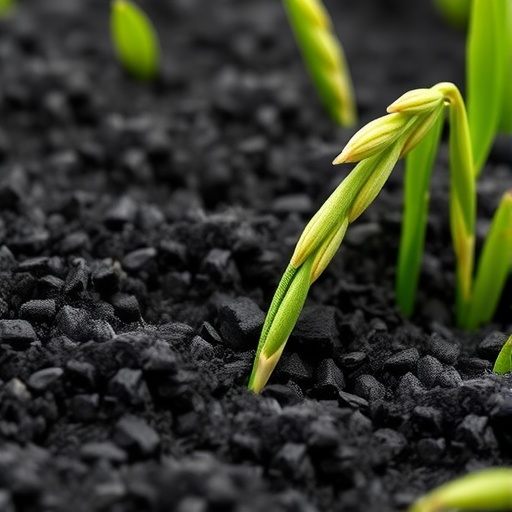
In the quest to secure global food safety amidst rising environmental contamination, researchers have pioneered a transformative approach targeting the persistent problem of toxic metalloid contamination in paddy soils. Rice, sustaining over half the world’s population, is at risk because arsenic (As) and antimony (Sb) present in mining-affected soils readily translocate into rice grains, posing substantial health hazards. Recent advancements reported in the journal Biochar reveal a cutting-edge remediation material—a magnetic silicon-enriched biochar gel—that shows exceptional efficacy in immobilizing these toxins, ultimately mitigating their bioaccumulation in rice and enhancing crop health.
The core innovation stems from the engineering of FeRBG, a functional biochar composite synthesized by integrating rice husk-derived biochar, iron oxides, and graphene into a three-dimensional porous gel network. Rice husk, an abundant agricultural byproduct, is distinguished by its natural silicon content, a mineral known to bolster plant stress resistance and potentially curtail metalloid uptake. The strategic incorporation of iron oxides and graphene amplifies reactive surface sites and structural stability, facilitating stronger affinity and retention of arsenic and antimony within paddy soils.
The significance of this approach is underscored by the system-level testing conducted in soils sourced from the heavily contaminated Qinglong Antimony Mine in Guizhou Province, China. This locale represents a critical case study for dual metalloid contamination. Employing greenhouse pot trials, researchers benchmarked FeRBG’s performance against untreated soil and soils amended with either unmodified rice husk biochar or iron-loaded biochar. The results definitively highlighted FeRBG as the premier amendment capable of simultaneously diminishing the bioaccessible pools of both arsenic and antimony.
Quantitative geochemical analyses demonstrated that FeRBG reduced phosphate-extractable arsenic and antimony concentrations by approximately 22.3% and 23.1%, respectively. These reductions correspond to a substantial shift of contaminants into more stable residual and iron oxide-bound soil fractions. Such chemical sequestration minimizes mobilization pathways, thereby limiting metalloid uptake by rice plants during growth. This mechanism employs the formation of stable Fe-O-As and Fe-O-Sb complexes on the biochar surfaces, effectively locking these harmful metalloids in place.
Crucially, the study reports a pronounced decline in arsenic and antimony concentrations within rice grains themselves, a pivotal marker of improved food safety. FeRBG treatment achieved a 34.0% reduction in grain arsenic and a 16.1% decrease in grain antimony relative to controls. Notably, the arsenic content in rice grains under FeRBG application fell to 0.14 mg kg⁻¹, placing it well below China’s national regulatory threshold for brown rice. These findings herald a transformative advance in the mitigation of toxic metalloid transfer through the soil-rice continuum.
Beyond contaminant immobilization, FeRBG exhibits pronounced agronomic benefits that directly impact rice productivity and resilience. Enhanced root system architecture was observed, characterized by increased total root length, surface area, mean diameter, and root tip abundance. These morphological improvements translate to a robust root network capable of optimizing nutrient and water uptake. Consequently, rice plants cultivated in FeRBG-amended soils showed higher fresh biomass in roots, stems, and panicles, alongside a significant 13.1% increase in thousand-grain mass.
The multifunctional efficacy of FeRBG is attributed to synergistic mechanisms operating at geochemical, microbial, and phytophysiological levels. Silicon release from the biochar matrix may interfere with arsenic transport pathways in rice, mitigating uptake at the root-shoot interface. Additionally, the porous gel architecture ensures a high density of adsorption sites facilitating effective metalloid binding. On the microbial front, soil bacterial community profiling revealed shifts favoring taxa involved in nutrient cycling and environmental stress mitigation, indicating that FeRBG fosters a more resilient and health-promoting rhizosphere.
Integrating these diverse functional attributes, FeRBG transcends conventional soil amendments by simultaneously addressing pollutant immobilization and crop health enhancement. This integrated remediation strategy not only secures safer rice production pathways but also promotes sustainable agricultural practices in mining-impacted regions. The magnetism inherent to FeRBG adds a practical dimension, potentially enabling targeted recovery and recycling of the biochar material, optimizing field management approaches.
The implications of this research extend to environmental engineering, soil science, microbiology, and agronomy, providing a template for leveraging biochar-based technologies to tackle complex co-contamination challenges. While promising, broader deployment initiatives require comprehensive field-scale trials to evaluate long-term stability, cost-effectiveness, and ecological safety under varied climatic and farming scenarios. These future investigations will be pivotal for translating laboratory efficacy into real-world agricultural sustainability.
Overall, this pioneering work elevates functionalized biochar beyond a mere sorbent to an integrated soil amendment that enhances the biogeochemical dynamics of paddy ecosystems. By locking toxic elements securely in soil matrices and simultaneously bolstering plant physiological functions, FeRBG exemplifies the next generation of environmentally conscious remediation technologies tailored for food safety and ecosystem health.
Subject of Research: Magnetic silicon-enriched biochar gel for remediation of arsenic and antimony contamination in soil-rice systems.
Article Title: Magnetic silicon-enriched biochar for effectively mitigating As and Sb in soil-rice continuum: from integrated geochemical, microbial, and phytophysiological insights.
News Publication Date: March 10, 2026.
Web References: DOI Link
References: Gao, Y., Chen, H., Wang, F. et al. Biochar 8, 74 (2026).
Image Credits: Yurong Gao, Hanbo Chen, Fenglin Wang, Jiayi Li, Zheng Fang, Xiaokai Zhang, Xing Yang, Jin Wang, Juan Liu, Caibin Li & Hailong Wang.
Keywords
Biochar, arsenic remediation, antimony remediation, soil contamination, rice safety, magnetic biochar gel, silicon-enriched biochar, iron oxides, graphene, soil microbiology, phytophysiology, environmental remediation.
Tags: antimony pollution in paddy fieldsarsenic contamination in ricebiochar composite with iron oxides and grapheneenhancing rice crop health with biocharenvironmental cleanup of heavy metals in rice cultivationimmobilization of metalloids in soilmagnetic biochar gel for soil remediationreducing toxic metalloid uptake in cropsremediation of mining-affected agricultural soilsrice husk biochar for heavy metal removalsilicon-enriched biochar benefitssustainable agriculture in contaminated soils