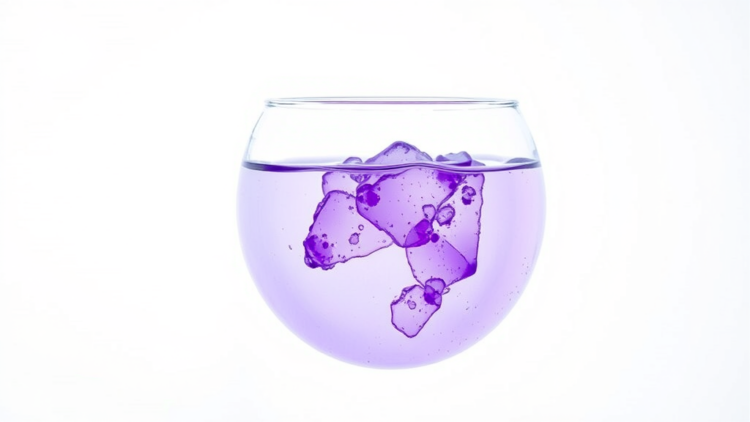
Crystal violet has been dyeing fabrics, ink cartridges, and biological specimens for more than a century, but its dark purple color conceals a darker truth. The cationic triphenylmethane compound is mutagenic, carcinogenic, and cytotoxic, and because of its chemical stability and affinity for biological tissue it lingers in rivers and lakes even at trace concentrations. Textile and dyeing operations discharge effluents loaded with such stubborn synthetic pigments, and conventional treatment trains struggle to keep pace. A new study published in the Journal of Saudi Chemical Society by Hamud A. Altaleb of the Islamic University of Madinah reports a promising countermeasure: a magnesium oxide nanoparticle-reinforced sulfonated chitosan hydrogel, dubbed MgO@S-hydrogel, that captures crystal violet from contaminated water with a maximum adsorption capacity of 822.36 milligrams per gram—well beyond the 800 milligram per gram threshold that few hydrogel adsorbents have reached.
The material begins with sulfonate chemistry. Sulfonate groups carry one of the lowest pKa values among common functional groups, which means they remain deprotonated—and therefore negatively charged—across a wide pH window. That persistent negative charge makes them ideal electrostatic traps for positively charged dye molecules. Earlier work on chitosan-grafted polystyrene sulfonate hydrogels demonstrated respectable performance, achieving capacities near 394 milligrams per gram, but such gels suffer from two chronic weaknesses: modest mechanical strength and excessive swelling that can compromise structural integrity in service. The new study set out to resolve those limitations by embedding inorganic magnesium oxide nanoparticles directly into the polymer network during synthesis.
Preparation followed a free-radical polymerization route. Magnesium oxide nanoparticles were first produced from magnesium nitrate hexahydrate using citric acid as a chelating agent, dried to a fluffy white precursor, and calcined at 600 degrees Celsius. Sodium styrene sulfonate was then polymerized in the presence of chitosan, ammonium persulfate as initiator, and N,N’-methylenebisacrylamide as cross-linker under nitrogen at 65 degrees Celsius. Three formulations containing 30, 150, and 300 milligrams of magnesium oxide were prepared by ultrasonically dispersing the nanoparticles before adding them to the reaction mixture. The highest-loading gel emerged as the clear performer and became the focus of all subsequent characterization and adsorption testing.
Microscopy revealed why the composite works so well. Field-emission scanning electron microscopy showed the pristine hydrogel as a relatively smooth, dense surface with low porosity—tight packing that restricts diffusion pathways to internal adsorption sites. After magnesium oxide incorporation, the morphology transformed dramatically: the surface became rougher and more irregular, with interconnected holes and voids. The nanoparticles act as physical spacers within the cross-linked network, reducing packing density and opening the architecture, which dramatically expands the accessible surface area. Energy-dispersive X-ray spectroscopy confirmed magnesium and oxygen signals alongside carbon, nitrogen, sodium, and sulfur from the organic framework, and elemental mapping showed uniform distribution with no large-scale phase segregation—evidence of genuine organic-inorganic integration rather than simple physical blending.
Fourier transform infrared spectroscopy reinforced that picture. The composite retained all the characteristic bands of the parent hydrogel, including broad O-H and N-H stretching near 3200 to 3500 inverse centimeters and the symmetric and asymmetric sulfonate stretches between 1030 and 1180 inverse centimeters, while new Mg-O vibrations appeared in the 500 to 700 range. Slight peak shifts of 10 to 30 inverse centimeters in the sulfonate and hydroxyl regions signaled strong interfacial bonding between the inorganic phase and the polymer functional groups. Thermogravimetric analysis added a thermal dimension to the story: the pure hydrogel retained only 3.7 percent residual mass at 800 degrees Celsius, whereas the composite left 24.87 percent behind, with decomposition stages shifted to higher temperatures—clear proof that magnesium oxide stiffens the network and delays degradation.
Adsorption experiments probed pH, initial dye concentration, contact time, temperature, and ionic strength using 10 milligrams of adsorbent in 10 milliliters of dye solution monitored at 589 nanometers. Performance rose steadily with pH: under acidic conditions, protonated amine and hydroxyl groups diminish the surface’s negative charge while hydrogen ions compete for binding sites, suppressing uptake. As pH climbs past the point of zero charge—measured at just 2.08 for the composite—the surface becomes strongly negative and electrostatic attraction to the cationic dye intensifies. The low pHpzc is a genuine asset, keeping the adsorbent negatively charged across nearly the entire practical pH range. Increasing ionic strength with potassium chloride produced only a slight decline in performance, indicating that electrostatics dominate but hydrogen bonding and magnesium oxide surface interactions also contribute. Selectivity tests against the anionic dye Acid Yellow 23 confirmed a strong preference for the cationic crystal violet.
Isotherm analysis with four nonlinear models placed the Langmuir equation on top, describing monolayer adsorption on a nearly homogeneous surface with a maximum capacity of 822.36 milligrams per gram and a Langmuir constant indicating strong surface affinity. The Langmuir-Freundlich model returned a nearly identical capacity of 811.56 milligrams per gram with a heterogeneity parameter close to one, confirming only slight surface heterogeneity. Kinetics told a subtler story. Uptake was rapid initially as abundant surface sites filled, then slowed toward equilibrium. Although pseudo-first-order and pseudo-second-order models both fit reasonably, the Elovich model proved best overall with an R-squared of 0.991, pointing to a heterogeneous, multi-step mechanism on surfaces with varying activation energies. Intraparticle diffusion plots showed two distinct linear segments with non-zero intercepts, meaning film diffusion and surface interactions—not pore diffusion alone—control the rate, aided by swelling that enlarges diffusion channels through the network.
Thermodynamics sealed the mechanistic interpretation. Gibbs free energy changes were negative at every temperature tested, ranging from -10.54 to -9.58 kilojoules per mole between 298 and 313 kelvin, confirming spontaneity. The enthalpy change of -29.89 kilojoules per mole marked the process as exothermic and dominated by physical interactions—chiefly electrostatic attraction between the dye cations and sulfonate groups—consistent with the kinetic picture. The entropy change of -64.09 joules per mole per kelvin reflected the ordering imposed when dye molecules immobilize on the polymer surface. Because the process releases heat, cooler water favors greater capacity, a useful practical note for treatment facilities operating at ambient temperatures.
Perhaps the most encouraging result is durability. Across six adsorption-desorption cycles, regenerated with a hydrochloric acid and acetone mixture, the composite held approximately 98 milligrams per gram through the first three rounds and still delivered roughly 86 milligrams per gram by the sixth—retaining over 88 percent of its original capacity. A slight uptick in the second cycle even suggested that initial swelling and shrinkage activated previously hidden sites. The authors attribute the structural resilience to magnesium oxide nanoparticles dispersed throughout the matrix, which reinforce the network against the mechanical fatigue of repeated swelling. Post-adsorption FTIR analysis confirmed the mechanism in action, with diminished sulfonate band intensities, emerging aromatic ring signals from pi-pi interactions, and subtle shifts in hydroxyl and amine regions pointing to hydrogen bonding.
Taken together, the findings position MgO@S-hydrogel as a serious candidate for cationic dye remediation. It combines the sustainability credentials of a chitosan-based bio-polymer, the electrostatic power of sulfonate chemistry, and the structural and adsorptive benefits of magnesium oxide nanoparticles, all while remaining regenerable through at least six cycles. With textile effluent threatening aquatic ecosystems worldwide and regulations tightening, adsorbents that pair exceptional capacity with mechanical stability and easy regeneration are precisely what the field has been demanding. This work suggests that a relatively simple nanocomposite strategy—embedding a basic, negatively charged metal oxide into a sulfonated biopolymer gel—can deliver performance that rivals or exceeds far more exotic materials, bringing lab-scale chemistry closer to real wastewater treatment.
Subject of Research: Magnesium oxide nanoparticle-reinforced sulfonated chitosan hydrogel for adsorptive removal of crystal violet dye from contaminated water
Article Title: MgO incorporated sulfonated chitosan hydrogel: a novel adsorbent to enhance the removal of crystal violet from aqueous solution
Article References: MgO incorporated sulfonated chitosan hydrogel: a novel adsorbent to enhance the removal of crystal violet from aqueous solution. (n.d.). https://doi.org/10.1007/s44442-026-00107-4
Image Credits: AI Generated
DOI: 10.1007/s44442-026-00107-4
Keywords: magnesium oxide nanoparticles, sulfonated chitosan hydrogel, crystal violet, cationic dye removal, adsorption, Langmuir isotherm, Elovich kinetics, wastewater treatment, nanocomposite, reusability, chitosan, water purification
Cite Scienmag News
APA
MLA
Chicago
Bethany Barker. (September 12, 2026). Magnesium Oxide-Infused Chitosan Hydrogel Pulls Toxic Crystal Violet Dye from Water. Scienmag. https://scienmag.com/magnesium-oxide-infused-chitosan-hydrogel-pulls-toxic-crystal-violet-dye-from-water/
Bethany Barker. “Magnesium Oxide-Infused Chitosan Hydrogel Pulls Toxic Crystal Violet Dye from Water.” Scienmag, 12 September 2026, https://scienmag.com/magnesium-oxide-infused-chitosan-hydrogel-pulls-toxic-crystal-violet-dye-from-water/. Accessed 12 September 2026.
Bethany Barker. “Magnesium Oxide-Infused Chitosan Hydrogel Pulls Toxic Crystal Violet Dye from Water.” Scienmag. September 12, 2026. https://scienmag.com/magnesium-oxide-infused-chitosan-hydrogel-pulls-toxic-crystal-violet-dye-from-water/
Copy citation
Download RIS
Tags: adsorptioncationic dye adsorption capacitycationic dye removalchitosancrystal violetcrystal violet dye removaldye wastewater treatmentElovich kineticsenvironmentally friendly dye removal methodshigh-capacity dye adsorbentshydrogel-based water purificationLangmuir isothermmagnesium oxide nanoparticle adsorbentsmagnesium oxide nanoparticlesnanocompositenanomaterial-enhanced hydrogel filtrationreusabilitysulfonated chitosan hydrogelsynthetic dye effluent treatmenttextile industry wastewater solutionswastewater treatmentwater pollution remediationwater purification