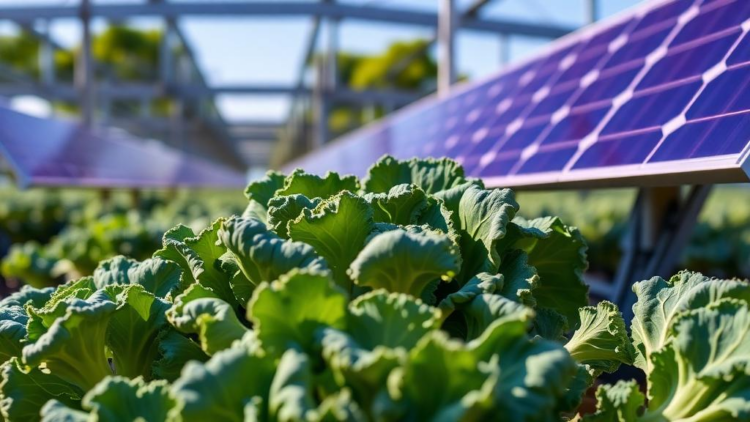
Broccoli plants grown beneath semi-transparent, magenta-colored solar panels used sunlight far more efficiently than crops grown in full sun, according to a study published October 2 in the Cell Press journal Cell Reports Physical Science. The research, conducted at an experimental site on a farm in Sweden, found that the shaded plants achieved a 4.5-fold increase in the efficiency with which they converted available sunlight into growth, ultimately reaching the same size as conventionally cultivated broccoli. The trade-off was time: the panel-grown crops needed 25 additional days to mature. The findings suggest that farmland could simultaneously produce food and renewable electricity without sacrificing crop yields, a central ambition of the fast-growing field known as agrivoltaics.
The underlying concept, as described by study author Silvia Ma Lu of Mälardalen University in Västerås, Sweden, is deceptively simple. The solar panels use part of the incoming sunlight to generate renewable electricity while allowing the remainder to pass through to the crops growing underneath. The broader scientific goal is to determine whether sunlight can be exploited more efficiently overall by allocating different portions of the solar spectrum to two separate purposes: photosynthesis for crop production and photovoltaic conversion for power generation. Because plants and solar cells respond to different wavelengths in different ways, splitting the spectrum in principle allows the same patch of land to do double duty.
The magenta coloring of the panels is not merely aesthetic. The customized, semi-transparent panels were designed to boost the blue and red wavelengths of light that plants use most heavily for photosynthesis, the process by which they convert light energy into chemical energy. Chlorophyll, the primary photosynthetic pigment, absorbs strongly in the blue and red regions of the spectrum while reflecting much of the green light that gives foliage its characteristic color. By filtering incoming sunlight to emphasize these photosynthetically valuable wavelengths, the panels can enhance the light quality reaching the crop while the photovoltaic cells capture energy from other parts of the spectrum to generate electricity.
Agrivoltaics has attracted growing attention as a way to reconcile two competing demands on land. Conventional solar panels installed on farm fields allow farmers to produce renewable electricity on land where ample space is already available, and they can also protect plants from excessive sunlight and extreme weather events such as hail or heavy rainfall. However, the dark-blue panels in standard use are typically opaque, and the deep shade they cast can reduce the yields of many crops. Semi-transparent and colored panels offer a potential solution to this shading problem, transmitting a portion of the light while still generating meaningful amounts of power.
To test the approach under real field conditions, Ma Lu and colleagues selected broccoli, a highly nutritious crop that is popular worldwide and well suited to the climate of their experimental site on a Swedish farm. The team built two systems, each measuring 20 meters by 20 meters, constructed from semi-transparent, magenta-colored solar panels with different levels of transparency. The differing transparency allowed varying amounts of sunlight to reach the broccoli plants cultivated beneath each array. A third plot of land, left uncovered, served as the control, with broccoli plants fully exposed to the sun throughout the growing season.
Throughout the 2024 growing season, the researchers compared the broccoli across all three plots while monitoring a comprehensive set of environmental and biological variables. These included air temperature, relative humidity, and soil moisture, alongside measures of crop yield, nutrient composition, and the efficiency with which the plants performed photosynthesis. This combination of microclimate data and physiological measurements allowed the team to assess not only how large the plants grew, but how the altered light environment beneath the panels changed the fundamental processes driving that growth.
One of the most striking results was how similarly the broccoli performed under the two panel systems despite their different transparency levels, a finding that carries practical implications because panels with a greater density of photovoltaic cells can produce more electricity. If crop performance remains comparable under denser arrays, farmers could potentially install more productive panels without further penalizing their harvest. Ma Lu cautioned, however, that these findings are specific to the experimental conditions of the study and should be validated across additional growing seasons and system configurations before broader conclusions are drawn.
The systems tested in the study are research prototypes, and the authors emphasize that considerably more work is needed at larger scales and over multiple growing seasons before the technology can be recommended for widespread commercial deployment. There is no single agrivoltaic design that will work optimally everywhere, Ma Lu noted, and more research is required to understand how different crops respond to different system configurations and climatic conditions, and to design systems that balance agricultural production with renewable electricity generation. The Swedish trial represents an early but encouraging data point in that larger effort.
If the technology were scaled up for commercial use, the electricity generated above crops could in principle power farm operations such as irrigation, machinery, or cooling and storage systems, or it could be fed into the electricity grid. For farmers, that could translate into lower electricity bills and even an additional source of income, turning fields that currently produce only food into dual-purpose land that also generates revenue from power. In regions where land is scarce or expensive, the ability to stack energy and agricultural production on the same acreage could prove economically significant.
The team has already moved forward with follow-up work, evaluating the magenta panels as well as red and blue variants in controlled laboratory settings, where the light can be measured without interference from unfiltered sunlight. For now, Ma Lu suggests that configurations similar to the research prototype may be best suited to smaller-scale applications, such as community gardens, or to integration into greenhouse roofs, rather than immediate deployment over large agricultural areas. The study was supported by funding from the J. Gust. Richert Foundation, the Swedish Energy Agency, the Knowledge Foundation, and Carbon2Food, and it was published as an experimental study in Cell Reports Physical Science under the title describing land productivity with semi-transparent colored CdTe thin-film photovoltaics and broccoli cultivation in agrivoltaic systems.
Subject of Research: Agrivoltaic cultivation of broccoli under semi-transparent colored cadmium telluride thin-film solar panels
Article Title: Broccoli grows well under magenta solar panels
Article References: Broccoli grows well under magenta solar panels. (n.d.). Original publication
Image Credits: AI Generated
DOI: Not provided
Keywords: agrivoltaics, broccoli, solar panels, semi-transparent photovoltaics, CdTe thin-film, photosynthesis, renewable energy, crop yield, Sweden, Cell Reports Physical Science, land productivity, spectrum splitting
Cite Scienmag News
APA
MLA
Chicago
Alan Morgan. (October 3, 2026). Magenta Solar Panels Boost Broccoli Growth While Harvesting Power. Scienmag. https://scienmag.com/magenta-solar-panels-boost-broccoli-growth-while-harvesting-power/
Alan Morgan. “Magenta Solar Panels Boost Broccoli Growth While Harvesting Power.” Scienmag, 3 October 2026, https://scienmag.com/magenta-solar-panels-boost-broccoli-growth-while-harvesting-power/. Accessed 3 October 2026.
Alan Morgan. “Magenta Solar Panels Boost Broccoli Growth While Harvesting Power.” Scienmag. October 3, 2026. https://scienmag.com/magenta-solar-panels-boost-broccoli-growth-while-harvesting-power/
Copy citation
Download RIS
Tags: agrivoltaicsbroccoliCdTe thin-filmCell Reports Physical Sciencecrop yielddual-purpose farmland energy and food productionenhanced broccoli growth under solar shadingimpact of colored solar panels on plant growthinnovative solar panel designs for farmingland productivitymagenta solar panels for agricultureoptimizing sunlight use for crops and electricityphotosynthesisRenewable Energyrenewable energy generation on agricultural landsemi-transparent photovoltaicssemi-transparent solar panels for crop cultivationsolar panel shading effects on crop yieldsolar panelssolar spectrum utilization for photosynthesisspectrum splittingsustainable farming with integrated solar powerSweden