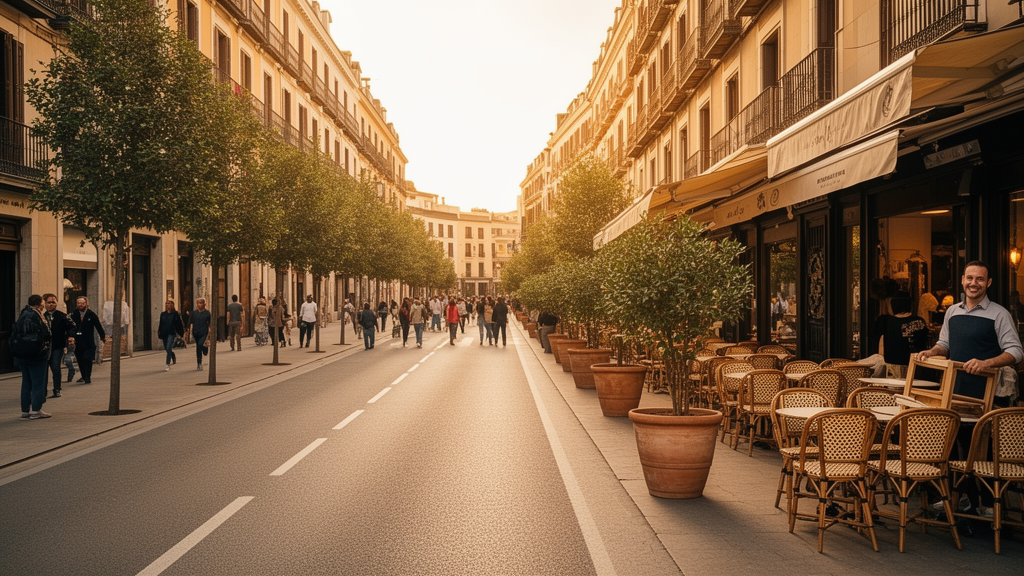
When Madrid stripped cars from two of its most prominent public spaces, the loudest predicted losers were the businesses lining the newly pedestrianised streets. Shopkeepers and bar owners had long warned that removing traffic and parking would drive away customers and strangle sales. A new study tracking more than one hundred businesses across two rounds of interviews finds the opposite pattern: satisfaction with the car-free zones was already high shortly after implementation and rose further once the interventions had bedded in, with perceived gains in sales, footfall and street quality emerging as the strongest correlates of support.
The research, published in European Transport Research Review, examined two large-scale pedestrianisation schemes in Madrid’s central business district. The first is Puerta del Sol, Spain’s symbolic “kilometre zero” and a major commercial and tourist hub, where the latest phase completed in 2023 permanently removed all remaining car traffic from the square and its access streets. The intervention eliminated nearly one kilometre of roadway and created 16,751 square metres of pedestrian space, rerouting several bus lines and stops while leaving the square’s metro and commuter rail interchange intact. The second case, Plaza de Olavide, lies about two kilometres north in a predominantly residential nineteenth-century neighbourhood. There, traffic and 212 on-street parking spaces were removed from six of eight streets, converting 621 metres of roadway into 14,000 square metres of pedestrian space, with two streets remaining open through an underground tunnel.
The two sites offered deliberately contrasting urban typologies. Sol is dominated by international brands, tourism and heavy pedestrian flows, with limited residential presence and a growing share of tourist-oriented businesses. Olavide functions mainly as a neighbourhood meeting point, anchored by small shops, cafés and bars serving local residents, with little tourism activity. Both interventions belong to a city-wide strategy launched in 2021 and represent the most ambitious pedestrianisation efforts within Madrid’s central district, making them unusually large test cases in a literature that has mostly studied single-street schemes.
Methodologically, the study set out to fill three gaps the authors identify in previous research. Most existing work has relied on quantitative indicators such as sales and footfall figures, focused on small-scale interventions, or captured business views at only a single point in time. Here, the team conducted mixed-format semi-structured interviews in 2023, shortly after implementation while renovation works were still ongoing, and again in 2025 once the schemes were established. In total, 103 businesses were interviewed: 52 in the first wave, comprising 30 in Sol and 22 in Olavide, and 51 in the second, comprising 36 in Sol and 15 in Olavide. Because the pedestrianised streets contain 80 establishments in Sol and 45 in Olavide, the researchers argue the samples provide high coverage of the local business population. The two waves were partially independent, as business turnover meant most second-round respondents differed from the first.
Each interview combined structured survey items, including Likert-scale and categorical questions, with open-ended prompts that let participants elaborate. The structured items were analysed descriptively and with Spearman’s rank correlation, a non-parametric measure suited to ordinal data and modest sample sizes, while the open-ended responses underwent a six-step thematic analysis following the framework of Braun and Clarke, with two researchers coding manually and iteratively. The interview guide covered business characteristics, satisfaction levels, motivations behind satisfaction, including perceived effects on sales, customer profiles and product supply, and open-ended follow-ups.
The headline numbers point in one direction. Businesses reported high satisfaction immediately after implementation, and average satisfaction increased markedly between 2023 and 2025. Perceived sales effects shifted dramatically: in 2023 an average of 61 percent of businesses reported no impact on sales, but by 2025 an average of 57 percent reported increased sales. In Sol the shift was especially pronounced, with 58 percent believing sales had risen and only 8 percent perceiving a decline. The authors note this contrasts with the aftermath of Madrid’s first Low Emission Zone in the Sol area in 2019, when only 13.7 percent of surveyed businesses reported increased sales. Perceived changes in customer type also grew, from 22 percent of businesses in 2023 to 35 percent in 2025, and particularly in Olavide, where the share jumped from 9 to 33 percent.
The correlation analysis sharpened the picture of what actually drives satisfaction. Perceived increases in sales, pedestrian traffic and street quality, specifically quieter and more comfortable streets, were all positively and significantly associated with satisfaction. Businesses that saw lower stock levels from logistics problems reported lower satisfaction, and difficulties with deliveries and stock replenishment showed a significant negative correlation. Strikingly, business characteristics such as years in operation, size and turnover were not significant predictors, which the authors interpret as evidence that threats to local businesses have not materialised and that pedestrianisation can be received positively across establishments of different profiles. Location was not significantly correlated with satisfaction either, and Olavide, despite having no prior exposure to car restrictions, reported slightly higher satisfaction than Sol, challenging the idea that previous experience with traffic measures paves the way for approval. Difficulty of customer access by car, a central argument in business opposition, showed no significant correlation with satisfaction.
The qualitative data explained these patterns. In 2023, Sol shopkeepers voiced frustration with roadworks, dirt, noise, construction delays and insufficient communication from the city council, with one retailer describing reduced foot traffic and repeatedly pushed-back deadlines. These complaints were absent from the 2025 interviews, suggesting they reflected the implementation process rather than the pedestrianisation itself. Delivery concerns clustered among businesses dependent on frequent restocking, particularly bars and grocery stores, although a Sol retailer noted that the 2019 Low Emission Zone had already forced adjustments to goods distribution. Some businesses feared losing car-borne customers, especially older people who might struggle to transport purchases, yet many interviewees reported increased pedestrian activity, and hospitality businesses in particular linked the schemes to pleasanter atmospheres and customers lingering longer. A minority of bars and restaurants also complained of noise, street drinking and competition from people using the new public space without consuming.
Satisfaction measured by business type in 2025 showed hospitality services, bars, restaurants and hotels, reporting the highest levels with low variation, retailers reporting lower averages with greater spread, and service providers also relatively satisfied, though the authors caution that very few service businesses were interviewed in Olavide. The study’s conclusions carry explicit limitations: the analysis is correlational and does not establish causal relationships, the effects of pedestrianisation are difficult to isolate from broader economic trends, both areas have long commercial histories, and the first round took place in a post-pandemic context that may have coloured responses. The authors also note that structural changes such as business displacement were not directly examined, since no longitudinal panel data were collected, although prior research in central Madrid has documented shifts toward chain stores and tourist-oriented shops after pedestrianisation. Their practical message is nonetheless concrete: communicate clearly, manage goods distribution, and involve businesses early, because satisfaction appears to depend less on who the businesses are than on how the transition is handled.
Subject of Research: Business satisfaction with large-scale pedestrianisation schemes in Madrid
Article Title: Shaping business satisfaction with pedestrianisation: evidence from Madrid (Spain)
Article References: Brownrigg-Gleeson, M. L., Monzon, A., Lopez-Carreiro, I., & Al Suleiman, S. (2026). Shaping business satisfaction with pedestrianisation: evidence from Madrid (Spain). European Transport Research Review, 18(1), Article 87. https://doi.org/10.1186/s12544-026-00846-w
Image Credits: AI Generated
DOI: 10.1186/s12544-026-00846-w
Keywords: pedestrianisation, Madrid, local businesses, satisfaction, urban mobility, retail, hospitality, footfall, sales, goods distribution, low emission zone, longitudinal study
News Source: Denise Maddox. (October 29, 2026). Madrid businesses grow happier with car-free streets over time. Scienmag.