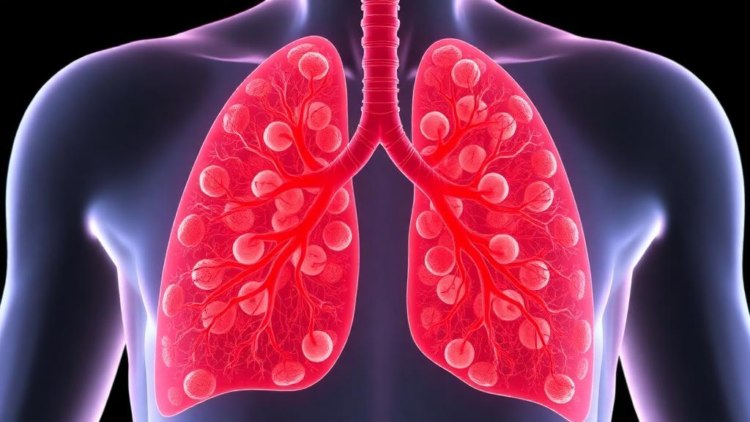
Pulmonary fibrosis is one of the most relentless diseases in medicine, a condition in which the delicate air sacs of the lung are progressively replaced by stiff, scar-like tissue until breathing itself becomes a struggle. Idiopathic pulmonary fibrosis, the most common and deadliest form, carries a median survival of only a few years after diagnosis, and existing therapies slow but do not halt the decline. Now a team of researchers in China has uncovered a previously underappreciated driver of this scarring process: tiny membrane-bound vesicles released by a specific class of immune cells that ferry a fibrosis-promoting microRNA directly into the structural cells of the lung. The findings, published in Cellular and Molecular Life Sciences, point to a molecular axis that could become a much-needed therapeutic target.
The study, led by Shuhong Guan, Xiaoqin Zhu, Yunqi Ge, Deyue Cui and corresponding author Jun Zhou of the Department of Respiratory and Critical Care Medicine at The First People’s Hospital of Changzhou, focused on macrophages, the versatile immune cells that patrol lung tissue. Macrophages are not a single entity but a spectrum of functional states. At one pole sit the M1-like cells, which mount inflammatory, microbe-killing responses; at the other pole sit the M2-like cells, which are classically associated with tissue repair, wound healing and, crucially, the resolution phase of inflammation. In the context of chronic injury, however, M2-like macrophages have increasingly been implicated in pathological scarring, and the new work helps explain how they communicate their pro-fibrotic message to neighboring cells.
The messengers in question are exosomes, nanoscale vesicles roughly 30 to 150 nanometers in diameter that cells release into their surroundings. Far from being cellular debris, exosomes are now recognized as sophisticated intercellular communication vehicles, packed with proteins, lipids and nucleic acids, including microRNAs, which are short regulatory RNA molecules that fine-tune gene expression after transcription. When an exosome is taken up by a recipient cell, its microRNA cargo can silence specific target messenger RNAs, effectively reprogramming the recipient’s behavior. To establish their experimental system, the researchers isolated exosomes from both resting M0 macrophages and M2-polarized macrophages, using two sources: the RAW264.7 mouse monocyte-macrophage cell line and primary macrophages derived from mouse bone marrow. The team verified the identity and purity of their vesicle preparations using transmission electron microscopy to visualize the characteristic cup-shaped morphology, nanoparticle tracking analysis to profile size distribution, and immunoblotting for canonical exosome markers such as CD9, CD63 and CD81, while confirming the absence of contaminants like the endoplasmic reticulum protein calnexin and the Golgi protein GM130.
With the vesicles characterized, the researchers turned to a mouse model of pulmonary fibrosis induced by bleomycin, a chemotherapy agent whose pulmonary toxicity produces scarring that closely mirrors the human disease. When M2-derived exosomes were administered to these mice, the fibrotic process was notably exacerbated compared with animals receiving exosomes from resting M0 macrophages. In other words, the cargo of the M2 macrophage vesicles was not benign; it actively accelerated the deposition of scar tissue in the injured lung. Fluorescently labeled exosomes injected into the tail vein were tracked in vivo and ex vivo, revealing that the vesicles homed to the lung among the major organs, and time-course experiments showed that exosomal microRNA content accumulated in recipient lung cells over hours of exposure.
Comprehensive microRNA sequencing of the exosomes from M0 and M2 macrophages revealed a candidate culprit: miR-350-5p, a microRNA that was markedly enriched in the M2-derived vesicles. Functional assays then demonstrated that this microRNA could be delivered into two key recipient cell types, lung fibroblasts and alveolar epithelial cells, the very populations whose misbehavior defines pulmonary fibrosis. Fibroblasts are the cells responsible for producing collagen and other extracellular matrix components, and in fibrosis they become activated into myofibroblasts, hypersecretory cells that lay down matrix far in excess of what tissue repair requires. Alveolar epithelial cells, meanwhile, can undergo epithelial-mesenchymal transition, or EMT, a developmental program in which epithelial cells lose their adhesive, barrier-maintaining character and acquire migratory, matrix-producing traits. Both processes were significantly promoted when cells were exposed to M2-derived exosomes in vitro.
To test whether miR-350-5p was truly the active ingredient, the researchers inhibited the microRNA inside M2 macrophages before collecting their exosomes. The result was striking: exosomes depleted of miR-350-5p lost much of their ability to drive fibroblast activation and EMT in cell culture. Moving back into the animal model, mice treated with exosomes from miR-350-5p-inhibited M2 macrophages showed significantly attenuated pulmonary fibrosis and reduced collagen deposition compared with mice receiving normal M2 exosomes. This gain-of-function and loss-of-function pairing, in which adding the microRNA worsens disease and removing it improves it, provides strong causal evidence that the microRNA is not merely a passenger but an active pro-fibrotic agent.
The mechanistic heart of the paper lies in the identification of the microRNA’s target. Using complementary approaches, the team showed that miR-350-5p directly binds to and suppresses Smad7, a well-characterized inhibitory molecule in the transforming growth factor beta signaling pathway. TGF-beta is the master cytokine of fibrosis, and its intracellular Smad signaling cascade drives the transcription of collagen genes, alpha-smooth muscle actin and other markers of the myofibroblast phenotype. Smad7 acts as a built-in brake on this pathway, providing negative feedback that keeps TGF-beta responses in check. By silencing Smad7, exosomal miR-350-5p effectively removes that brake, amplifying TGF-beta/Smad signaling in both fibroblasts and alveolar epithelial cells and pushing them toward fibrotic phenotypes. The elegance of this mechanism is that it allows immune cells to influence the fibrotic program of structural cells without direct cell-to-cell contact, using a soluble, packaged RNA message that survives in the extracellular space.
The clinical implications are considerable. Current antifibrotic drugs for idiopathic pulmonary fibrosis, nintedanib and pirfenidone, target downstream pathways of fibrogenesis but do not reverse established scarring, and the search for upstream, disease-modifying targets remains intense. The miR-350-5p/Smad7 axis identified here offers two potential intervention points. Antisense oligonucleotide technologies, including locked nucleic acid inhibitors and antagomirs, have matured to the point where microRNA inhibition in the lung is a plausible therapeutic strategy, and several microRNA-targeting drugs are already in clinical trials for other indications. Alternatively, strategies that bolster Smad7 expression or mimic its braking function could restore equilibrium to TGF-beta signaling in fibrotic lungs. Because the exosomal delivery mechanism concentrates the microRNA in recipient lung cells, intercepting the vesicles themselves, for example by blocking uptake pathways, represents a third possible approach.
As with any preclinical study, important caveats apply. The work was performed in mouse models and mouse cell lines, and miR-350-5p is a rodent microRNA whose human counterpart and target repertoire would need to be validated before the findings can be translated. Bleomycin-induced fibrosis, while widely used, captures only part of the pathology of idiopathic pulmonary fibrosis, which develops over decades rather than weeks and involves repeated microinjuries, aging-related changes and genetic susceptibility. The authors also note that inhibiting miR-350-5p in M2 macrophages only partially improved fibroblast activation and EMT in vitro, indicating that other cargo molecules within M2 exosomes likely contribute to the pro-fibrotic signal. Nonetheless, the study adds a compelling new layer to the understanding of how macrophages orchestrate fibrosis, and it underscores a broader theme in modern cell biology: that the vesicles cells shed are not waste but potent packages of regulatory information. If the miR-350-5p/Smad7 axis holds up in human tissue and translational models, it could open a genuinely new front in the fight against a disease that medicine has long been losing.
Subject of Research: The role of M2 macrophage-derived exosomal miR-350-5p in targeting Smad7 to drive pulmonary fibrosis
Article Title: M2 macrophage-derived exosomal miR-350-5p facilitates pulmonary fibrosis through targeting Smad7 in lung fibroblasts and alveolar epithelial cells
Article References: Guan, S., Zhu, X., Ge, Y., Cui, D., & Zhou, J. (2026). M2 macrophage-derived exosomal miR-350-5p facilitates pulmonary fibrosis through targeting Smad7 in lung fibroblasts and alveolar epithelial cells. Cellular and Molecular Life Sciences. https://doi.org/10.1007/s00018-026-06400-0
Image Credits: AI Generated
DOI: 10.1007/s00018-026-06400-0
Keywords: pulmonary fibrosis, M2 macrophages, exosomes, miR-350-5p, Smad7, TGF-beta signaling, epithelial-mesenchymal transition, fibroblast activation, microRNA, idiopathic pulmonary fibrosis, collagen deposition, lung fibrosis
Cite Scienmag News
APA MLA Chicago
Drew Townsend. (October 2, 2026). Macrophage Exosomes Carry a MicroRNA That Drives Scarring in the Lung, Study Finds. Scienmag. https://scienmag.com/macrophage-exosomes-carry-a-microrna-that-drives-scarring-in-the-lung-study-finds/
Drew Townsend. “Macrophage Exosomes Carry a MicroRNA That Drives Scarring in the Lung, Study Finds.” Scienmag, 2 October 2026, https://scienmag.com/macrophage-exosomes-carry-a-microrna-that-drives-scarring-in-the-lung-study-finds/. Accessed 2 October 2026.
Drew Townsend. “Macrophage Exosomes Carry a MicroRNA That Drives Scarring in the Lung, Study Finds.” Scienmag. October 2, 2026. https://scienmag.com/macrophage-exosomes-carry-a-microrna-that-drives-scarring-in-the-lung-study-finds/
Copy citation Download RIS
Tags: collagen depositionepithelial-mesenchymal transitionexosome-mediated cell signalingexosomesextracellular vesicles in diseasefibroblast activationIdiopathic pulmonary fibrosisimmune cell communication in lungslung fibrosislung tissue remodelingM2 macrophagesmacrophage exosomesmacrophage polarization in lung diseasemicroRNAmicroRNA in lung scarringmicroRNA-driven fibrosismiR-350-5pmolecular mechanisms of lung scarringpulmonary fibrosisrole of immune cells in lung fibrosisSmad7TGF-beta signalingtherapeutic targets for pulmonary fibrosis