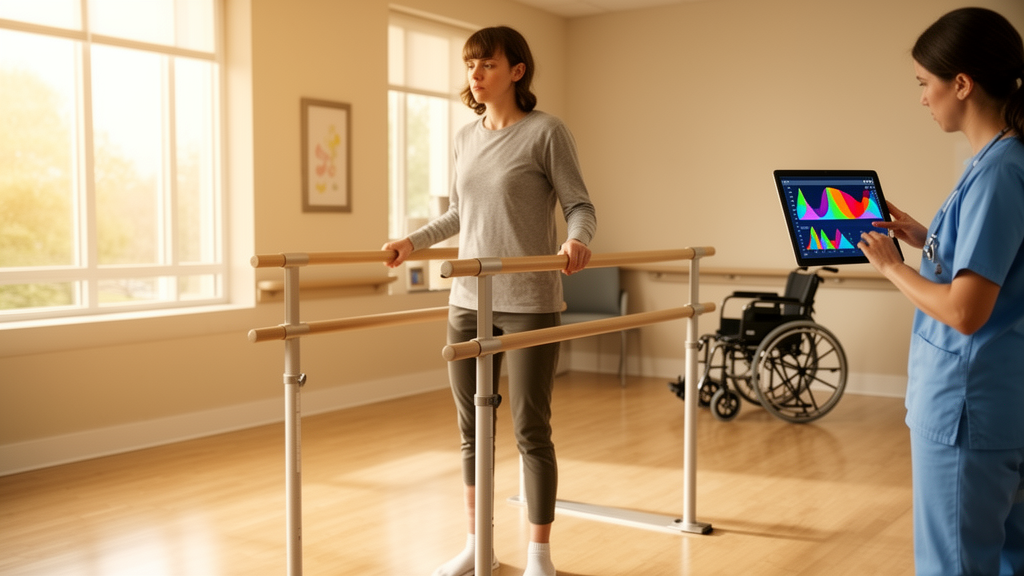
Machine learning models can classify how independently a person with spinal cord injury will manage everyday tasks — grooming, bladder management, and moving around indoors — directly from standardized neurological assessments, according to a new study published in BMC Biomedical Engineering. Drawing on one of the largest spinal cord injury datasets in the world, the European Multicenter Study about Spinal Cord Injury (EMSCI), researchers show that the link between neurological status and functional independence strengthens as time passes after injury, and that the choice of algorithm matters in clinically meaningful ways.
The study, a secondary analysis of EMSCI data collected since 2001, included 5,904 patients who met the inclusion criteria. The researchers split the data into three post-injury phases: early (up to 40 days after injury, with 4,686 patients contributing 6,186 observations), intermediate (70 to 100 days, 3,355 patients), and late (more than 182 days, 2,736 patients with 2,922 observations). Over 90 percent of the cohort had sustained their injuries through traumatic causes, roughly half had cervical-level injuries and 37 percent thoracic-level injuries, and the most prevalent injury severities were complete injuries (AIS grade A, 38 percent) and injuries with preserved motor function (AIS grade D, 35 percent).
Rather than collapsing these outcomes into a single total score or a yes/no category, as most previous studies have done, the researchers treated each SCIM item as a multi-class ordinal prediction problem.
The headline result is a clear temporal pattern: model accuracy improved over time. In the early phase, accuracy ranged from 46 to 71 percent depending on the task and model; in the late phase, it reached 50 to 85 percent. Grooming was the most reliably predicted outcome, with accuracy climbing from 0.59 to 0.70 early after injury to 0.79 to 0.85 in the late phase. Bladder management and indoor mobility were more variable, with late-phase accuracies of 0.50 to 0.72 and 0.55 to 0.74 respectively. The authors attribute the early-phase difficulty to ongoing neurological changes, concomitant injuries, secondary complications, and strong class imbalances — for example, 58 percent of early observations for indoor mobility involved total assistance.
Across all scenarios, the random forest classifier achieved the best overall performance, with a relative performance score of 0.93 ± 0.03 averaged across the five evaluation metrics, which included accuracy, balanced accuracy, mean absolute error, macro-averaged mean absolute error, and quadratic weighted kappa — a measure that penalizes large disagreements between predicted and actual classes more heavily. The ordinal forest (0.918 ± 0.032) and random forest with ordered partitions (0.912 ± 0.030) followed closely, indicating that forest-based approaches were the most reliable family of models overall. All models outperformed random chance, which ranged from 0.20 to 0.24 for tasks with four to five possible outcomes, although some models fell below a naive majority-class baseline in specific early-phase scenarios.
One of the study’s most clinically relevant findings concerns the severity of errors. Ordinal models did not systematically beat nominal models on raw accuracy — nominal variants often showed higher balanced accuracy — but ordinal models consistently made fewer severe misclassifications, performing better on metrics that penalize the magnitude of errors. In spinal cord injury care, the difference between predicting, say, walking unaided versus wheelchair-dependent mobility has profound implications for the type of assistance and clinical management a patient requires. The cumulative link model illustrated this trade-off most starkly: it ranked lowest on accuracy and balanced accuracy yet achieved the best overall quadratic weighted kappa of any model tested.
The results confirmed that the models rely on anatomically plausible relationships. Upper extremity motor scores at cervical levels C5 to T1 dominated grooming predictions, with C8 — which innervates the finger flexors — consistently the top feature, and C6, linked to the tenodesis grip that allows people with tetraplegia to grasp objects, gaining importance in later recovery phases. For bladder management, voluntary anal contraction strongly increased the likelihood of full independence, and for indoor mobility, lumbar motor scores at L2 and L3 — hip flexors and knee extensors — had the highest SHAP values, distinguishing walkers from non-walkers, while L4 and L5 scores differentiated walking-aid requirements among those who could ambulate.
The interpretability analysis also revealed temporal dynamics that may reflect recovery and rehabilitation. Days after injury was especially influential in early-phase predictions but faded in importance over time, while age became more relevant in later stages. The growing weight of C6 motor scores for grooming over time likely captures both neurological recovery and learned compensatory strategies, such as tenodesis grasp patterns developed through rehabilitation. The authors caution, however, that SHAP values do not imply causality and should be interpreted carefully, particularly for minority outcome classes where model performance was weakest.
The study has important limitations. Performance was assessed with internal cross-validation only, which may overestimate generalisability; external validation on an independent dataset would be needed before any clinical application. Class imbalance biased models toward majority classes despite weighting strategies, and the ISNCSCI’s restriction to ten key muscles per body side may not capture the full neurological picture. Factors such as psychological support and social circumstances, which influence functional independence, were not available in the dataset. Still, the authors argue their models form the basis of a modular prognostic framework: future neurological scores could first be predicted, then fed into these classifiers to estimate the most likely functional independence class — a computationally efficient approach that avoids building separate models for every task and time point in spinal cord injury care.
Subject of Research: Machine learning classification of functional independence after spinal cord injury from ISNCSCI neurological assessments across post-injury phases
Article Title: Linking neurological status to functional outcomes in spinal cord injury: a multi-class, task-specific approach
Article References: Tuci, M., Steck, L., Lukas, L. P., Taran, O., Rupp, R., Weidner, N., Schubert, M., Röhrich, F., Waldmann, J., Kalke, Y. B., Abel, R., Maier, D., Liebscher, T., Zörner, B., Curt, A., Bolliger, M., Brüningk, S. C., & Jutzeler, C. R. (2026). Linking neurological status to functional outcomes in spinal cord injury: a multi-class, task-specific approach. BMC Biomedical Engineering, 8(1), Article 9. https://doi.org/10.1186/s42490-026-00110-1
Image Credits: AI Generated
DOI: 10.1186/s42490-026-00110-1
Keywords: spinal cord injury, machine learning, ISNCSCI, SCIM, functional independence, random forest, ordinal classification, SHAP interpretability, EMSCI, rehabilitation, prognostic modeling, Linking
News Source: Teresa Odom. (October 29, 2026). Machine Learning Ties Spinal Cord Scores to Everyday Independence After Injury. Scienmag.