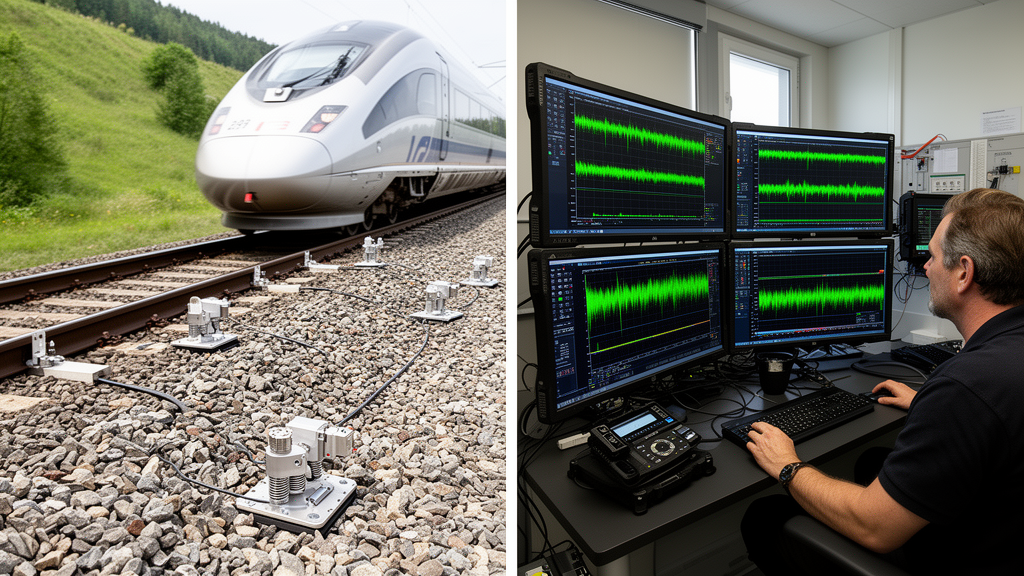
A neural-network method trained on semi-analytical simulations and railway field measurements predicted the ground vibration produced by high-speed trains crossing elevated tracks, matching measurements along a Chinese railway line with a maximum reported relative deviation of 4.75%. The model, described in a 2026 research article, could generate predictions within seconds, offering a potentially faster alternative to detailed numerical models of train–bridge–soil interaction. Its test covered train speeds from 290 to 335 km/h, monitoring points 5–40 m from bridge piers, varied bearing stiffness and six soil-shear-modulus conditions, although the reported performance is bounded by the ranges represented in the data.
Ground vibration is generated when moving trains load elevated railway structures, and those dynamic forces can pass from bridge piers into the surrounding soil. The resulting response depends on interactions among the train, track, bridge, foundations and local geology, making prediction computationally demanding. Conventional approaches based on the finite element method, the boundary element method and combined numerical formulations can represent complex systems, but they often require extensive computation and detailed meshing. The new study addresses that problem with a Genetic Algorithm-Enhanced Backpropagation Neural Network, or GAE-BNN, designed to estimate vertical vibration levels quickly from four inputs: train speed, distance from the pier, bridge-bearing stiffness and soil shear modulus.
The model’s starting point was a semi-analytical representation of the railway system. The bridge superstructure was treated as an elastically supported beam subjected to a moving train load, while the upper soil layer was modeled as an elastic half-space. The response of each pier was calculated through the Green’s function for a harmonic point load, a mathematical expression used to represent ground displacement in the elastic half-space. By combining responses from multiple piers and transforming results between the frequency and time domains, the researchers generated vibration histories for different operating scenarios. For the model calculations, a five-second time history was evaluated with a time increment of 0.005 seconds while the train crossed the bridge. This approach was much faster than building a comparable finite-element model, which the authors said could require considerable resources, time and labor-intensive mesh construction.
The researchers checked the semi-analytical model against field observations from a bridge along the high-speed railway line between Hangzhou and Changsha. Comparisons covered peak acceleration in the time history and the dominant frequency in one-third-octave bands. The calculated and measured values were described as agreeing well, with differences attributed to how the bridge–foundation–soil system, soil shear modulus and material damping were represented. Soil parameters were established through Rayleigh-wave exploration combined with on-site drilling data. The upper layers were characterized as fully weathered and strongly weathered phyllite, and the model used a shear modulus of 351.99 MPa for the relevant soil calculation.
For the machine-learning dataset, the study used specifications of the elevated track and soil conditions on the Nanchang section of the Nanchang–Hangzhou High-Speed Railway. Six shear-modulus values—150, 200, 250, 300, 350 and 400 MPa—were crossed with four bearing-stiffness values of 1 × 10^9, 1 × 10^10, 1 × 10^11 and 1 × 10^12 N/m² and five train speeds: 290, 300, 310, 320 and 335 km/h. These combinations produced 120 model scenarios, each containing responses at seven monitoring points. The points were positioned at distances from 5 to 40 m from the central axis of a pier, yielding 840 simulated vibration-response samples.
The researchers added 96 sets of measured responses, bringing the total dataset to 936 groups. After randomizing the sample order, 655 groups were assigned to training and 281 to testing, with a validation subset separated from the training data for early-stopping monitoring. Normalization placed the input values on a scale from 0 to 1 before training. This mixture of simulated and measured data was central to the approach: the semi-analytical calculations supplied the volume of training examples, while field observations allowed the network to adjust to actual operating conditions. The study did not frame the network as a physics-informed architecture with a physics-based loss function; instead, the physical representation entered through the synthetic training data.
The neural network had a compact “4-10-1” architecture, with four input neurons, one hidden layer containing 10 neurons and one output neuron representing the vertical Z-vibration level. A Sigmoid activation function was used between the input and hidden layers, while a linear Purelin function connected the hidden layer to the output. A control-variable comparison indicated that training performance peaked with 10 hidden neurons. The network contained 50 weights and 11 biases, all encoded as a 61-element chromosome for a genetic algorithm with a population of 100 and 100 generations. The genetic algorithm used proportional selection, arithmetic crossover and mutation, then transferred the best chromosome into the neural network for backpropagation training.
During training, forward propagation generated predictions that were compared with the observed vibration values using mean squared error. Backpropagation updated the model whenever the error had not reached a target of 1 × 10^−4, and the network was trained with the Levenberg–Marquardt algorithm. The GAE-BNN reached its best reported training performance at epoch 42. Across the training, validation, test and complete datasets, its regression correlation coefficient R exceeded 0.97; in comparison, the minimum R reported for a standard backpropagation artificial neural network was 0.93. The higher correlation indicates closer agreement between predictions and observations in the sampled data, although the paper does not establish that the model will perform equally well for other railways, bridge designs, soils, train types or speeds outside the tested range.
For practical validation, the research team monitored vertical vibration along another bridge on the Shanghai–Kunming Passenger Dedicated Line. Measurements captured more than 100 passages by high-speed trains, with the base of a particular pier serving as the reference and sensors extending outward to 40 m. The neural network produced vibration-level curves at seven points that were closely aligned with both the semi-analytical calculations and the field measurements. In one comparison, the largest difference between a predicted Z-vibration level and its measured value was reported as 2.39 dB, equivalent to a maximum relative deviation of 4.75%. The same results section separately reported a largest difference of 3.67 dB, or 6.52%, between measured values and the semi-analytical calculations. The article’s conclusion assigns the 3.67 dB and 6.52% figures to the machine-learning model, making the attribution internally inconsistent even though both comparisons are described as within acceptable engineering limits.
The model also reproduced the expected distance and speed patterns in the tested scenarios. Vertical vibration levels generally varied as measurement points moved farther from the pier, while faster train speeds produced larger dynamic responses. Across the five tested speeds, the study placed most train-induced vibration energy in a reported range of 45–90 dB. Predicted and calculated levels at each speed remained close, with the authors reporting that their differences were generally within 3 dB. These results support the model’s ability to reproduce effects of train speed and measurement distance within the verified operating range, but they do not show that the method can predict every vibration signal or waveform. The trained network outputs a vibration level from four summarized variables rather than a complete time history, and the field validation was confined to particular Chinese high-speed railway bridges and their local conditions.
Overall, the study presents machine learning as a practical front end for railway vibration assessment: the semi-analytical model generates training data, field measurements calibrate the model, and the optimized network supplies rapid estimates after training. The reported speed of prediction—typically seconds—could make repeated scenario analysis more practical than rebuilding computationally intensive numerical models for every combination of train speed, bridge condition, soil property and sensor distance. The evidence supports use as a forecasting tool within the study’s tested scope, not as a replacement for site-specific investigation. The authors state that the overall error is acceptable for engineering applications and that the model showed satisfactory generalization across the tested conditions, but additional validation would be needed before applying it to elevated networks with different structures, geotechnical profiles, operating practices or vibration standards.
Subject of Research: Machine-learning prediction of high-speed train ground vibration on elevated railway bridges
Article Title: Prediction of ground vibration induced by high-speed trains over elevated tracks based on machine learning
Article References: Wang, C., Yan, S., & Fu, L. (2026). Prediction of ground vibration induced by high-speed trains over elevated tracks based on machine learning. Discover Artificial Intelligence, 6(1), Article 1051. https://doi.org/10.1007/s44163-026-02169-0
Image Credits: AI Generated
DOI: 10.1007/s44163-026-02169-0
Keywords: high-speed rail, ground vibration, machine learning, neural networks, elevated tracks, bridge monitoring, railway engineering, environmental vibration, semi-analytical modelling, field measurements, Prediction, ground
News Source: Blake Davidson. (October 26, 2026). Machine learning predicts high-speed train ground vibration in seconds. Scienmag.