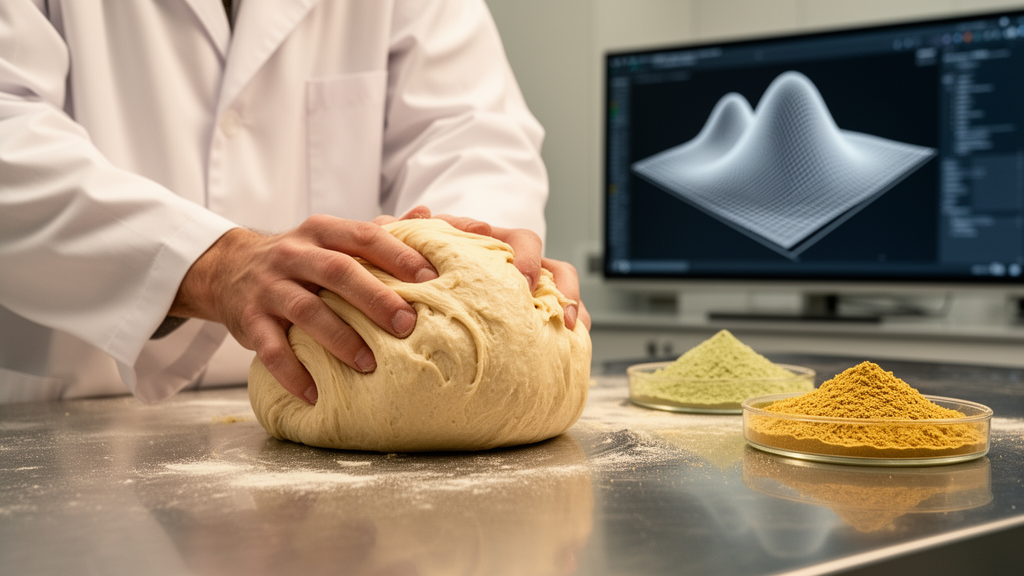
Researchers have developed a machine learning framework capable of predicting the mechanical properties of wheat flour dough fortified with various dietary proteins. By combining regression and classification models, the team provides a systematic method for screening composite doughs, moving beyond traditional trial-and-error approaches to offer data-driven guidance for food formulation.
The study addresses a critical gap in food science, where the addition of dietary proteins to bakery products can significantly alter processability. While protein fortification is increasingly popular for health benefits, it disrupts the native gluten network formed by wheat storage proteins. Exogenous proteins dilute these native components and compete for water, leading to steric hindrance and hydration competition. This molecular-level disruption often results in increased dough brittleness, reduced chewiness, and a loss of textural elasticity, making it difficult to predict final product quality without extensive experimental testing.
To construct a robust predictor matrix, the researchers engineered 432 dough samples using a structured, orthogonal combinatorial framework. The dataset was partitioned into three functional cohorts: 12 protein-free controls, 224 mono-protein formulations, and 196 dual-protein blends. The design incorporated eight different protein sources, including pea, soy, egg white, casein, whey, gluten, chickpea, and a pea-quinoa mixture. Substitution levels varied, with individual protein ceilings ranging from 20.0% for whey to 61.1% for soy, while combined binary-protein substitution reached up to 70.6%. Water addition was empirically adjusted for each formulation to ensure proper handling properties, resulting in water-to-flour ratios ranging from 0.55 to 1.59.
The mechanical behavior of these formulations was profiled using standardized instrumental protocols. Dynamic oscillatory rheology was measured at 25°C using a stress-controlled rotational rheometer, capturing 12 variables including storage modulus, loss modulus, loss tangent, and complex viscosity across low, medium, and high frequency regions. Concurrently, texture profile analysis was performed using a texture analyzer to measure seven parameters: hardness, adhesiveness, springiness, cohesiveness, gumminess, chewiness, and resilience. These 19 mechanical properties served as the target variables for the predictive models, allowing for a comprehensive assessment of both viscoelastic and textural responses.
For regression analysis, five candidate models were employed to predict each mechanical property as a continuous variable: Ridge regression, support vector regression with a radial basis function kernel, random forest, extra trees, and histogram-based gradient boosting. Ridge regression achieved the highest average predictive performance across the 19 properties, particularly for rheological measures. It achieved the highest R² for storage modulus and complex viscosity across all frequency regions. However, model performance was property-dependent; Extra Trees achieved the highest R² for tan(δ) at medium frequency, reaching 0.865, while support vector regression performed best for loss modulus at high frequency. Predictive performance generally decreased from low to high frequency for storage and loss moduli, but increased for tan(δ).
In contrast, predictive performance was considerably lower for several textural properties. Adhesiveness, springiness, and cohesiveness showed relatively low R² values across all models, with springiness peaking at only 0.278. This difficulty in prediction may reflect the complex mechanical responses captured by large-deformation compression testing, which are influenced by factors beyond formulation composition, such as structural heterogeneity. Resilience was an exception to this trend, with R² values ranging from 0.697 to 0.778, indicating that it remained more predictable than other texture attributes. Nonlinear models, such as Extra Trees and support vector regression, achieved higher R² values for specific attributes like cohesiveness and gumminess, suggesting complex formulation-property relationships.
Permutation importance analysis revealed marked differences in how individual ingredients contributed to the models’ predictive capacity. Soy protein was identified as the most dominant predictive feature, exhibiting an importance score substantially higher than any other formulation component. This prominence may reflect formulation changes such as gluten dilution and hydration competition. Bread flour and the pea-and-quinoa protein mixture followed with nearly identical importance scores, indicating comparable overall predictive relevance. Pea protein ranked fourth, followed by gluten and chickpea proteins. Collectively, these top six protein-related ingredients accounted for the vast majority of the total regression importance, while lipid-related ingredients and salt showed minimal predictive relevance.
Classification models were also developed to predict the categorical levels of mechanical properties, discretized into low, medium, and high tertiles. Logistic regression achieved the highest overall predictive performance among the five classification models, consistent with the trend observed in regression. It achieved the highest prediction accuracy for 16 of the 19 mechanical properties, including hardness, gumminess, and resilience. For tan(δ) at high frequency, logistic regression reached a prediction accuracy of 0.893. The strong performance of logistic regression suggests that comparatively simple decision boundaries could capture useful distinctions among categorical mechanical responses for many properties within the tested formulation space.
Sequential ingredient removal was used to evaluate how model performance changed as less important ingredients were progressively excluded. For regression, several texture properties, including hardness, gumminess, chewiness, and resilience, maintained at least 90% of full-model predictive performance until only four ingredients remained. Pea protein was consistently identified as the ingredient whose removal first weakened model performance for these properties. In contrast, rheological properties generally required a larger number of ingredients, with eight to 10 predictors needed to maintain 90% retention. Casein protein was frequently identified as the ingredient triggering weakened performance across storage modulus, loss modulus, and complex viscosity, despite its lower overall importance ranking.
The study acknowledges several limitations, including the restriction to eight conventional protein sources and the lack of external validation across varied wheat crop years or commercial bakery lines. The models were evaluated using internal cross-validation under standardized laboratory conditions. Furthermore, the inherent coupling between hydration demand and protein functionality remains a statistical reality of realistic formulation datasets. The findings demonstrate that while empirical machine learning models do not establish direct biophysical causation, they offer internally validated predictive approximations and valuable screening guidance for multi-component composite dough formulations within the tested formulation space.
The study’s predictive framework relies on an experimental design where categorical factors were strictly balanced, while continuous parameters were set according to physical constraints. Each of the eight dietary proteins appears in exactly 77 formulations, comprising 28 single-protein and 49 binary-protein samples. This uniform distribution ensures that no single protein source dominates the discrete predictor space due to frequency imbalances. The continuous parameters, including protein substitution ceilings, lipid ratios, and salt percentages, were set according to physical constraints from previous work. Because the proteins have markedly different hydration capacities, water addition was adjusted for each formulation to prevent fragmentation or surface stickiness during testing. This adjustment resulted in water-to-flour ratios ranging from 0.55 to 0.71 in protein-free controls to 1.08 to 1.59 in formulations containing casein or concentrated pea and soy blends. The complete baker's percentages for all 432 formulations are provided in Supplementary Table 1.
Feature importance analysis distinguishes between the overall predictive relevance of ingredients and their specific effects on individual properties. In the regression models, soy protein exhibited the highest importance score, followed by bread flour and the pea-and-quinoa mixture, which had nearly identical scores. These similar scores indicate comparable overall predictive relevance rather than equivalent functional effects. Bread flour provides the wheat matrix, while the pea-and-quinoa mixture introduces additional protein ingredients that alter matrix composition and hydration. Because the mixture was treated as a single variable, its importance cannot be attributed separately to pea and quinoa or interpreted as evidence of synergism. The lower rankings of gluten and chickpea relative to soy and pea indicate that predictive importance varied among the tested protein ingredients, rather than being determined solely by their inclusion as protein sources.
The classification models revealed a feature hierarchy broadly consistent with the regression findings, with soy protein, the pea-and-quinoa mixture, and bread flour as the top predictors. However, casein protein ranked sixth in classification, displaying a notably higher predictive weight than in regression. This discrepancy suggests that casein’s limited networking-forming capacity is statistically associated with gluten network disruption in a threshold-dependent manner, which classification algorithms capture more readily than continuous regression frameworks. Conversely, chickpea protein displayed negligible predictive utility in the classification model, despite a more substantial statistical association in regression. These model-dependent exceptions highlight that the relative contribution of ingredients can vary depending on whether the outcome is modeled as a continuous variable or a categorical class. Lipid-related ingredients and salt consistently showed minimal importance across both tasks, reinforcing the prominence of protein-related variables.
The sensitivity of model performance to sequential ingredient removal reveals property-specific dependencies on the predictor set. For regression, rheological properties generally required eight to 10 ingredients to maintain at least 90% of full-model predictive performance, whereas several texture properties could be predicted with reasonable robustness using a smaller subset. Casein protein was frequently identified as the ingredient triggering weakened performance across storage modulus, loss modulus, and complex viscosity. This recurring pattern indicates that casein provided useful predictive information once other variables had been excluded, despite its relatively low overall importance. In contrast, for classification, chewiness required as few as two predictors to preserve unchanged performance, indicating that its classification was particularly robust to predictor removal. Adhesiveness and gumminess required three predictors, while hardness, cohesiveness, and resilience required five. Springiness showed greater sensitivity, requiring four predictors to maintain unchanged performance and showing the lowest single-predictor retention among all texture properties.
The study’s limitations include the restriction to eight conventional plant and animal-derived protein isolates or concentrates. The predictive relationships identified may not directly extrapolate to novel alternative proteins, such as those from precision fermentation, fungi, or insects, or to non-traditional processing matrices like gluten-free systems without recalibrating the feature space. The models were evaluated using internal cross-validation under standardized laboratory conditions with a single wheat flour cultivar. The absence of external validation across varied wheat crop years, commercial flour blends, or diverse mixing equipment represents a clear boundary. The findings offer internally validated predictive approximations and valuable screening guidance for multi-component composite dough formulations within the tested formulation space, but they do not establish direct biophysical causation or provide precise processing control.
Subject of Research: Machine learning prediction of wheat dough mechanical properties
Article Title: Quantitative and Qualitative Control of Wheat Flour Dough's Mechanical Properties via Dietary Protein Addition
Article References: An, J., Jones, O., Simsek, S., Whitney, K., Hamaker, B., & Yao, Y. (2026). Quantitative and Qualitative Control of Wheat Flour Dough's Mechanical Properties via Dietary Protein Addition. Food Science & Nutrition, 14(11), Article e72564. https://doi.org/10.1002/fsn3.72564
Image Credits: AI Generated
DOI: 10.1002/fsn3.72564
Keywords: wheat dough, machine learning, protein fortification, rheology, texture analysis, food formulation, predictive modeling, bakery products, Quantitative, Qualitative, Control, Wheat
News Source: Teresa Odom. (November 10, 2026). Machine Learning Predicts Dough Texture from Protein Blends. Scienmag.