Researchers have introduced a unified, multiscale machine learning framework designed to predict performance and optimize material formulations for basalt fiber reinforced concrete exposed to harsh environmental stressors. Basalt fiber reinforced concrete has drawn growing interest in civil engineering due to its potential for enhancing chemical resistance, mechanical durability, and overall structural strength under challenging ambient conditions. However, accurate long-term performance forecasting and proactive mixture design have historically faced significant hurdles stemming from intricate, multiscale interactions among embedded fibers, the cementitious matrix, and destructive environmental factors.
To address these compounding predictive challenges, the investigators integrated five analytical models into a single operational machine learning pipeline. The core predictive engine utilizes a physics-augmented graph attention transformer network known as P-GATNet. This computational architecture incorporates interfacial physics directly into graph-based message passing routines to capture load-driven structural responses. Through this physics-informed modeling approach, the network achieves high precision in estimating mechanical strength and fracture progression, demonstrating a predictive coefficient of determination of approximately 0.97 for flexural properties.
Alongside mechanical stress evaluation, the pipeline incorporates a specialized spectral decomposition assisted degradation model dedicated to monitoring durability in aggressive chemical exposures. This component employs Hilbert-Huang-based spectral analysis to decouple distinct physical degradation mechanisms from one another. By isolating these individual degradation pathways, the analytical model forecasts damage kinetics and alkali resistance in harsh settings with a reported error rate below 4.5 percent.
The framework also integrates targeted optimization routines to balance inherently competing structural requirements. Using an algorithm termed the multi-agent physics reinforcement optimizer, or MAPRO, the system models rivaling failure modes via cooperative computational agents. This multi-agent approach allows the optimization tool to refine concrete performance by simultaneously balancing mechanical strength requirements against environmental durability and chemical degradation constraints.
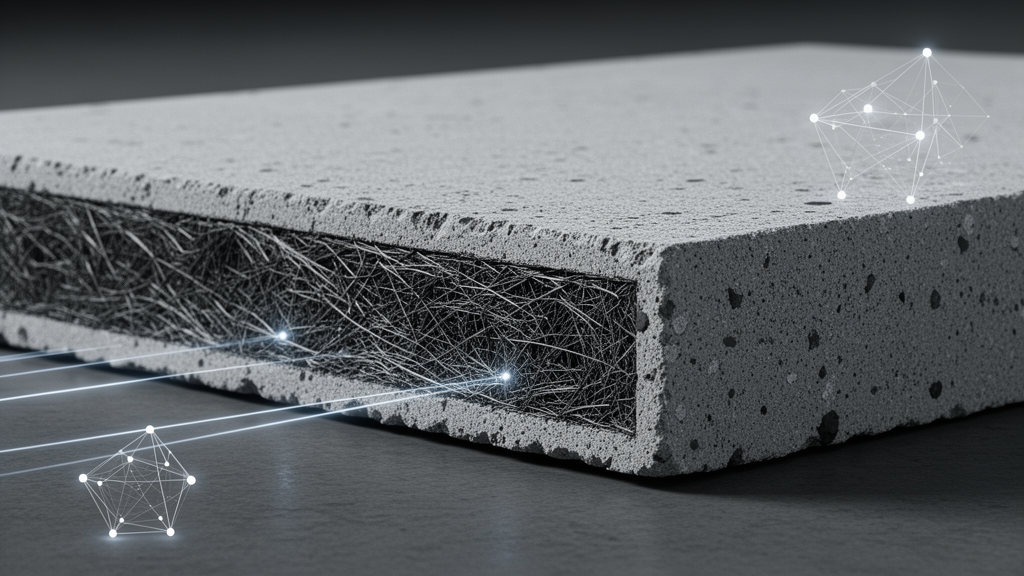
To bolster model interpretability and improve foundational feature representation, the research team implemented a deep morphological encoder equipped with multi-modal fusion, abbreviated as DME-MMF. This analytical unit combines image-derived morphological embeddings with tabular experimental measurements, ensuring that internal microstructural geometry informatively augments traditional macroscopic engineering data throughout downstream predictions.
Finally, the framework facilitates reverse engineering of target materials through a transformer-based inverse composite generator. Rather than relying solely on forward performance estimation, this generator enables reverse material design by proposing concrete mix proportions engineered to satisfy specified durability and strength thresholds. In validation tests, the inverse generator synthesized feasible basalt fiber reinforced concrete mixtures meeting predetermined engineering targets with an approximate success rate of 93 percent, marking a substantial advance in computational material design.
By uniting these analytical models into a single predictive-optimization pipeline, the framework resolves long-standing difficulties arising from multiscale interactions between fibers, matrix, and environmental stressors. Rather than evaluating degradation mechanisms or mechanical responses in isolation, the integrated system connects load-driven structural behavior directly with chemical resistance. This comprehensive synthesis enables accurate long-term performance forecasting and systematic optimization for basalt fiber reinforced concrete subjected to severe environmental exposures.
Furthermore, coupling forward prediction with reverse material design establishes an effective strategy for composite development. By combining morphological embeddings with experimental tabular data and cooperative agents, the pipeline preserves high interpretability while modeling competing failure mechanisms. Producing feasible formulations that meet predetermined strength and durability targets ultimately improves predictive fidelity, interpretability, and design for basalt fiber reinforced concrete under harsh environmental conditions.
Subject of Research: Machine learning framework for basalt fiber reinforced concrete modeling and design
Article Title: Predictive modeling and design optimization of concrete properties reinforced with basalt fiber under harsh environment
Article References: Vairagade, V. S. (2026). Predictive modeling and design optimization of concrete properties reinforced with basalt fiber under harsh environment. Journal of Materials Science: Materials in Engineering, 21(1), Article 203. https://doi.org/10.1186/s40712-026-00583-x
Image Credits: AI Generated
DOI: 10.1186/s40712-026-00583-x
Keywords: basalt fiber reinforced concrete, machine learning, physics-augmented graph attention transformer network, predictive modeling, material design optimization, P-GATNet, spectral decomposition, Hilbert-Huang transform, MAPRO, multi-agent reinforcement learning, deep morphological encoder, multi-modal fusion, inverse composite generator, concrete durability, alkali resistance, fracture evolution
News Source: Teresa Odom. (November 21, 2026). Machine Learning Pipeline Optimizes Basalt Fiber Reinforced Concrete for Harsh Environments. Scienmag.