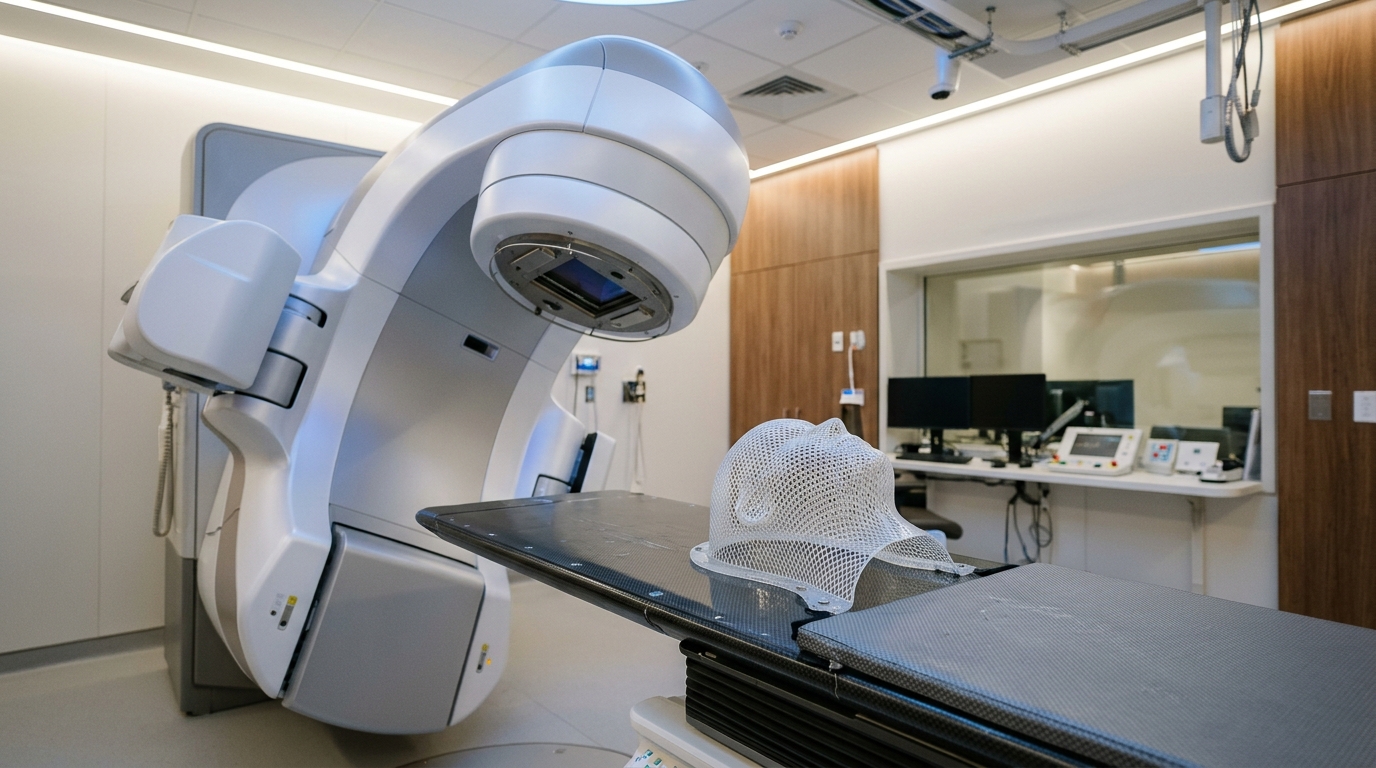
A machine learning model built before treatment can predict which individual brain metastases will fail to respond to Gamma Knife radiosurgery, and can estimate when that failure will occur, according to a study published in the Journal of Neuro-Oncology. The model, a Random Survival Forest, was trained and internally validated on lesions from patients with melanoma and renal cell carcinoma, two cancer types whose brain metastases are known to be relatively resistant to radiation.
Local control after Gamma Knife radiosurgery remains variable for these radioresistant tumors, and clinicians have had limited tools for predicting, before treatment, whether a specific lesion will fail locally and how quickly. The research team, led by Jheremy S. Reyes and colleagues at the University of Pittsburgh, addressed this gap by modeling local failure as a right-censored survival outcome, meaning the analysis accounted for lesions that had not yet failed by the end of follow-up as well as those that had.
The study was retrospective and conducted at a single center. It included 893 brain metastases from melanoma and renal cell carcinoma patients treated with Gamma Knife radiosurgery. Of these lesions, 228, or 25.5 percent, developed local failure during follow-up. The individual lesion served as the unit of prediction, while the data were partitioned at the patient level to minimize information leakage between the training and testing sets, a design choice that prevents information from the same patient inflating performance estimates.
The Random Survival Forest was trained exclusively on variables available before treatment, including baseline demographic, clinical, and tumor-level characteristics. No post-treatment information entered the model, which is what makes it a genuinely pre-treatment prediction tool. Survival forests are ensemble methods that grow many decision trees on bootstrap samples of the data and aggregate their risk estimates, allowing them to capture nonlinear relationships and interactions among predictors without requiring the analyst to specify those relationships in advance.
Performance was assessed with three complementary metrics. The concordance index measures how well the model ranks pairs of lesions by their relative risk of failure. Cumulative and dynamic area under the receiver operating characteristic curve values capture time-dependent discrimination, that is, how well the model separates lesions that fail by a given time point from those that do not. The Brier score combines discrimination with calibration, penalizing both incorrect rankings and predicted probabilities that stray from observed event rates. All three were computed with patient-grouped five-fold internal cross-validation, meaning each fold held out entire patients rather than individual lesions.
In the holdout test set of 179 lesions, the model achieved a concordance index of 0.842. Dynamic AUC values were 0.904 at six months, 0.890 at twelve months, and 0.851 at twenty-four months, with corresponding Brier scores of 0.130, 0.153, and 0.152. Cross-validation confirmed stable performance, with a mean concordance index of 0.882 across folds. These figures indicate strong internal discrimination, particularly in the first year after treatment, though the modest rise in Brier scores at later time points reflects the growing difficulty of accurate probability estimation further from the treatment date.
The strongest predictors of local failure and its timing were age at treatment, pre-treatment Karnofsky Performance Status, and tumor volume. Age and performance status capture aspects of overall patient condition and biology that appear to influence how individual lesions respond to radiosurgery, while tumor volume has long been recognized as a key determinant of local control, with larger lesions generally harder to control permanently with a single radiosurgical dose.
The authors conclude that pre-treatment Random Survival Forest modeling demonstrated strong internal performance for predicting local failure and time to local failure after Gamma Knife radiosurgery in radioresistant brain metastases. They suggest this supports the model’s potential for individualized risk stratification and follow-up planning, potentially allowing clinicians to tailor surveillance intensity for lesions flagged as high risk before any radiation is delivered.
Several limitations deserve emphasis. The study was retrospective and performed at a single center, and the model was internally validated only, meaning its performance has not yet been tested on patients from other institutions or on prospectively collected data. The cohort was restricted to melanoma and renal cell carcinoma metastases, so extension to other histologies remains untested. External validation and prospective evaluation would be needed before such a model could inform routine clinical decisions. The findings, published online on 2 November 2026, represent an early but methodologically careful step toward lesion-level, pre-treatment risk prediction in radiosurgery for tumors that have historically been difficult to control with radiation alone.
Subject of Research: Machine learning prediction of local failure and time to local failure after Gamma Knife radiosurgery for radioresistant brain metastases
Article Title: Pre-treatment machine learning prediction of local failure and time to local failure after Gamma Knife radiosurgery for radioresistant brain metastases
Article References: Reyes, J. S., Shohayeb, M. A. M., Bouras, A., Lunsford, L. D., Hadjipanayis, C. G., & Niranjan, A. (2026). Pre-treatment machine learning prediction of local failure and time to local failure after Gamma Knife radiosurgery for radioresistant brain metastases. Journal of Neuro-Oncology, 180(2), Article 35. https://doi.org/10.1007/s11060-026-05861-4
Image Credits: AI Generated
DOI: 10.1007/s11060-026-05861-4
Keywords: Gamma Knife radiosurgery, brain metastases, machine learning, Random Survival Forest, melanoma, renal cell carcinoma, local failure, risk stratification, survival analysis, radioresistance, concordance index, internal validation
News Source: Nathaniel Bowman. (November 7, 2026). Machine learning model predicts local failure timing after radiosurgery for radioresistant brain metastases. Scienmag.