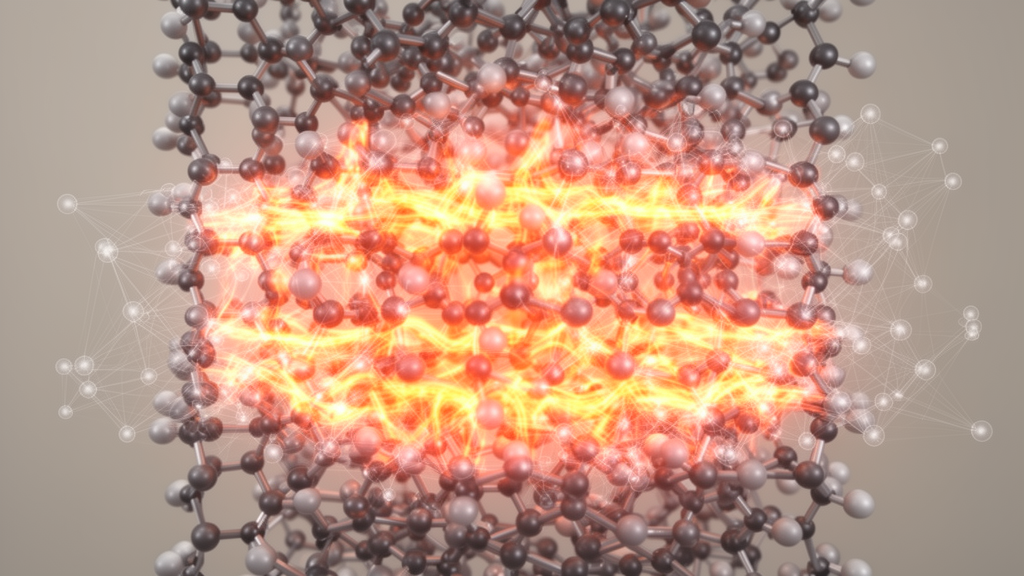
Computational materials physicists are deploying artificial intelligence architectures to bypass conventional modeling bottlenecks and predict crystalline materials exhibiting unprecedented extremes of lattice thermal conductivity, according to a Perspective published in the Journal of Materials Science: Materials Theory. The synthesis and management of heat in modern solid-state devices fundamentally depend on lattice thermal conductivity, denoted as κL, which quantifies the propagation of phonons, or quantized collective vibrations, through a crystal lattice. Historically, the search for thermal materials has been governed by empirical formulations such as the Slack equation or Keyes model, alongside labor-intensive density functional theory calculations. These conventional first-principles approaches require solving the linearized Peierls–Boltzmann transport equation, an endeavor that demands calculating second- and third-order interatomic force constants across dozens or hundreds of symmetry-inequivalent displaced supercells. Because a single thermal conductivity computation can consume between 1,000 and 10,000 CPU hours, first-principles workflows have historically been unable to screen more than several hundred compounds out of millions of potential crystal configurations.
To overcome this computational barrier, researchers have established a multi-tiered pipeline that integrates universal machine learning interatomic potentials, crystal graph neural networks, and generative inverse-design models. In rigorous benchmarking evaluations spanning 2,429 crystalline materials, universal interatomic potentials demonstrated the capacity to calculate interatomic force constants at speeds orders of magnitude faster than conventional methods. Crucially, the evaluations revealed that atomic force accuracy alone is an insufficient proxy for reliable phonon transport calculations. Certain models achieve low root-mean-square error on atomic forces yet fail to accurately capture the potential energy surface curvature that governs the higher-order anharmonic force constants responsible for three-phonon scattering rates. Among the tested architectures, a fine-tuned EquiformerV2 model achieved a mean absolute error of 0.347 log(Wm−1 K−1) in predicting lattice thermal conductivity across thousands of chemically diverse structures, benefiting from equivariant transformer operations that preserve geometric tensorial symmetries.
Complementing potential-energy modeling, deep-learning screening frameworks now evaluate crystal structures directly without requiring explicit atomic force evaluations or Boltzmann equation integrations. Researchers constructed the Crystal Attention Graph Neural Network, known as CATGNN, which incorporates electronic bonding descriptors derived from Crystal Orbital Hamilton Population analysis and Crystal Orbital Bond Index theory. The normalized negative integrated Crystal Orbital Hamilton Population, or −ICOHP, alongside the integrated Crystal Orbital Bond Index, or ICOBI, quantify the quantum-mechanical character of chemical bonding. High values correspond to strong, directional covalent bonds and small mean-squared atomic displacements, producing elevated phonon group velocities and extended phonon lifetimes. Conversely, low values denote weakly bonded environments vulnerable to rattling modes—localized, low-frequency anharmonic oscillations that scatter acoustic phonons. Applied across roughly 200,000 crystal candidates, CATGNN identified 106 dynamically stable compounds with ultralow lattice thermal conductivities below 5 Wm−1 K−1, including 68 percent below 2 Wm−1 K−1, alongside 13 compounds exceeding 100 Wm−1 K−1.
The power of active-learning potential construction is demonstrated in the double perovskite crystal family, where an active-learning framework named Elemental-SDNNFF screened 9,709 cubic double perovskite configurations to identify 1,597 dynamically stable structures. Among these, the halide double perovskite Cs2HgPtCl6 emerged as an extraordinary computational outlier, exhibiting a predicted room-temperature lattice thermal conductivity of 0.071 Wm−1 K−1. This predicted value is comparable to the thermal conductivity of still air, approximately 0.025 Wm−1 K−1, representing the lowest isotropic bulk value computationally reported. Physical analyses show that this extreme insulation stems from asymmetric coordination around divalent mercury cations, which function as intrinsic quasi-rattlers that scatter acoustic phonon modes across wide vibrational frequencies. Furthermore, because traditional Boltzmann equations fail to track off-diagonal heat current tunneling between nearly degenerate phonon branches, researchers utilized the Wigner transport equation, establishing that quantum wave-like coherence contributes approximately 35 percent of the total room-temperature heat transport in Cs2HgPtCl6.
At the opposite physical extreme, machine-learning exploration has identified metallic thermal conductors capable of surpassing copper and silver, which have long defined the metallic conductivity ceiling at roughly 400 Wm−1 K−1. Computational investigations identified theta-phase tantalum nitride, or θ-TaN, as an exceptional conductor with a predicted room-temperature lattice thermal conductivity of approximately 1,100 Wm−1 K−1. This elevated transport arises from an unusually large acoustic-optical phonon frequency gap that eliminates the dominant three-phonon scattering channels, combined with phonon branch bunching that focuses heat flux into a concentrated, high-velocity acoustic manifold. Subsequent epitaxial synthesis of defect-free single crystals validated the computational prediction within 10 percent using time-domain thermoreflectance and synchrotron inelastic X-ray scattering measurements. Ultrafast spectroscopy further confirmed exceptionally weak electron–phonon coupling, a necessary prerequisite for suppressing carrier-mediated phonon scattering and allowing lattice conduction to dominate heat transport within a metal.
Because high-throughput screening remains confined to known crystal repositories containing only 200,000 to 400,000 stable materials, investigators have turned to generative inverse design to explore unmapped chemical space. Generative models have progressed from early adversarial formulations such as MatGAN to the Physics-Guided Crystal Generative Model, which directly incorporates space group symmetry operators and interatomic distance penalty losses, increasing chemically plausible structure outputs by over 700 percent. The diffusion-based framework InvDesFlow-AL integrates denoising diffusion probabilistic models with active learning loops to reverse noise perturbations over atomic species, coordinates, and lattice vectors simultaneously. On structural prediction benchmarks, InvDesFlow-AL achieved a coordinate root-mean-square error of 0.0423 angstroms and a 38.4 percent dynamical stability rate, substantially exceeding language-model generators such as CrystaLLM. In parallel, generative diffusion pipelines applied to carbon allotropes yielded 34 polymorphs with predicted conductivities exceeding 800 Wm−1 K−1, reaching up to 2,400 Wm−1 K−1 for non-diamond carbon structures.
Despite these computational successes, critical theoretical and physical limitations bound current machine-learning methodologies. Both Boltzmann transport and Wigner formalisms assume atoms vibrate around well-defined equilibrium lattice sites, an assumption that breaks down completely in superionic conductors or near order-disorder phase transitions where ions exhibit diffusive motion. In such regimes, temperature-dependent effective potentials or molecular dynamics simulations are required. However, classical molecular dynamics driven by machine-learning potentials relies on classical Maxwell–Boltzmann statistics rather than quantum Bose–Einstein distributions, omitting zero-point motion and rendering cryogenic predictions below the Debye temperature unreliable. Moreover, computational dynamical and thermodynamic stability do not guarantee experimental synthesizability; unfavorable reaction kinetics, competitive metastable phases, and synthetic route absences frequently prevent laboratory realization of computationally stable proposals.
A profound operational hurdle confronting artificial intelligence in materials science is the out-of-distribution generalization gap. Existing databases are heavily biased toward binary and ternary materials in high-symmetry space groups where density functional theory is tractable. Benchmarks evaluating graph neural networks under leave-one-cluster-out and extreme outlier holdout conditions revealed that model error rates escalate by factors of two to five when predicting unfamiliar chemistries. To counteract this vulnerability, algorithms such as Crystal Adversarial Learning perturb training structures to generate hard negative examples, encouraging neural networks to construct robust latent representations that reduce out-of-distribution error. Simultaneously, symbolic regression combined with sensitivity analysis has succeeded in extracting closed-form algebraic expressions relating thermal conductivity to bulk modulus, acoustic velocity, and vibrational free energy, providing interpretable physical formulas that bypass opaque black-box neural networks.
At the device level, heat dissipation across internal boundaries represents a primary thermal bottleneck, particularly in high-electron-mobility transistors fabricated from wide-bandgap semiconductors such as gallium nitride, aluminum nitride, and beta-gallium oxide. Deep convolutional neural networks integrated with Orbital Field Matrix representations have screened tens of thousands of substrate interfaces, identifying mean atomic number, atomic weight, and ground-state atomic volume as the primary descriptors governing interfacial thermal conductance. This screening revealed that pairing beta-gallium oxide with substrates such as yttrium nitride or magnesium oxide yields interfacial thermal conductances up to 1,224 MWm−2 K−1, rivaling the benchmark gallium nitride on diamond interface used in radio-frequency electronics.
Looking toward 2030, researchers have outlined four key developmental milestones for artificial intelligence in phonon engineering: achieving routine sub-hour calculation of comprehensive phonon properties across arbitrary inorganic crystals; establishing scalable machine-learning models for electron–phonon coupling interactions using unified representations like Heterogeneous Edge Networks; experimentally synthesizing an artificial-intelligence-designed crystal exhibiting thermal conductivity near air or above 2,000 Wm−1 K−1 in non-diamond phases; and realizing fully autonomous self-driving laboratories. By coordinating generative algorithms, robotic synthesis platforms, and inline thermoreflectance characterization into automated closed loops, the scientific community aims to compress multi-year materials development cycles into rapid, multi-day experimental campaigns.
Subject of Research: Artificial intelligence applications in phonon engineering and extreme thermal materials discovery
Article Title: Artificial intelligence and the frontier of phonon engineering: a perspective on discovering extreme thermal materials
Article References: Hu, M. (2026). Artificial intelligence and the frontier of phonon engineering: a perspective on discovering extreme thermal materials. Journal of Materials Science: Materials Theory, 10(1), Article 13. https://doi.org/10.1186/s41313-026-00083-7
Image Credits: AI Generated
DOI: 10.1186/s41313-026-00083-7
Keywords: phonon engineering, lattice thermal conductivity, machine learning interatomic potentials, crystal graph neural networks, generative inverse design, Boltzmann transport equation, double perovskites, tantalum nitride, thermal insulation, heat dissipation, electron-phonon coupling, interfacial thermal conductance, self-driving laboratories, out-of-distribution generalization, computational materials science, EquiformerV2, Wigner transport equation
News Source: Blake Davidson. (November 20, 2026). Machine Learning Frameworks Accelerate Discovery of Extreme Thermal Transport Materials. Scienmag.