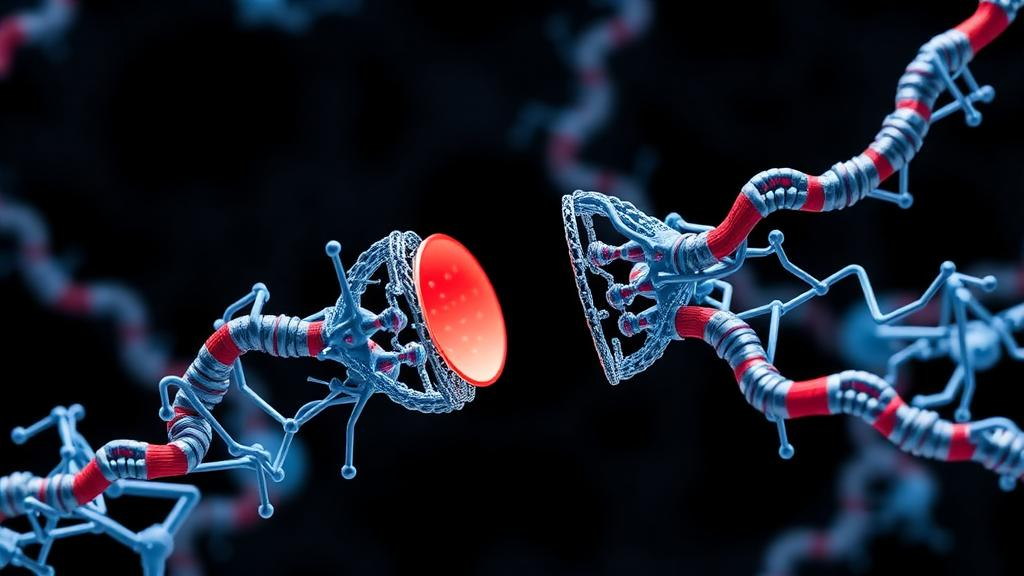
Deep inside every synapse in the brain, a molecular gate decides when calcium floods into a neuron. That gate belongs to the N-methyl-D-aspartate receptor, or NMDAR, a ligand-gated ion channel that underlies synaptic plasticity, learning, and memory. Despite decades of crystallography and cryo-electron microscopy, the receptor’s fully open, active state has never been resolved at atomic resolution, leaving a stubborn gap between what structural biologists can photograph and what the channel actually does in the moment it conducts ions. A new computational study from the State University of New York at Buffalo, published in Frontiers in Chemical Biology, has now used 5.6 microseconds of molecular dynamics simulation and machine learning to map, residue by residue, how this gate flickers open and closed.
The NMDA receptor is a heterotetramer, typically assembled from two GluN1 and two GluN2A subunits, and it demands two co-agonists before it will open: glycine binds GluN1, glutamate binds GluN2A, and the magnesium block must be relieved. Once activated, the receptor undergoes a cascade of conformational changes that dilate a central pore, allowing calcium and sodium to pour into the cell. Because mutations in this receptor are linked to Alzheimer’s disease, depression, stroke, epilepsy, and schizophrenia, understanding the open state is not merely an academic exercise; it is a prerequisite for rational drug design. Yet the open state is transient, heterogeneous, and notoriously difficult to capture experimentally, which is precisely why the Buffalo team, led by Wenjun Zheng with first author Xing Liu, turned to simulation.
The researchers built a truncated model of the GluN1/GluN2A receptor containing only the ligand-binding domains and the transmembrane domain, the two layers that carry the essential channel-gating machinery. They started from a crystal structure of an allosterically inhibited GluN1/GluN2B receptor, generated a homology model for the rat GluN1 and GluN2A sequences using SWISS-MODEL, embedded the truncated receptor in a POPC lipid bilayer with CHARMM-GUI, and then drove it toward an active-like conformation with targeted molecular dynamics, using an active-state ligand-binding domain structure derived from a cryo-EM map as the target. Once there, they held the ligand-binding domains in their active conformation with positional restraints and let the transmembrane domain move freely across seven independent 800-nanosecond trajectories at 30 degrees Celsius.
The resulting ensemble revealed something striking: the channel pore is not a static tunnel but a violently fluctuating one. Analysis with the HOLE program showed the minimal pore radius swinging between 0 and 2.8 angstroms across the simulation frames. Using established criteria for ion-channel conductance, the team estimated that 55 percent of frames were water permeable, 35 percent partially ion-conducting, and less than 1 percent fully open. The authors interpret these rapid pore-radius fluctuations as a dynamic feature of the transmembrane domain in the active-like state, distinct from the much slower transitions between fully open and closed functional states. In other words, even when the receptor is nominally active, its gate breathes.
Zooming in on individual residues, the team calculated root mean square fluctuations across the ensemble and found pronounced flexibility in the S1-M1 linker, the M1-M2 loop, the M2-M3 loop, the M3-S2 linker, the S2-M4 linker, and the C-terminus of the M4 helix. Crucially, the two subunit types behaved differently. GluN1 showed higher flexibility in the S1-M1, M3-S2, and S2-M4 linkers, while GluN2A was more mobile in M1 and the M2-M3 loop. At the two proposed gates, the upper gate at the bundle crossing of the M3 helices and the lower gate at the apex of the M2 pore loops, the fluctuations were moderate but subtly asymmetric between subunits, hinting that GluN1 and GluN2A play distinct roles in controlling channel opening and closing.
Principal component analysis of the combined trajectories identified ten dominant modes of collective motion that together account for 83 percent of the structural variation. Three of these modes correlated significantly with pore radius, and all three showed subunit-dependent amplitudes, with GluN2A moving more vigorously near the lower gate while the two subunits moved similarly near the upper gate. The analysis also highlighted the M1-M2 loop, a region so flexible that it is often missing from experimentally solved structures, as a hub of collective motion. These findings reinforce a growing consensus that the NMDA receptor’s active state is not a single conformation but an ensemble of rapidly interconverting sub-states.
To connect motion to mechanism, the researchers catalogued every hydrogen bond and van der Waals contact between residue pairs across all 5,600 simulation frames and computed Pearson correlations between each interaction and the minimal pore radius. Interactions with correlations above 0.3 or below negative 0.3 were flagged as potentially favoring opening or closing, respectively. The analysis yielded five hydrogen-bonded pairs that appear to stabilize the open pore, including a cross-subunit contact between GluN1 M4 and the GluN2A M2-M3 loop, and fifteen pairs that appear to favor closure, many clustered in the flexible linkers that transmit force from the ligand-binding domains down to the pore. In total, 35 key residues emerged from the hydrogen-bond analysis, 33 of them evolutionarily conserved and 11 known sites of disease mutations recorded in ClinVar and HGMD.
The van der Waals analysis painted an even denser picture, identifying 144 residues whose nonpolar contacts correlate with pore dynamics, 125 of them conserved and 49 linked to disease. Because so many transmembrane residues are conserved and therefore plausibly functional, the correlation-based approach produced a long list of candidates that was too diffuse to guide experiments efficiently. To sharpen the predictions, the team turned to machine learning. They trained a random forest regressor to predict the minimal pore radius from pairwise interaction energies and hydrogen-bond occupancies, then used SHAP values, an explainable-AI technique borrowed from cooperative game theory, to rank the importance of every interaction. The result was a much sparser list: just 32 residues in the top 10 percent of importance, 29 of them conserved and 19 carrying disease mutations, an enrichment from under 25 percent to roughly 60 percent compared with the correlation analysis.
Notably, twelve of those 32 machine-learning hits had not been flagged by the Pearson correlation analysis at all, suggesting that nonlinear relationships between residue contacts and pore geometry exist that simple linear statistics miss. The machine-learning model, however, came with an honest caveat: it learned a trajectory-specific relationship that failed to generalize across independently sampled trajectories, meaning the model captured local statistical structure rather than a universal physical law. The authors are candid about this limitation, as well as about the artifacts that truncating the amino-terminal domain and restraining the ligand-binding domains may introduce, and they call for larger-scale simulations of the full-length receptor as computational hardware improves.
The study’s most actionable contribution may be its bridge to medicine. By annotating predicted gating residues with evolutionary conservation grades and known pathogenic mutations, the work offers a concrete, testable hypothesis: that disease-associated variants in the S1-M1 linker, the M2-M3 loop, and the M4 helix disrupt channel gating by perturbing the transient network of polar and nonpolar interactions that stabilizes the open pore. A recent functional study independently showed that the S1-M1 linker critically controls channel opening, lending weight to this framework. The next step, the authors suggest, is to simulate specific disease mutations to determine whether they produce gain-of-function or loss-of-function phenotypes, turning a 5.6-microsecond computational experiment into a roadmap for understanding, and eventually treating, the neurological disorders that arise when this molecular gate malfunctions.
Subject of Research: Molecular dynamics simulation and machine learning analysis of the active-like state of the GluN1/GluN2A NMDA receptor channel
Article Title: Molecular dynamics simulation of the truncated NMDA receptor in a partially restrained active-like state
Article References: Liu, X., & Zheng, W. (2026). Molecular dynamics simulation of the truncated NMDA receptor in a partially restrained active-like state. Frontiers in Chemical Biology, 5, Article 1894245. https://doi.org/10.3389/fchbi.2026.1894245
Image Credits: AI Generated
DOI: 10.3389/fchbi.2026.1894245
Keywords: NMDA receptor, molecular dynamics, GluN1, GluN2A, ion channel gating, machine learning, random forest, SHAP, hydrogen bonds, van der Waals interactions, synaptic plasticity, disease mutations
News Source: Drew Townsend. (October 16, 2026). Machine Learning and Molecular Dynamics Reveal How the NMDA Receptor’s Channel Flickers Between Open and Closed. Scienmag.