Civil engineering researchers have demonstrated that supervised machine learning algorithms and genetic symbolic regression can accurately predict the ultimate moment capacity and structural failure modes of long-bolted hollow structural section connections used in modular steel construction. Developed to support rapid and durable building solutions for housing shortages in Canada, particularly across northern and remote communities where harsh climatic conditions and severe transportation constraints complicate traditional construction, the study leverages advanced computational modeling to address the structural behavior of two-dimensional panelized systems. By replacing conventional time-consuming numerical analyses with trained predictive algorithms, the investigation establishes a data-driven framework capable of evaluating cold-formed steel beam-to-column connections under monotonic loading. The researchers integrated nonlinear finite element simulations, ensemble decision trees, multilayer feedforward neural networks, and evolutionary symbolic regression to create practical analytical tools that determine both the load-carrying limits and complex failure mechanisms of modular steel joints without requiring computationally exhaustive individual simulations.
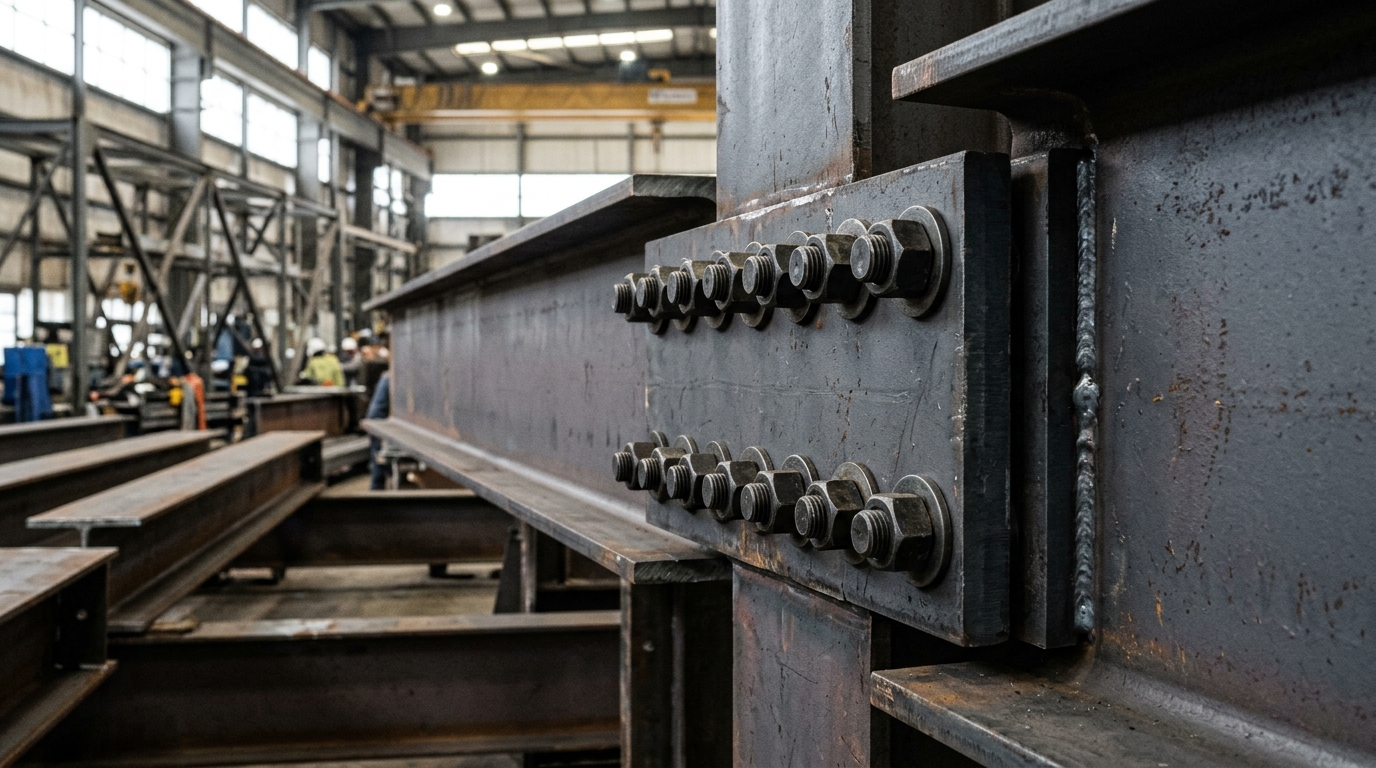
The structural assembly under investigation utilizes cold-formed steel hollow structural sections connected through an innovative detailing strategy that incorporates high-strength long bolts passing through extended steel plates. In modular panelized construction, beam-to-column joints must transfer substantial moments and resist extreme environmental actions, such as lateral wind and seismic events, while remaining simple enough to permit rapid assembly on-site. To evaluate the mechanical behavior of this joint under physical testing conditions, the research team referenced laboratory experiments involving full-scale specimens loaded via a rigid bracket plate measuring 340 millimeters by 170 millimeters. Monotonic load was applied with a lever arm measuring 1,080 millimeters from the face of the column, allowing researchers to record moment-rotation curves by multiplying measured forces by the moment arm and calculating connection rotation as the differential displacement between the beam and the column.
To overcome the economic and physical constraints of testing hundreds of physical specimens, the authors developed a three-dimensional nonlinear finite element model using the explicit and implicit computational mechanics software LS-DYNA. Simulations were executed using high-performance computing clusters managed by the Digital Research Alliance of Canada through SHARCNET, with each numerical simulation requiring an average computational run time of 48 hours and 760 time steps to reach full physical termination. The numerical formulation modeled steel plasticity using the piecewise linear plasticity material formulation, while the geometrical mesh comprised approximately 390,000 eight-node solid elements with reduced integration. The cold-formed steel beam profile was discretized using a four-millimeter element size across seven through-thickness layers, supplemented by inflation layers around bolt holes to accurately resolve local stress gradients. Contact interfaces between steel plates incorporated surface-to-surface mortar formulations with a friction coefficient of 0.3 reflecting sandblasting surface treatment, mortar-tied contact for welded components, and an explicit two-millimeter bolt clearance to capture initial bolt slip during snug tightening, achieving numerical moment-rotation predictions within an average error of 3 percent compared to experimental benchmarks.
Using the experimentally verified finite element modeling procedure, the researchers generated an extensive parametric database comprising 240 unique structural configurations to train, validate, and test their predictive models. The parametric matrix systematically varied four primary geometric design variables: extended plate thickness, bolt count, bolt arrangement pitch ratios, and bolt diameters. Statistical evaluation of the resulting 240-model matrix through Pearson correlation coefficients established that while all four design features possessed nonzero correlations with ultimate moment capacity, none exhibited mutual linear dependence or perfect correlation coefficients of 1.0. This verified the distinct statistical independence of the selected design parameters, confirming that multi-variable computational models were strictly required to capture the intricate physical interactions governing connection strength.
The classification of structural failure modes was conducted using supervised learning techniques to categorize physical failure into six distinct mechanisms observed across the numerical simulations: beam bearing failure, beam block shear, bolt shear, extended plate rupture, column local buckling, and beam local buckling. Traditional decision trees, including fine, medium, and coarse variants, encountered notable difficulties when classifying minority failure mechanisms, repeatedly failing to identify beam bearing and beam block shear failures due to overfitting and an inability to map complex parameter interactions, which capped single-tree classification accuracy near 80 percent. In contrast, ensemble methodologies demonstrated significantly enhanced classification performance across all structural classes. The optimizable bagged tree ensemble emerged as the most accurate classification architecture, achieving an overall accuracy of 95 percent on both validation and testing datasets. This model operated with an optimized learning rate of 0.001 and allowed a maximum of 50 tree splits, providing gradual error reduction that successfully captured less frequent failure modes as verified through comprehensive precision and recall assessments.
For predicting numerical ultimate moment capacity, researchers trained and compared six regression models based on decision trees and ensemble algorithms using five-fold cross-validation across the database, which was split into 70 percent training, 15 percent validation, and 15 percent testing subsets. Model performance was evaluated using the Pearson correlation coefficient, mean absolute error, mean squared error, and root mean squared error. The optimizable ensemble tree model and the fine tree model exhibited the highest predictive precision among the tree-based architectures, both attaining a correlation coefficient of 0.96 across training and testing partitions. The superior performance of the optimizable ensemble model stemmed from its tuned hyperparameter configuration, which utilized a leaf size of 4 to generate precise regional splits, 26 ensemble learners to ensure generalization across data variations, and a learning rate of 0.17 to balance gradient minimization speed against model stability, outperforming standard boosted and bagged regression trees.
To explore alternative machine learning frameworks, the authors formulated a multi-layer perceptron artificial neural network using a two-layer feedforward architecture developed within the MATLAB Neural Network Toolbox. The network received the four geometric joint parameters as inputs and utilized the Levenberg-Marquardt backpropagation algorithm to optimize connection weights and biases across the standard 70 percent training, 15 percent validation, and 15 percent independent testing subsets. Parametric evaluation of hidden layer depth demonstrated that predictive accuracy scaled directly with neuron density up to a specific threshold: a network configured with 3 hidden neurons produced a correlation coefficient of 0.8430 and a root mean squared error of 6.5761, whereas expanding the hidden layer to 10 neurons elevated the correlation coefficient to 0.98026 and reduced the root mean squared error to 2.3967. Adding neurons beyond 10 provided no statistical performance enhancement while unnecessarily complicating the mathematical structure; the optimized 10-neuron network yielded an output bias of negative 1.41620, maintained over 80 percent of all dataset predictions within an error range of 2.903 percent to negative 2.798 percent, and experienced a maximum testing error of negative 11.76 percent across the 36 independent testing specimens.
To overcome the opaque, black-box character of neural networks and complex tree ensembles, the investigators employed genetic algorithm-based symbolic regression via HeuristicLab and Eureqa software to generate transparent, closed-form mathematical equations for design office applications. The symbolic regression search operated without predefined mathematical templates, allowing genetic programming to evolve mathematical operators through 10,000 generations across a population of 1,000 candidate solutions, thereby evaluating approximately 9.9 million potential formula structures. The optimization incorporated a 15 percent mutation probability to prevent premature mathematical convergence, an expression tree depth limit of 15, and a maximum tree length of 30 nodes to restrict algebraic complexity.
Quantitative sensitivity analyses conducted across the machine learning and symbolic regression models revealed the exact hierarchical contribution of individual geometric variables toward total joint moment capacity. The total number of bolts proved to be the single most influential parameter, accounting for 52.08 percent of the relative impact on ultimate capacity. The thickness of the extended plate represented the second most dominant feature, contributing 22.96 percent of the overall influence, while bolt arrangement pitch ratios and bolt diameters accounted for 13.29 percent and 11.67 percent, respectively.
Notwithstanding the high statistical accuracy achieved across the 240 finite element simulations, the researchers identified clear boundaries regarding the operational scope and physical applicability of their models. First, because physical structural testing requires substantial time and capital, direct experimental validation was conducted on only six physical joint specimens, meaning that extrapolating these machine learning models to extreme connection geometries outside the calibration dataset could reduce predictive reliability. Second, the current analytical matrix evaluated connection behavior strictly under monotonic static loading, omitting real-world dynamic phenomena such as cyclic seismic degradation, cyclic fatigue damage accumulation, and long-term bolt corrosion. The authors emphasize that future research must expand physical experimental validation across wider parametric dimensions and integrate environmental durability and cyclic dynamic loading into the computational database, ensuring that data-driven machine learning models can be reliably deployed in real-world structural engineering practice.
Subject of Research: Machine learning prediction of structural capacity and failure modes in long-bolted steel modular connections
Article Title: Machine learning-based prediction of the structural performance of a long-bolted steel connection
Article References: Elhadary, M., Bediwy, A., & Elshaer, A. (2026). Machine learning-based prediction of the structural performance of a long-bolted steel connection. AI in Civil Engineering, 5(1), Article 6. https://doi.org/10.1007/s43503-026-00087-9
Image Credits: AI Generated
DOI: 10.1007/s43503-026-00087-9
Keywords: Structural Engineering, Machine Learning, Modular Construction, Finite Element Analysis, Steel Structures, Symbolic Regression, Neural Networks, Civil Engineering, Machine, learning-based, prediction, structural
News Source: Teresa Odom. (November 6, 2026). Machine Learning Accurately Predicts Capacity of Long Bolted Steel Modular Joints. Scienmag.