Two-dimensional $\text{Ti}_3\text{C}_2\text{T}_x$ MXene has emerged as a highly promising material for flexible conductive hydrogel sensing applications, primarily due to its exceptional electrical conductivity and ease of solution processability. However, this material faces a critical hurdle in real-world deployment: its rapid oxidative degradation when exposed to aqueous environments. This instability severely restricts the long-term service life of devices built with MXene, necessitating a robust strategy for environmental protection and interfacial stabilization.
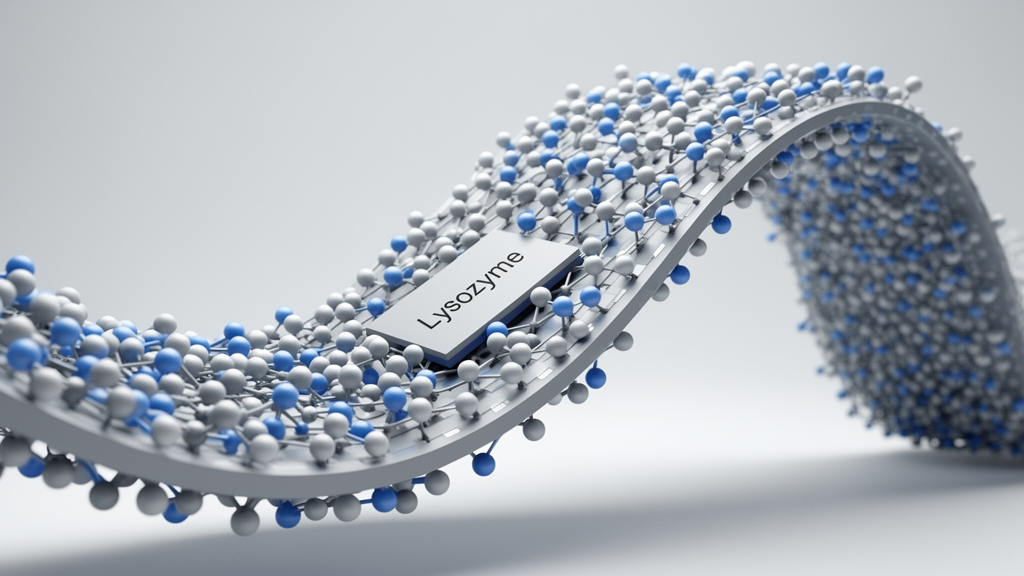
Researchers have addressed this challenge by proposing an innovative interfacial stabilization strategy centered on the use of lysozyme. The team exploited the tris(2-carboxyethyl)phosphine (TCEP)-induced phase transition of lysozyme to assemble a dense, protein amyloid-like aggregate, designated as PTL, directly onto the surfaces of the $\text{Ti}_3\text{C}_2\text{T}_x$ nanosheets. This process yielded a composite material, PTL@$\text{Ti}_3\text{C}_2\text{T}_x$, which demonstrated remarkable improvements in both chemical stability and electrical performance.
The resulting PTL@$\text{Ti}_3\text{C}_2\text{T}_x$ exhibited a high hydrogel conductivity of $94.5\text{ mS cm}^{-1}$. To understand the fundamental basis of this stabilization, density functional theory (DFT) calculations were employed.
The efficacy of this protective layer was rigorously verified through a suite of analytical techniques, including spectroscopic, elemental, and electrical analyses. These tests confirmed that the PTL coating successfully provided substantial antioxidant protection to the MXene core. This enhanced chemical resilience is crucial for transitioning MXene technology from laboratory curiosity to practical, long-lasting wearable electronics.
To demonstrate the practical utility of the stabilized MXene, the researchers integrated the PTL@$\text{Ti}_3\text{C}_2\text{T}_x$ material into a PVA/cellulose nanofiber composite hydrogel sensor, denoted as PCPT. This composite sensor showcased impressive mechanical properties suitable for flexible electronics. Specifically, the PCPT exhibited a high fracture strain of $584\%$, a tensile strength of $1.60\text{ MPa}$, and a toughness of $5.25\text{ MJ m}^{-3}$. Furthermore, it maintained a gauge factor of $4.27$, indicating reliable strain sensing capabilities.
Perhaps the most significant finding relates to the operational longevity of the device. The PCPT sensor, constructed using the PTL@$\text{Ti}_3\text{C}_2\text{T}_x$ MXene, maintained stable sensing functionality even after 90 days of storage. This performance significantly surpassed that of unmodified $\text{Ti}_3\text{C}_2\text{T}_x$ counterparts, directly addressing the primary limitation of oxidative degradation and establishing the material’s long-term viability.
This work presents a highly effective and environmentally conscious strategy—a ‘green’ approach—for enhancing the durability and service life of $\text{Ti}_3\text{C}_2\text{T}_x$ in demanding flexible electronics and wearable sensing applications. By leveraging natural biopolymers like lysozyme to create a protective, conductive interface, the research paves the way for more reliable and sustainable next-generation flexible sensors.
Subject of Research: Interfacial stabilization of $\text{Ti}_3\text{C}_2\text{T}_x$ MXene using lysozyme for durable flexible strain sensing.
Article Title: Interfacial stabilization of Ti₃C₂Tₓ MXene via lysozyme amyloid coating for durable flexible strain sensing
Article References: Song, W., Zhang, L., Li, X., Zhao, Y., Lan, C., Li, T., Zhu, Y., Nica, V., & Qian, L. (2026). Interfacial stabilization of Ti₃C₂Tₓ MXene via lysozyme amyloid coating for durable flexible strain sensing. Advanced Composites and Hybrid Materials. https://doi.org/10.1007/s42114-026-02146-2
Image Credits: AI Generated
DOI: 10.1007/s42114-026-02146-2
Keywords: MXene, Flexible Electronics, Strain Sensing, Lysozyme, Nanomaterials, Hydrogels, Oxidative Degradation, Biopolymer Coating, Advanced Composites, Interfacial, stabilization, amyloid
News Source: Denise Maddox. (October 27, 2026). Lysozyme Coating Stabilizes MXene for Durable Flexible Strain Sensors. Scienmag.