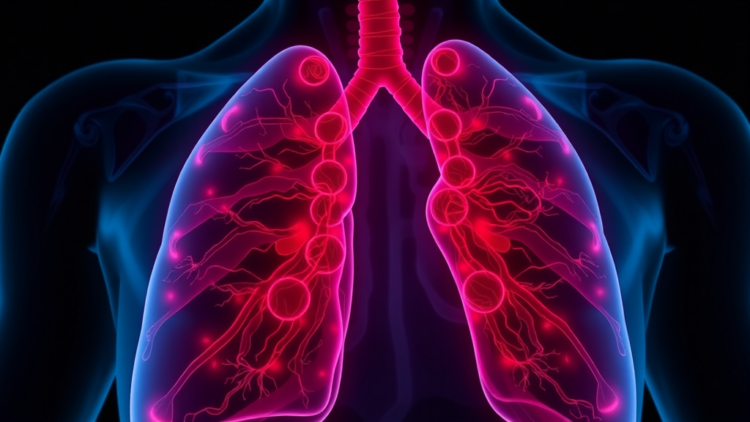
In a striking illustration of how far the reach of inflammatory bowel disease can extend beyond the gut, clinicians have documented a case of organising pneumonia—a form of inflammatory lung injury—in a 76-year-old woman whose ulcerative colitis was demonstrably in biochemical remission. The report, published in Respirology Case Reports, arrives at a moment when the respiratory complications of inflammatory bowel disease are gaining formal recognition, and it adds weight to a provocative idea: that the lungs can come under attack from the same immune forces that drive bowel inflammation, even when the bowel itself appears quiet.
Ulcerative colitis is well known for the symptoms it causes in the large intestine, but it belongs to a family of conditions whose influence is systemic. Extraintestinal manifestations affect up to 27 percent of patients, and among these, lung disease has been increasingly appreciated. One large cohort study of 563 patients with ulcerative colitis identified lung involvement in 5 percent, with organising pneumonia accounting for 1.8 percent. Yet that same study attributed nine of the ten organising pneumonia cases to drug-induced mechanisms, leaving open a fundamental question: can organising pneumonia arise as a primary, disease-intrinsic feature of ulcerative colitis itself, independent of any medication?
The new case suggests that it can. The 2025 update to the international multidisciplinary classification of the interstitial pneumonias, issued jointly by the European Respiratory Society and the American Thoracic Society, now explicitly lists ulcerative colitis among the secondary causes of cicatricial organising pneumonia, a histologically distinct entity. That formal recognition matters, because it provides a framework for attributing lung disease to the underlying bowel condition rather than defaulting to a drug reaction—a distinction with direct consequences for how patients are treated.
The patient at the centre of the report was a lifelong never-smoker with a ten-year history of ulcerative colitis pancolitis, maintained on a stable dose of mesalamine at 2.4 grams daily. She carried a concurrent diagnosis of rheumatoid arthritis, made five years after her colitis began, based on bilateral symmetric polyarthritis affecting fifteen small joints with finger nodules. Two biologic drugs, adalimumab and certolizumab, had been trialled and discontinued for lack of efficacy. Three months before admission, her pulmonary function tests had been entirely normal. Then she developed progressive shortness of breath over the course of a single month.
On admission, she required low-flow oxygen, and examination revealed crackles in both lungs. Crucially, a faecal calprotectin measurement obtained one month earlier stood at 62 micrograms per gram, below the 80 micrograms per gram threshold that identifies histological bowel activity—a biomarker-confirmed remission. Her systemic inflammatory markers, however, told a different story: C-reactive protein, erythrocyte sedimentation rate and white cell count were all elevated. High-resolution computed tomography of the chest showed bilateral interstitial haziness, predominantly in the mid and lower lung fields, representing clear progression from prior imaging that had shown only mild scattered scarring.
Diagnostic workup proceeded along two tracks. Bronchoalveolar lavage fluid revealed a differential cell count of 42 percent neutrophils and only 3 percent lymphocytes—a profile that would later prove important. A transbronchial cryobiopsy of the right lower lobe was performed, and the initial histopathological interpretation locally was fibrotic non-specific interstitial pneumonia, a diagnosis that prompted plans for antifibrotic therapy with mycophenolate and nintedanib. But when the slides were reviewed by expert pulmonary pathologists, the interpretation changed fundamentally. The expert consultation identified organising pneumonia, characterised by polypoid fibroblast plugs known as Masson bodies within the airspaces, with only mild background fibrosis and an absence of honeycomb change or fibroblast foci—the hallmarks that would have supported a diagnosis of usual interstitial pneumonia or fibrotic non-specific interstitial pneumonia.
That diagnostic reversal was directly consequential. The planned antifibrotic regimen was abandoned in favour of corticosteroid therapy, the standard treatment for organising pneumonia, which carries a five-year survival exceeding 90 percent when treated appropriately. The patient received three days of intravenous pulse methylprednisolone followed by oral prednisone with a planned six-month taper. Mesalamine was held as a precaution, but withholding the drug produced no clinical improvement on its own—further evidence against a drug-induced mechanism. Follow-up imaging at two months showed partial resolution of the bilateral infiltrates, with residual changes consistent with her pre-existing baseline scarring, and azathioprine was added as a steroid-sparing agent with the additional benefit of maintaining her colitis.
The authors lay out a careful argument for why this organising pneumonia was disease-intrinsic rather than drug-induced. First, mesalamine exposure had been stable for a decade; drug-induced pneumonitis typically appears within weeks to months of initiation or dose change. Second, discontinuation of the drug during hospitalisation brought no improvement, whereas corticosteroids were required for a response—inconsistent with the natural history of a drug reaction. Third, the 2025 classification now formally recognises ulcerative colitis as a secondary cause of cicatricial organising pneumonia. The case also extends the sole prior published report of organising pneumonia occurring after histologically confirmed ulcerative colitis remission, adding biomarker-confirmed remission, systematic drug exclusion, detailed lavage data and a complete autoimmune workup that reclassified the patient’s joint disease as ulcerative colitis-associated spondyloarthropathy rather than rheumatoid arthritis, removing rheumatoid-associated lung disease from the differential.
Perhaps the most scientifically intriguing observation is the lavage profile. Classic cryptogenic organising pneumonia typically shows lymphocytic predominance in bronchoalveolar lavage, with lymphocyte counts of 20 to 40 percent and only mild neutrophil elevation. This patient showed the reverse: 42 percent neutrophils and a mere 3 percent lymphocytes. Prior research has shown that secondary organising pneumonia carries lower lymphocyte counts than the cryptogenic form, and the authors hypothesise that ulcerative colitis-associated disease may carry a distinctly neutrophil-predominant signature reflecting immune cell trafficking along the gut-lung axis. Mouse studies lend plausibility to this idea: colitis has been shown to induce pulmonary neutrophil infiltration through interleukin-17 elevation and microbial translocation, and interleukin-6-driven, neutrophil-mediated pulmonary inflammation has been documented in murine models of colitis with bacteremia.
The case is also a cautionary tale about diagnostic uncertainty in interstitial lung disease. The discordance between the local reading of fibrotic non-specific interstitial pneumonia and the expert reading of organising pneumonia mirrors a documented pitfall of cryobiopsy interpretation: intraluminal Masson bodies within airspaces favour organising pneumonia, whereas interstitial fibroblast foci within the alveolar wall characterise the fibrotic pneumonias. The CAN-ICE trial found only fair between-center agreement for cryobiopsy-based diagnoses, with a kappa of 0.29. In this instance, expert pathology review changed the entire treatment trajectory, and the authors argue that such review should be considered routine whenever cryobiopsy-based diagnoses drive major therapeutic decisions. Two cases over thirteen years may reflect genuine rarity, the authors concede, but under-recognition is equally plausible, given that prior cohorts attributed drug causation without systematic exclusion criteria. For clinicians, the message is twofold: organising pneumonia can flare during biomarker-confirmed bowel remission, and drug-induced causes must be rigorously excluded before the lung disease is attributed to the bowel condition—because the correct diagnosis determines whether a patient receives antifibrotics or steroids, a fork in the road with very different prognoses.
Subject of Research: A case of disease-intrinsic organising pneumonia occurring during biomarker-confirmed ulcerative colitis remission
Article Title: Disease‐Intrinsic Organising Pneumonia During Biomarker‐Confirmed Ulcerative Colitis Remission
Article References: Disease‐Intrinsic Organising Pneumonia During Biomarker‐Confirmed Ulcerative Colitis Remission. (n.d.). https://doi.org/10.1002/rcr2.70702
Image Credits: AI Generated
DOI: 10.1002/rcr2.70702
Keywords: ulcerative colitis, organising pneumonia, extraintestinal manifestations, gut-lung axis, cryobiopsy, interstitial lung disease, bronchoalveolar lavage, corticosteroids, ERS/ATS classification, mesalamine, inflammatory bowel disease, Masson bodies
Cite Scienmag News
APA MLA Chicago
Barbara Leach. (September 22, 2026). Lung Disease Strikes During Ulcerative Colitis Remission, Challenging Drug Explanation. Scienmag. https://scienmag.com/lung-disease-strikes-during-ulcerative-colitis-remission-challenging-drug-explanation/
Barbara Leach. “Lung Disease Strikes During Ulcerative Colitis Remission, Challenging Drug Explanation.” Scienmag, 22 September 2026, https://scienmag.com/lung-disease-strikes-during-ulcerative-colitis-remission-challenging-drug-explanation/. Accessed 22 September 2026.
Barbara Leach. “Lung Disease Strikes During Ulcerative Colitis Remission, Challenging Drug Explanation.” Scienmag. September 22, 2026. https://scienmag.com/lung-disease-strikes-during-ulcerative-colitis-remission-challenging-drug-explanation/
Copy citation Download RIS
Tags: bronchoalveolar lavagecase report on lung disease during IBD remissionchallenges in diagnosing ulcerative colitis-related lungcorticosteroidscryobiopsydrug-induced vs primary lung complicationsERS/ATS classificationextraintestinal manifestationsextraintestinal manifestations of ulcerative colitisgut-lung axisimmune system involvement in ulcerative colitisimmune-mediated lung injury in IBDinflammatory bowel diseaseinflammatory lung injury in ulcerative colitisinterstitial lung diseaseMasson bodiesmesalamineorganising pneumoniaorganising pneumonia in ulcerative colitis remissionpulmonary complications of ulcerative colitisrespiratory involvement in inflammatory bowel diseasesystemic effects of inflammatory bowel diseaseulcerative colitisUlcerative colitis lung manifestations