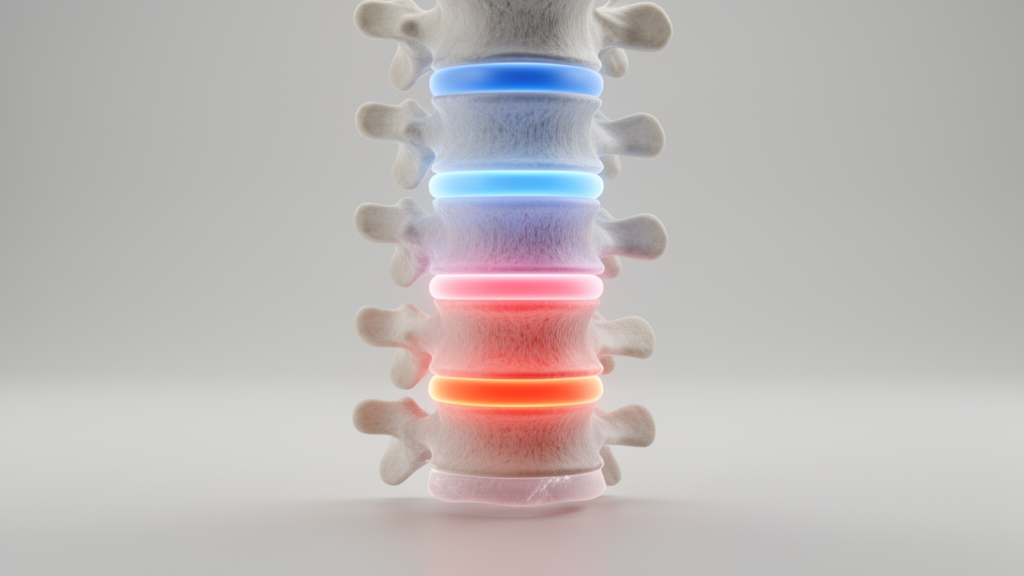
Which sitting or standing position is kindest to the lower back is a question that has been argued over for decades, often with more conviction than data. A new finite element study published in Frontiers in Bioengineering and Biotechnology now offers a detailed computational answer, mapping how the von Mises stress inside the lumbar intervertebral discs and their gel-like nucleus pulposus changes across eight everyday postures. The headline result is striking: in this model, the lowest peak disc stresses at the clinically critical L4-L5 and L5-S1 segments occurred not in any standing position but in two specific sitting postures, upright sitting in a neutral position and relaxed sitting in a neutral position with lumbar support.
The research team, led by Xuhui Zhang of The 83rd Group Army Hospital in Xinxiang, China, together with collaborators from several Chinese hospitals, set out to compare disc and nucleus pulposus stresses under different lumbar curvature configurations. Their motivation was practical. The L4-L5 and L5-S1 levels are the segments most relevant to the development and progression of spinal problems, and the sagittal shape of the lumbar spine, its natural lordosis, strongly influences how compressive loads are shared between the discs, the facet joints and the surrounding soft tissues. Yet most computed tomography scans are taken with the patient lying flat, so the true curvature of the standing or sitting spine is rarely captured in the imaging data used to build biomechanical models.
To get around that limitation, the researchers used an unusual two-step modeling strategy. First, they reconstructed a lumbosacral spine from supine CT data of a single 44-year-old male volunteer, 168 centimeters tall, weighing 76 kilograms, with no symptoms of low back pain or other spinal disorders. Then, using lateral X-ray images of the same volunteer taken in different postures, they treated each vertebral body as a component unit, measured the sagittal angles of the L1 to L5 vertebral bodies and the heights of the intervertebral spaces, and rearranged the spatial positions of the vertebrae in the sagittal plane. The result was a set of three-dimensional models whose curvatures matched the postures actually observed on radiographs, rather than idealized geometries.
Eight postures were modeled in total: standing with a forward inclination of roughly 30 degrees, standing in a neutral position, standing with the trunk extended backward roughly 15 degrees, relaxed sitting with a forward inclination, upright sitting in a neutral position, relaxed sitting with a backward inclination, relaxed sitting in a neutral position, and relaxed sitting in a neutral position with a rigid lumbar support backrest. In each model, the sacrum was fixed as a reference, a coupling constraint was placed on the superior surface of the L1 vertebra, and a vertical 400-newton load, representing the physiological load of the upper body weight, was applied. The authors note that real spinal loading involves complex six-axis forces and muscle activity, so this standardized loading was chosen to allow a controlled comparison of posture effects alone.
The models themselves were built to a high level of detail. Vertebral bodies were meshed with tetrahedral elements, the outermost millimeter defined as cortical bone and the interior as cancellous bone. Intervertebral discs were generated between the vertebral endplates, with the outer layers assigned as annulus fibrosus and the central portion as nucleus pulposus, and the discs were meshed at a global element size of one millimeter. Seven spinal ligaments, from the anterior longitudinal ligament to the capsular ligament, were simulated as spring elements with published material properties. The neutral standing model was validated by applying a 7.5 newton-meter moment and comparing the range of motion at L2-L3, L3-L4 and L4-L5 in flexion-extension, lateral bending and axial rotation against previous experimental and computational studies, with results the authors judged close enough to proceed.
A mesh convergence analysis added further confidence. Refining the L4-L5 disc mesh from 2 millimeter to 1 millimeter elements lowered the predicted peak von Mises stress from 2.932 megapascals to 2.754 megapascals, and the L5-S1 value from 2.978 to 2.825 megapascals, but further refinement to 0.5 millimeters changed these figures by only 0.04 percent and 0.07 percent. The predicted disc stresses could therefore be considered independent of mesh density at the chosen one-millimeter discretization.
The standing results followed a clear anatomical gradient. Among the three standing postures, the peak von Mises stresses in the L3-L4, L4-L5 and L5-S1 discs were higher than in the L1-L2 and L2-L3 discs, reflecting the greater load borne by the lower lumbar segments. The smallest peak disc stresses at L3-L4, L4-L5 and L5-S1 all occurred in the neutral standing position, where the L4-L5 disc reached 2.754 megapascals and L5-S1 2.825 megapascals, compared with 2.852 and 3.177 megapascals in forward-inclined standing. Nucleus pulposus stresses were minimal at L3-L4 and L4-L5 in neutral standing, while the L5-S1 nucleus was least stressed in the backward-inclined standing position. As the torso leaned forward, the stress distribution within the discs and nuclei shifted from the posterior region toward the anterior side, remaining roughly symmetrical left and right.
The sitting results were, on their face, counterintuitive. Across all five sitting postures, the smallest peak von Mises stresses and nucleus pulposus stresses at L4-L5 and L5-S1 were found in upright sitting in a neutral position and in relaxed sitting with lumbar support, where the L4-L5 disc stress fell to 0.623 and 0.674 megapascals respectively, and nucleus stresses dropped as low as 0.022 and 0.011 megapascals. In fact, the peak disc and nucleus stresses during sitting were lower than during standing in this model. The authors place this finding in a long-running scientific debate: classic intradiscal pressure measurements suggested sitting raises disc pressure above standing, but later indirect studies and implanted-sensor measurements by Wilke and colleagues cautiously suggested seated pressure might be lower than during upright standing, and no direct evidence links sitting posture to disc degeneration. The discussion also cautions that maintaining lumbar lordosis requires trunk muscle activity that cannot be sustained indefinitely without support, which is precisely where a backrest may help.
The study’s conclusion is that lumbar curvature configuration significantly influences both the distribution and magnitude of von Mises stress in the L4-L5 and L5-S1 discs and nucleus pulposus, and that maintaining proper spinal alignment and avoiding postures that reduce lumbar lordosis are generally more favorable for lowering stress at these two segments. The authors are careful about the limits of their work. The model represents a single volunteer, the material parameters were taken from previous studies rather than measured in this individual, muscle forces and shifts in the body’s center of mass were not included, the geometry was defined primarily in the sagittal plane, and range-of-motion validation does not guarantee the accuracy of internal disc stresses. The computational parameters, they write, primarily represent trends rather than accurate absolute values. For readers without back pain, the practical takeaway is modest but concrete: in this single-subject finite element model, neutral standing and lordosis-preserving sitting, especially with lumbar support, produced the lowest stresses at the two lumbar levels that matter most.
Subject of Research: Finite element analysis of lumbar intervertebral disc and nucleus pulposus stresses across eight standing and sitting postures
Article Title: Comparison of intervertebral disc and nucleus pulposus stresses under different lumbar curvature configurations
Article References: Niu, S., Yang, H., Wu, J., Song, L., Meng, B., Niu, Z., Zhang, Q., & Zhang, X. (2026). Comparison of intervertebral disc and nucleus pulposus stresses under different lumbar curvature configurations. Frontiers in Bioengineering and Biotechnology, 14, Article 1969400. https://doi.org/10.3389/fbioe.2026.1969400
Image Credits: AI Generated
DOI: 10.3389/fbioe.2026.1969400
Keywords: finite element analysis, lumbar spine, intervertebral disc, nucleus pulposus, von Mises stress, lumbar lordosis, posture, sitting, standing, lumbar support, biomechanics, L4-L5
News Source: Gregory Coleman. (October 29, 2026). Lumbar Posture Reshapes Disc Stress in Finite Element Spine Model. Scienmag.