A new retrospective cohort study published in the journal Radiation Oncology reveals that the respiratory movement of thoracic lymph nodes during breathing is location-dependent, with lower nodes undergoing significantly greater displacement than upper nodes within the same individual. Conducted by a team of researchers led by Hidenobu Tachibana and colleagues, the investigation used four-dimensional computed tomography simulation data from patients undergoing thoracic radiotherapy to evaluate how respiratory motion varies across different anatomical node stations and to examine the extent of regional and interpatient variability.
In clinical radiation oncology practice, internal margins for thoracic lymph nodes are commonly applied uniformly across target regions. This standard approach persists despite longstanding recognition that lymph node motion during respiration varies widely both across individual patients and among distinct nodal stations. Prior studies employing four-dimensional computed tomography have documented clear movement of mediastinal and hilar lymph nodes, as well as notable discordance between the motion of these nodes and the motion of the primary tumor. However, the translation of those dynamic observations into practical, individualized internal margin strategies in radiotherapy planning has remained distinctly limited.
To address this clinical challenge, the investigators hypothesized that the magnitude of movement during respiration differs systematically between upper and lower thoracic lymph nodes within the same patient. To test this hypothesis, the authors designed a retrospective cohort study that evaluated patients undergoing four-dimensional computed tomography simulation for thoracic radiotherapy. To be included in the analytical cohort, eligible patients were required to have complete respiratory phase imaging datasets and to possess at least one upper thoracic lymph node and at least one lower thoracic lymph node identifiable on their baseline reference-phase computed tomography scans.
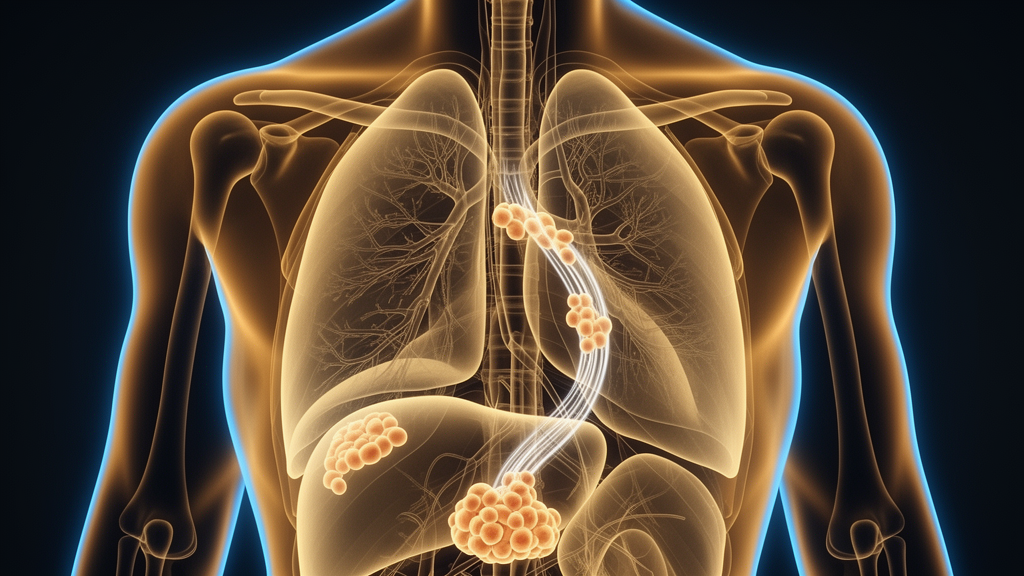
Anatomical lymph nodes were systematically classified in relation to the carina, which served as the dividing landmark between upper and lower thoracic stations. Under this classification scheme, lymph node stations 1 through 6 were designated as upper thoracic nodes, whereas stations 7 through 14 were categorized as lower thoracic nodes. For each identified node, researchers tracked the anatomical centroid across all available respiratory phases, allowing them to quantify both directional displacement along specific anatomical axes and the overall three-dimensional vector magnitude of movement relative to the initial reference phase.
The complete study cohort comprised forty-one patients with a total of 229 analyzed lymph nodes, representing 130 upper thoracic nodes and 99 lower thoracic nodes. To rigorously compare the respiratory motion between upper and lower nodal stations, the research team implemented linear mixed-effects models. This statistical modeling framework specifically accounted for within-patient clustering, ensuring that multiple lymph node observations taken from within the same individual did not bias the comparisons or distort the assessment of location-dependent differences.
The tracking data revealed that thoracic lymph node motion during respiration was predominantly oriented in the cranio-caudal direction. Upper thoracic lymph nodes exhibited a mean cranio-caudal displacement of 3.3 ± 1.9 millimeters, whereas lower thoracic lymph nodes showed a mean cranio-caudal displacement of 5.2 ± 3.0 millimeters. When evaluated through within-patient comparative analysis, lower nodes demonstrated significantly greater cranio-caudal movement than upper nodes, with a mean within-patient difference of 1.9 millimeters and a statistical significance level of p < 0.001.
A similar pattern of regional disparity emerged when the researchers evaluated the three-dimensional vector magnitude of displacement. The mean three-dimensional vector displacement was significantly greater for lower thoracic nodes at 5.7 ± 2.9 millimeters compared with 4.1 ± 2.0 millimeters for upper thoracic nodes, also achieving statistical significance at p < 0.001. In addition, the proportion of nodes experiencing substantial displacement varied noticeably by station, with motion exceeding 5 millimeters in three-dimensional vector magnitude occurring in 51 percent of lower nodes compared with 37 percent of upper nodes.
Further exploratory analysis evaluating patient-level motion at the 90th percentile showed that the movement of thoracic nodes was anisotropic across spatial dimensions. Based on these findings, the authors concluded that respiratory motion of thoracic lymph nodes is distinctly location-dependent, marked by greater displacement in lower stations alongside substantial variability from patient to patient. Consequently, the study results support the adoption of individualized assessment of respiratory motion using four-dimensional computed tomography rather than continued reliance on uniform, population-based internal margins in thoracic radiation therapy.
Subject of Research: Respiratory motion differences between upper and lower thoracic lymph nodes in radiotherapy
Article Title: Within-patient four-dimensional computed tomography analysis reveals location-dependent motion of thoracic lymph nodes during respiration
Article References: Tachibana, H., Oyoshi, H., Someya, T., Mizunuma, Y., Suzuki, T., Hirotaki, K., Nakamura, S., Takahashi, R., Nakamura, M., & Zenda, S. (2026). Within-patient four-dimensional computed tomography analysis reveals location-dependent motion of thoracic lymph nodes during respiration. Radiation Oncology. https://doi.org/10.1186/s13014-026-02951-5
Image Credits: AI Generated
DOI: 10.1186/s13014-026-02951-5
Keywords: four-dimensional computed tomography, 4DCT simulation, thoracic lymph nodes, respiratory motion, radiation oncology, internal margins, radiotherapy planning, upper thoracic lymph nodes, lower thoracic lymph nodes, cranio-caudal displacement, carina, linear mixed-effects models, three-dimensional vector magnitude, interpatient variability, within-patient clustering, nodal stations, anisotropic motion
News Source: Nathaniel Bowman. (November 23, 2026). Lower Thoracic Lymph Nodes Exhibit Greater Respiratory Motion Than Upper Nodes. Scienmag.