


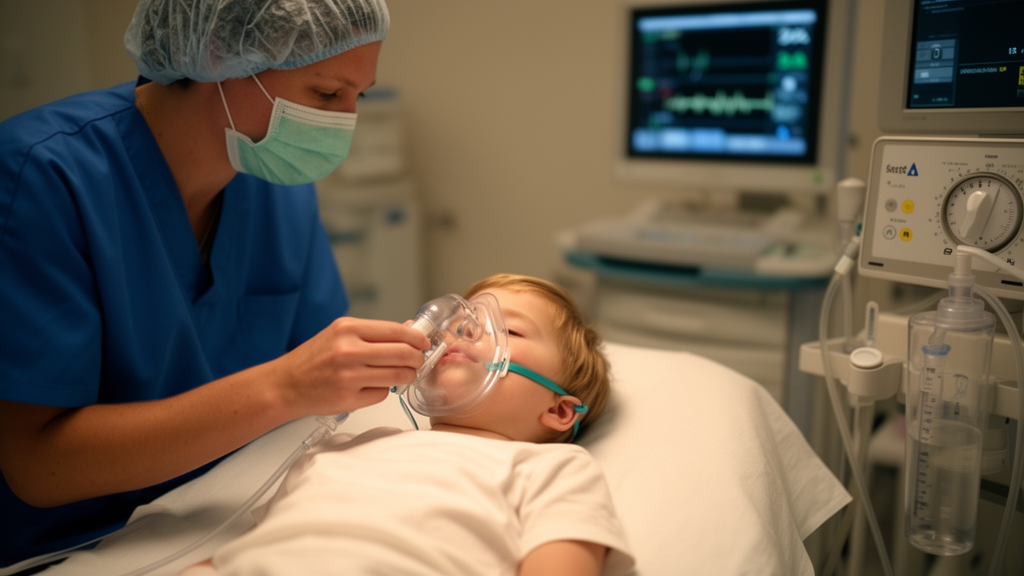
A single-center randomized controlled trial has found that simply lowering the sevoflurane vaporizer setting during mask induction, from 8% to 6%, was associated with substantially lower emergence delirium scores in young children undergoing brief eye surgery. The study, published in BMC Anesthesiology, enrolled 80 children aged 1 to 6 years who were scheduled for ambulatory chalazion surgery and were otherwise healthy, with American Society of Anesthesiologists physical status I.
The researchers asked whether a simple change in the vaporizer setting used during mask induction could reduce this problem without adding any medication. The trial was registered on ClinicalTrials.gov as NCT07450495 (SEVOPED), although the registration was retrospective: it was first submitted on 23 February 2026 and first posted on 4 March 2026, after the study had begun.
Children were assigned 1:1 by random-number table to a sevoflurane vaporizer setting of either 6% or 8% during mask induction. Allocation was concealed using sequentially numbered, opaque, sealed envelopes that were opened immediately before induction. The oxygen flow during induction was standardized at 4 liters per minute, and all other perioperative procedures followed a common protocol. The trial was outcome assessor-blinded, and the analyses included all randomized participants.
The protocol-defined primary outcome was a single Pediatric Anesthesia Emergence Delirium (PAED) score assessed on awakening. The researchers compared the two groups using medians and a Hodges–Lehmann estimate of the difference between them.
The results favored the lower setting. The median PAED score was 9.0 (interquartile range 5.5 to 11.0) in the 6% group and 14.0 (interquartile range 9.8 to 15.3) in the 8% group.
The trial also included a post hoc exploratory analysis that defined emergence delirium as a PAED score of 10 or higher. Under this threshold, delirium occurred in 12 of 40 children (30.0%) in the 6% group versus 30 of 40 (75.0%) in the 8% group. The absolute risk difference was 45.0 percentage points (95% CI 23.3 to 61.1), the risk ratio was 2.50 (95% CI 1.51 to 4.15), and the number needed to treat with the 6% rather than the 8% setting was 2.2 (95% CI 1.6 to 4.3). An exploratory adjusted risk ratio was 2.41 (95% CI 1.51 to 3.85).
The authors are careful about what these numbers mean. In their conclusion, they state that in healthy children undergoing brief chalazion surgery, the 6% vaporizer-setting strategy yielded lower early PAED scores than the 8% strategy, and that the post hoc threshold analyses supported a possible reduction in emergence delirium but remain exploratory. The primary outcome was the continuous PAED score itself; the dichotomous delirium results come from the post hoc analysis and should not be read as a pre-specified confirmatory finding.
There are further important caveats. The trial concerned assigned clinical strategies rather than verified alveolar sevoflurane exposure, so the study does not establish which concentration of sevoflurane the children actually received in their lungs, only which vaporizer dial setting was used. The findings require independent replication, and the single-center design with a narrow population of healthy children undergoing one brief procedure limits how far the results can be generalized to other surgeries, age groups, or anesthesia practices.
Even with those limitations, the trial addresses a question of real practical interest. For now, the evidence comes from one randomized trial in 80 children, and the authors themselves note that independent replication is needed before the strategy can be considered established practice.
Subject of Research: The effect of sevoflurane vaporizer settings during mask induction on emergence delirium in children undergoing chalazion surgery
Article Title: Effect of 6% versus 8% sevoflurane vaporizer settings during mask induction on emergence delirium in children undergoing chalazion surgery: a randomized controlled trial
Article References: Zhuang, S., Zhou, F., Lin, C., Xie, J., Lin, Q., Li, D., Wu, J., Huang, S., Lv, L., & Wu, K. (2026). Effect of 6% versus 8% sevoflurane vaporizer settings during mask induction on emergence delirium in children undergoing chalazion surgery: a randomized controlled trial. BMC Anesthesiology. https://doi.org/10.1186/s12871-026-04382-x
Image Credits: AI Generated
DOI: 10.1186/s12871-026-04382-x
Keywords: sevoflurane, emergence delirium, pediatric anesthesia, mask induction, randomized controlled trial, PAED score, chalazion surgery, vaporizer setting, BMC Anesthesiology, anesthesiology, Effect, versus
News Source: Ophelia Keating. (October 30, 2026). Lower Sevoflurane Vaporizer Setting During Mask Induction Cuts Emergence Delirium Scores in Children. Scienmag.



