

• HOME
  • NEWS
  • EXPLORE
    • CAREER
      • Companies
      • Jobs
    • EVENTS
    • iGEM
      • News
      • Team
    • PHOTOS
    • VIDEO
    • WIKI
  • BLOG
  • COMMUNITY
    • FACEBOOK
    • INSTAGRAM
    • TWITTER
Tuesday, July 14, 2026
BIOENGINEER.ORG
No Result
View All Result
  • Login
  • HOME
  • NEWS
  • EXPLORE
    • CAREER
      • Companies
      • Jobs
        • Lecturer
        • PhD Studentship
        • Postdoc
        • Research Assistant
    • EVENTS
    • iGEM
      • News
      • Team
    • PHOTOS
    • VIDEO
    • WIKI
  • BLOG
  • COMMUNITY
    • FACEBOOK
    • INSTAGRAM
    • TWITTER
  • HOME
  • NEWS
  • EXPLORE
    • CAREER
      • Companies
      • Jobs
        • Lecturer
        • PhD Studentship
        • Postdoc
        • Research Assistant
    • EVENTS
    • iGEM
      • News
      • Team
    • PHOTOS
    • VIDEO
    • WIKI
  • BLOG
  • COMMUNITY
    • FACEBOOK
    • INSTAGRAM
    • TWITTER
No Result
View All Result
Bioengineer.org
No Result
View All Result
Home Headlines

Lost your appetite? Try inviting yourself to dinner

Bioengineer.org by Bioengineer.org
January 19, 2018
in Headlines, Health, Science News
Reading Time: 2 mins read
0
Share on FacebookShare on TwitterShare on LinkedinShare on RedditShare on Telegram
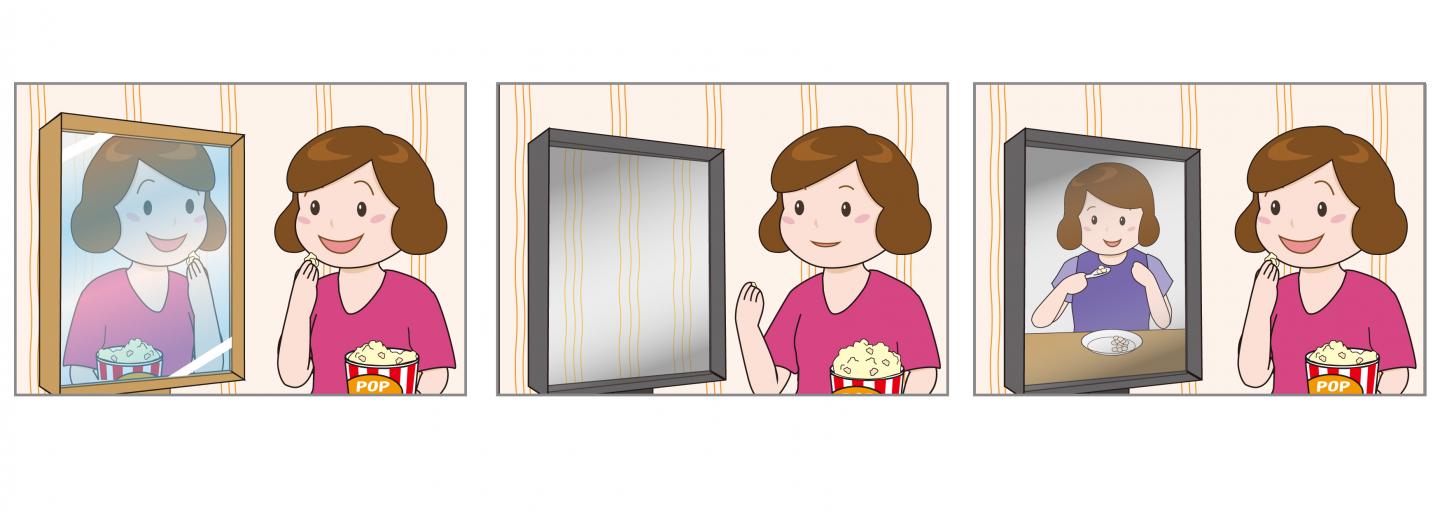
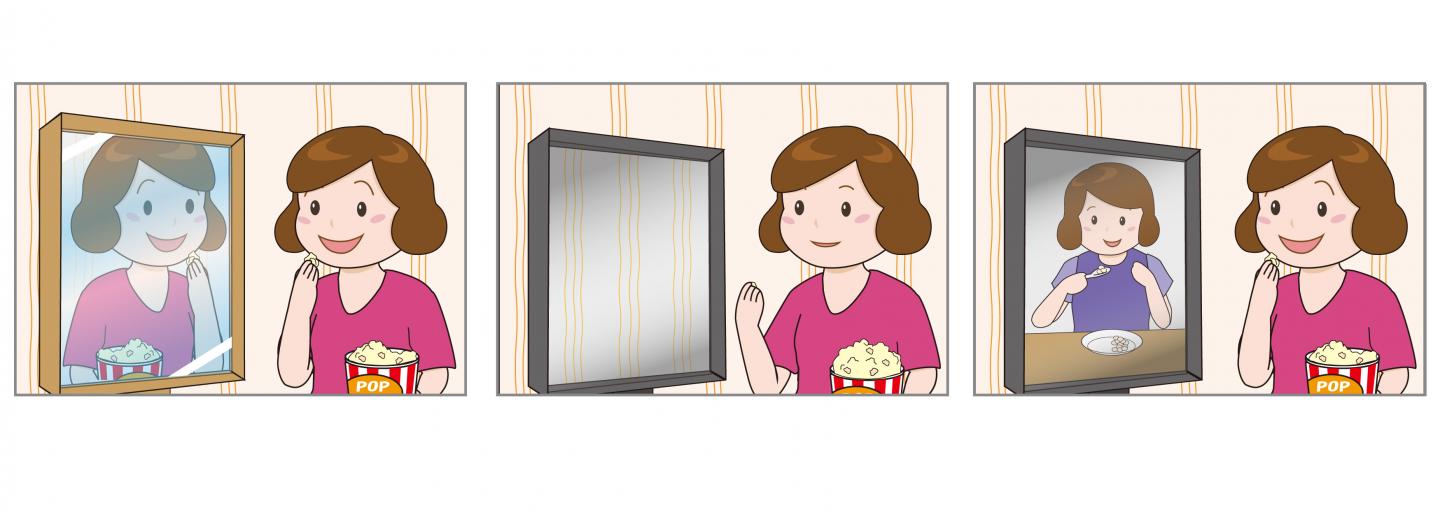
IMAGE

Credit: Nagoya University

Nagoya, Japan – People rate food as tasting better, and eat more of it, when they eat with company than when they eat alone. This so-called "social facilitation of eating" is a well-established phenomenon; however, exactly what it is about company that produces the effect is not clear.

Now, researchers at Nagoya University have discovered that the same effect can be achieved in individuals eating alone simply by providing a mirror to reflect them while they eat. The study was published in Physiology & Behavior.

"We wanted to find out what the minimum requirement is for the social facilitation of eating," lead author Ryuzaburo Nakata says. "Does another person have to actually be physically present, or is information suggesting the presence of others sufficient?" The researchers found that people eating alone reported food as tasting better, and ate more of it, when they could see themselves reflected in a mirror, compared with when they ate in front of a monitor displaying an image of a wall.

The research team initially worked with a group of older adult volunteers. Approaches to enhance enjoyment of food in people eating without company are particularly relevant for elderly people, because research has shown that many frequently eat alone. However, when the team repeated the experiment with young adult volunteers, they observed the same "social" facilitation of eating when a mirror was present, suggesting that the effect is not limited to older people.

In a further experiment, when the researchers replaced the mirror with photos of the volunteers eating, they discovered that the volunteers still experienced an increase in the appeal of food and ate more. Thus, perhaps surprisingly, a static image of a person eating seems sufficient to produce the "social" facilitation of eating.

"Studies have shown that for older adults, enjoying food is associated with quality of life, and frequently eating alone is associated with depression and loss of appetite," corresponding author Nobuyuki Kawai says. "Our findings therefore suggest a possible approach to improving the appeal of food, and quality of life, for older people who do not have company when they eat–for example, those who have suffered loss or are far away from their loved ones."

###

The article, "The "social" facilitation of eating without the presence of others: Self-reflection on eating makes food taste better and people eat more", was published in Physiology & Behavior at DOI: 10.1016/j.physbeh.2017.05.022.

Media Contact

Koomi Sung
[email protected]
@NU__Research

http://www.nagoya-u.ac.jp/en/

Original Source

http://en.nagoya-u.ac.jp/research/activities/news/2017/06/lost-your-appetite-try-inviting-yourself-to-dinner.html http://dx.doi.org/10.1016/j.physbeh.2017.05.022

Share12Tweet8Share2ShareShareShare2

Related Posts

Aging Cells Revert to Stem Cells as Self-Repair Mimics

Aging Cells Revert to Stem Cells as Self-Repair Mimics

July 14, 2026
Special Supplemental Nutrition Program and Cerebral Palsy Risk

Special Supplemental Nutrition Program and Cerebral Palsy Risk

July 14, 2026

Reactivated DRP1 Enables Resistance to MEK Inhibitors in Pancreatic Cancer Cells

July 14, 2026

KTU Researchers Develop AI System to Forecast Solar Power From Cloud Data

July 14, 2026
Please login to join discussion

POPULAR NEWS

  • New Drug Candidate Developed at McMaster Shows Potential for Treating Brain Cancer

    58 shares
    Share 23 Tweet 15
  • Detection of EDCs in Breast Milk and Infant Urine Up to Six Months Highlights Early Exposure Risks

    77 shares
    Share 31 Tweet 19
  • Experimental Therapy Simultaneously Destroys Prostate Tumor Cells and Reactivates Antitumor Immunity

    46 shares
    Share 18 Tweet 12
  • 高齢者の骨粗鬆症治療の持続性比較

    51 shares
    Share 20 Tweet 13

About

We bring you the latest biotechnology news from best research centers and universities around the world. Check our website.

Follow us

Recent News

Aging Cells Revert to Stem Cells as Self-Repair Mimics

Special Supplemental Nutrition Program and Cerebral Palsy Risk

Reactivated DRP1 Enables Resistance to MEK Inhibitors in Pancreatic Cancer Cells

Subscribe to Blog via Email

Enter your email address to subscribe to this blog and receive notifications of new posts by email.

Join 85 other subscribers
  • Contact Us

Bioengineer.org © Copyright 2023 All Rights Reserved.

Welcome Back!

Login to your account below

Forgotten Password?

Retrieve your password

Please enter your username or email address to reset your password.

Log In
No Result
View All Result
  • Homepages
    • Home Page 1
    • Home Page 2
  • News
  • National
  • Business
  • Health
  • Lifestyle
  • Science

Bioengineer.org © Copyright 2023 All Rights Reserved.
