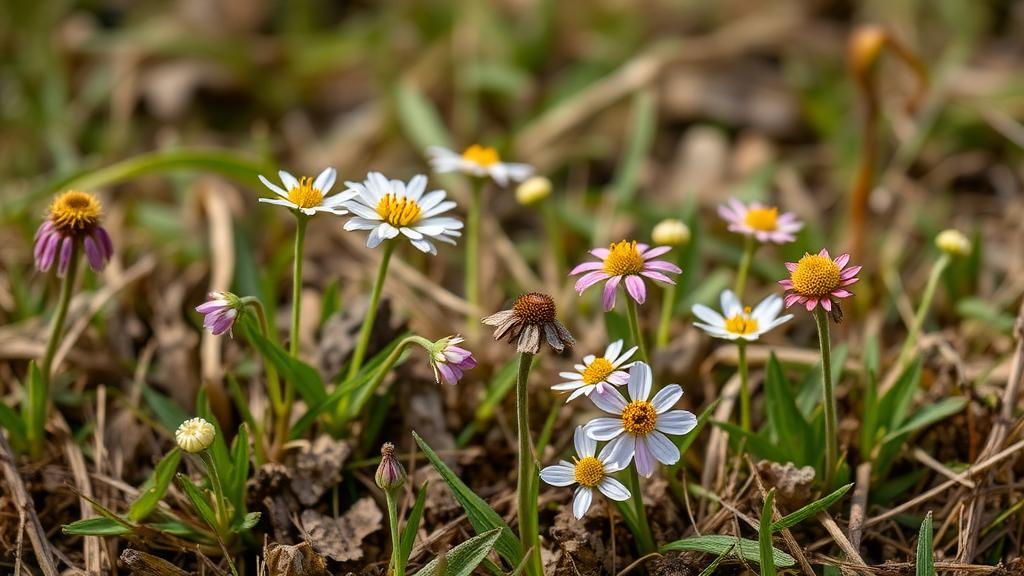
Deep in the Umbria-Marche Apennines, at roughly 900 metres above sea level, two high mountain basins known as the Piani di Montelago have quietly preserved one of central Italy’s most remarkable wetland floras. A new study published in the Italian Botanist has now compiled the first complete inventory of the vascular plants of this site, combining more than six decades of herbarium specimens, historical literature and five years of dedicated field surveys. The result is a checklist of 481 species and subspecies belonging to 65 families and 263 genera, and a sobering account of what has been lost along the way.
The research team set out with two goals: to build a comprehensive floristic inventory for an area that had never been fully catalogued, and to measure how the occurrence of species of conservation interest had changed over the past 65 years. To achieve this, the botanists examined specimens preserved in the Herbarium Universitatis Camerinensis, collected by generations of botanists from the University of Camerino, and cross-referenced them with records from classical Italian floras and phytosociological studies dating back to the early 1960s. Between 2021 and 2025, they then carried out systematic field surveys restricted to wet and humid habitats, croplands, uncultivated land, hedges and roadside verges, deliberately excluding the woodlands and grasslands on the surrounding slopes.
The Piani di Montelago themselves are geologically fascinating. These closed basins of structural and tectonic origin sit within calcareous Apennine mountains, their floors sealed by clayey deposits and impermeable rock layers. Water escapes only underground through a network of sinkholes, and after intense rain or snowmelt, two temporary lakes briefly form across the plains. The upper plain is especially significant because layers of peat in its soil support a rare peat bog vegetation dominated by the broad-leaved cottongrass Eriophorum latifolium, while the wetter inner zones host sedges and hay meadows of exceptional biogeographic value.
Human history has left deep marks on this landscape. During the Renaissance, the Da Varano family, lords of Camerino, demolished the natural rock barrier separating the two plains and dug an artificial canal in 1458 to drain water from the upper to the lower level, enabling agriculture on the plain. But the most damaging interventions came much later. Between 1963 and 1979, large sections of the upper plain adjacent to the peat bog were ploughed, tilled and drained with deep canals to convert them into cropland, progressively destroying the humid, marshy and peaty meadows. The most recent tillage was recorded as late as 2006. The lower plain, by contrast, remained practically intact and still largely retains its natural character.
The checklist reveals a flora of striking richness. The most represented families are Asteraceae with 58 taxa, Poaceae with 53, Fabaceae with 44, Lamiaceae with 26, and Cyperaceae and Rosaceae with 23 each. The richest genera are Carex with 18 taxa, Trifolium with 15 and Veronica with 10. Life form analysis shows a clear dominance of hemicryptophytes at 50.7 percent, reflecting the extensive perennial grasslands, followed by therophytes at 22.7 percent, a signature of the transition between temperate and Mediterranean climates. Geophytes account for 14.3 percent, phanerophytes for 8.7 percent, while hydrophytes and helophytes together make up less than 2 percent, underscoring how rare true aquatic habitats have become.
Among the 481 taxa, the survey produced genuine discoveries. One species, the dandelion relative Taraxacum subalpinum, is new to the Italian flora, and a historical herbarium specimen of the Taraxacum porrigentilobatum group also appears to be a first for the country. Six further taxa are new to the regional flora of Marche: Carex paniculata subsp. paniculata, Hypericum perfoliatum, Lophiolepis eriophora, Mentha arvensis, Taraxacum frisicum and Taraxacum olivaceum. Critical genera such as Taraxacum, Orobanche and Thymus were sent to specialist taxonomists for verification, and the nomenclature follows the most recent checklists of the native and alien vascular flora of Italy.
Yet the study also documents a quiet erosion. Of the 481 taxa recorded, 68 were last documented more than 30 years ago and were not found during the recent survey. Seventeen of these unconfirmed species are typical of wetlands or are of conservation interest. The latest record of the marsh helleborine Epipactis palustris dates back to 1963; several others, including Carex riparia, Eleocharis uniglumis and three Taraxacum species, were last seen in 1966. Limniris pseudacorus was last recorded in 1978, and species such as Ophioglossum vulgatum and Isolepis cernua in 1984. The pattern is unmistakable: most of these losses trace directly back to the ploughing and drainage works carried out between 1963 and 1979 on the upper plain near the peat bog.
Twenty-one taxa in the checklist are included in the IUCN Red List of the Italian Flora, eleven of which are endemic to Italy. The most threatened is Ranunculus ophioglossifolius, classified as Vulnerable. Two species are Near Threatened, fifteen are Least Concern and three are Data Deficient. Six Red-listed taxa were not found during the survey, only one of which, Epipactis palustris, was linked to peaty and marshy meadows. Alien species make up just 1.9 percent of the flora, with six archaeophytes reflecting centuries of traditional mountain farming, including Medicago sativa as fodder, Centaurea cyanus as a cereal weed indicator of low-input agriculture, Malus domestica from traditional intercropping and Galega officinalis from ancient medicinal cultivation.
Compared with the neighbouring Altipiani di Colfiorito, the Montelago plains show a higher proportion of hemicryptophytes and geophytes and fewer therophytes, reflecting the more limited presence of croplands and uncultivated ground. Montelago also hosts more Italian endemic taxa, eleven versus six, and more Red List species, twenty-one versus seventeen, than Colfiorito. Both sites share a legacy of similar anthropogenic pressures: at Colfiorito, peat extraction eliminated species such as Hippuris vulgaris and Hydrocotyle vulgaris, both now Endangered on the Italian Red List. The chorological spectrum is dominated by Eurasian and boreal elements, which together account for nearly 70 percent of the flora, consistent with the severe and prolonged cold stress of this Apennine sector.
The findings carry a clear conservation message. The negligible percentage of alien species, combined with the persistence of numerous taxa of conservation interest, reflects currently limited anthropogenic pressure and highlights the key role of the Piani di Montelago for species conservation in the central Apennines. Today the area falls within the Natura 2000 network as both a Special Area of Conservation and a Special Protection Area, and the meadows are still mowed and grazed by sheep and cattle. As the authors note, a significant loss of plant species has occurred in recent decades, primarily due to habitat destruction and alteration, but the survival of this wetland flora offers a rare second chance for one of Italy’s most botanically significant mountain plains.
Subject of Research: Floristic checklist and conservation assessment of the vascular flora of the Piani di Montelago wetland in the Marche region of central Italy
Article Title: Checklist of the vascular flora of the “Piani di Montelago” (Marche, Italy)
Article References: Venturi, E., Ballelli, S., Pennesi, R., Akosim, S. V., Catorci, A., & Tardella, F. M. (2026). Checklist of the vascular flora of the “Piani di Montelago” (Marche, Italy). Italian Botanist, 21, 159-171. https://doi.org/10.3897/italianbotanist.21.188515
Image Credits: AI Generated
DOI: 10.3897/italianbotanist.21.188515
Keywords: vascular flora, Piani di Montelago, wetland conservation, Marche, Apennines, floristic checklist, IUCN Red List, endemic species, Taraxacum, peat bog, Natura 2000, plant diversity
News Source: Margaret Porter. (October 16, 2026). Lost wetland flowers of an Italian mountain plain revealed by 65-year flora checklist. Scienmag.