Münster University researchers develop web app for comparing genomes
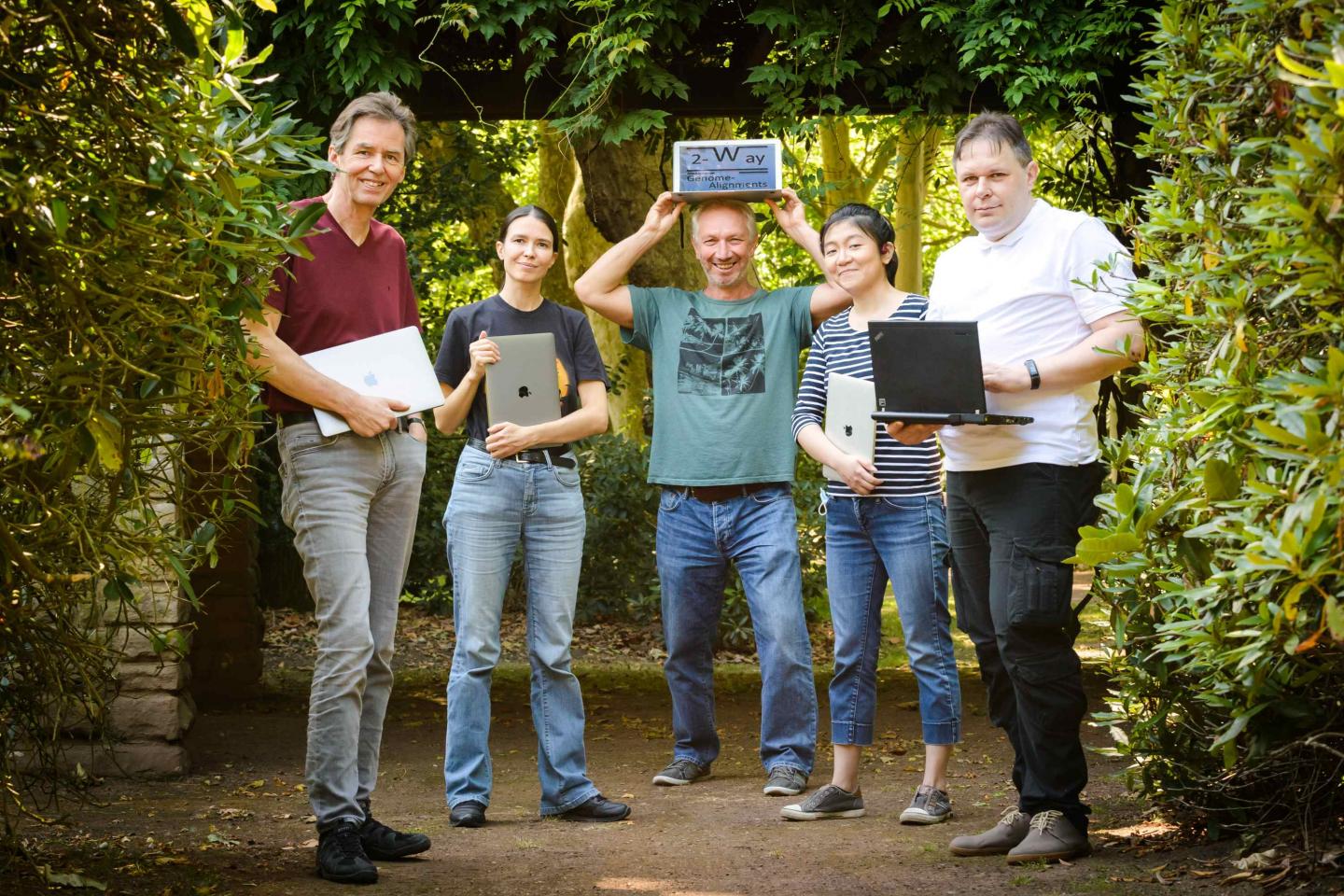
Credit: Erk Wibberg
Evolution leaves its traces in particular in genomes. Pinpointing its influence is a laborious process – but one in which Dr. Jürgen Schmitz and his team at the University of Münster are at home. Five years ago, the team made public a web app which can compare the genomes of humans and animals and thus help to provide an understanding of evolutionary developments. The Münster researchers are now going one step further: their new software – “2-n-way” – can compare any genomes from and for anyone and systematically search for regions which are characterized by the presence or absence of certain sequences – or, to put it simply, what is missing and where in the genome and when it got lost or when it newly emerged. This makes it possible to recognize relationships among species or individuals. The Münster researchers have now published details of their new development – which, like its predecessor – is freely available on the internet – in the journal Genome Research.
Jürgen Schmitz, a biologist and zoologist at the Institute of Experimental Pathology at Münster University’s Faculty of Medicine, led the study together with Dr. Gennady Churakov and for him it represents a “unique, forward-pointing opportunity to take a close look at the mutability of multiple genomes”. It means that not only genome evolutions can be analysed, but also the occurrence of genetic diseases as a result of deletions or insertions – i.e. the loss of a DNA segment or the insertion of a new one. The decisive difference between the new model and its predecessor, GPAC – which has been used hundreds of thousands of times since it was activated – is that 2-n-way can sequence any number of genomes. “The tool is a response to the modern genomic era – and it is a piece of software which, despite the complexity behind it, can be used by anyone, whether a non-medical layperson, a student or a professor. Last but not least, the tool links up a very wide range of areas, such as evolution, population genetics and medicine” says Schmitz.
The term “2-n-way” is derived from two abbreviations used by specialists: “2-way” stands for the linear alignment of sequences to be compared; and “n-way” means the combination of individual components and the subsequent multiple comparison. But users do not need to know such background information. “They only have to download on the internet the genomes they want to compare. One source, for example, is the website of the National Center for Biotechnology Information (NCBI) in the USA. The genomes fed into 2-n-way are then aligned with each other by the software. The genes which are of particular interest are selected from the genomic “coordinates” – or “loci”, to give them their proper technical term. “The search can be geared for example to some or all of the so-called jumping genes, i.e. those genes which have changed their position in the genome,” Schmitz explains.
If for example a search is made for certain jumping genes in humans, chimpanzees or rhesus monkeys, the results are given in a table with “plus” and “minus”. If the evaluation contains two finds and an exact gap in the rhesus monkey, then the conclusion is that humans and chimpanzees have inherited the jumping gene from a common ancestor and are therefore closely related – while the rhesus monkey still displays the original locus without any insertion and is therefore only distantly related. However, the software not only indicates whether a certain insertion is present, but also the region in which it is to be found. In addition to the table of correlations, 2-n-way also provides the user with a list of DNA sequences for all loci.
Although the new tool has only just been made public, the team of researchers is already looking ahead – working on the simplification of the individual creation of 2-ways, i.e. the alignment. “This is a process which, at the moment, can take up a lot of time – which is a bit annoying,” says Schmitz. Otherwise, he comments, the tool “has been tested intensively and is absolutely perfect”.
###
Media Contact
Dr. Jürgen Schmitz
[email protected]
Original Source
https:/
Related Journal Article
http://dx.