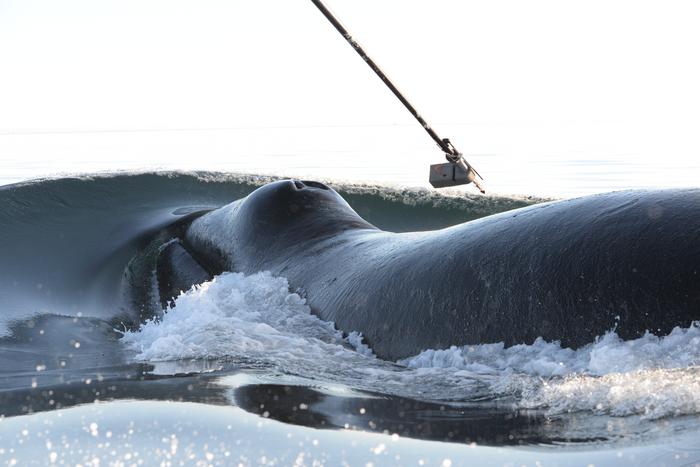
Applying chaos theory to the movement of iconic arctic whales uncovered a 24-hour diving cycle and a long-range (~100 km) synchronization.
Applying chaos theory to the movement of iconic arctic whales uncovered a 24-hour diving cycle and a long-range (~100 km) synchronization.
Bowhead whales are among the largest and longest-lived mammals in the world. They play a vital role in the marine ecosystems of the Arctic Ocean, yet relatively little is known about their foraging and diving behaviors. Now, in a paper to be published in the journal Physical Review Research, a team of scientists from Japan, Greenland and Denmark have detected patterns in the whales’ behavior that could offer clues into how they forage and socialize.
Associate Professor Evgeny A. Podolskiy at the Arctic Research Center, Hokkaido University, Professor Jonas Teilmann at the Department of Ecoscience, Aarhus University, and Professor Mads Peter Heide-Jørgensen at the Department of Birds and Mammals, Greenland Institute of Natural Resources, studied 144 days of diving records of 12 bowhead whales tagged in Disko Bay, West Greenland. Because whale diving behavior can be seen as a chaotic, self-sustained oscillation that balances the need for food at depths with the need for oxygen at the surface, the researchers used a dynamical systems chaos approach to uncover patterns within the apparently disorderly collective behavior.
Their analysis detected a 24-hour cycle of diving during the spring, with the whales swimming deepest in the afternoon to track the daily movement of their prey towards the surface, a phenomenon known as the diel vertical migration.
“We find that foraging whales dive deeper during the daytime in spring, with this diving behavior being in apparent synchrony with their vertically migrating prey,” said Heide-Jørgensen. “Until now, this hasn’t been shown for spring, and remained contradictory for autumn.”
The research team also made the surprising discovery of two bowhead whales diving in synchrony over the course of a week at a time, even when they were around one hundred kilometers apart. The pair — one female and one of unknown sex — were sometimes as close as five kilometers and sometimes hundreds of kilometers apart, yet they would closely time their diving bouts for durations of up to a week, although to different depths. The synchronization was observed when they were within acoustic range of each other, which can exceed 100 kilometers, although the researchers didn’t record the whales’ sounds to determine whether they were interacting, as it remains a technically challenging task.
“Without direct observations, such as recordings of the two whales, it isn’t possible to determine that the individuals were exchanging calls,” said Teilmann, nevertheless, “the observed subsurface behavior might be the first evidence supporting the acoustic herd theory of long-range signaling in baleen whales proposed by Payne and Webb back in 1971.”
“The possibility of acoustically connected whales, which seem to be diving alone but are actually together, is mind bending. Our study identifies a framework for studying the sociality and behavior of such chaotically moving, unrestrained marine animals, and we encourage the research community to collect more simultaneous tag data to confirm if our interpretation is appropriate,” Podolskiy concluded.
Journal
Physical Review Research
Method of Research
Data/statistical analysis
Subject of Research
Animals
Article Title
Synchronization of bowhead whales
Article Publication Date
15-Aug-2024