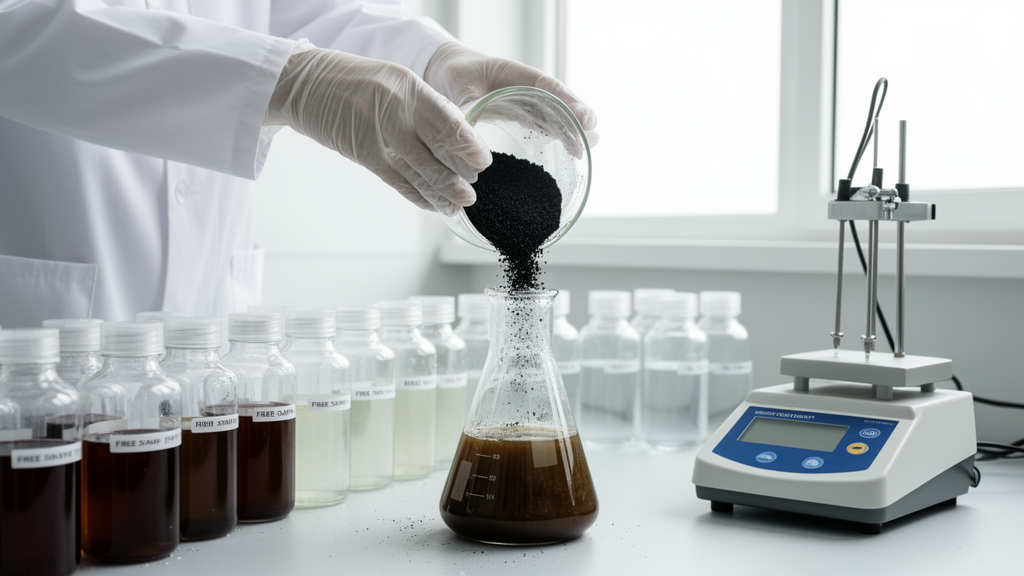
Untreated wastewater from the Kumasi Abattoir in Ghana carries pollution loads far above regulatory limits, with a chemical oxygen demand of 6613.33 ± 46.19 mg/L and a five-day biochemical oxygen demand of 1832.28 ± 28.57 mg/L, according to a peer-reviewed study published in Discover Chemical Engineering. The research, led by Solomon Nandomah with colleagues including Isaac K. Tetteh, Ibrahim Issahaku, Antonia Y. Tetteh and Lawson Mensah, tested whether a locally engineered, bio-based adsorbent could bring these figures down.
The adsorbent, called P-32 Powdered Activated Carbon, was applied in batch adsorption experiments at doses ranging from 5 to 25 grams per litre of effluent. Standard methods were used for sample collection and analysis. The researchers framed their question as a formal hypothesis — that P-32 PAC would effectively remediate COD and BOD5 in the abattoir effluent — and tested it with a paired-samples t-test. At the highest dose of 25 g/L, the material removed 69.4% of total COD and 73.7% of BOD5, a result the authors report as statistically significant (p = 0.0014; Cohen’s d > 2.9), allowing them to reject the null hypothesis.
A key diagnostic finding shaped the treatment strategy. The effluent’s biodegradability index was 0.28 ± 0.01, which the authors interpret as limited potential for biological treatment and, therefore, a need for physical-chemical remediation approaches such as adsorption. Because much of the organic load resists microbial breakdown, conventional biological treatment trains would struggle with this waste stream, making an adsorbent-based route a practical alternative for high-strength abattoir wastewater.
Beyond the removal percentages, the study characterised how the adsorbent and the pollutants interact. Adsorbent-adsorbate interactions were examined with linear and nonlinear adsorption isotherms: the linear Langmuir model described COD behaviour, while the Freundlich model described BOD5. To predict the dosage needed to reach regulatory limits, the team compared polynomial and modified exponential decay models. The polynomial predictive model showed superior fit, with root-mean-square errors of 85.50 for COD and 24.73 for BOD5, and it estimated optimal adsorbent masses of 34.07 g/L for COD remediation and 28.12 g/L for BOD5 — figures above the maximum 25 g/L tested in the batch experiments, indicating that the doses required for full compliance still need experimental confirmation.
The authors position P-32 PAC as an effective, eco-friendly adsorbent for high-strength abattoir effluent treatment, with implications for scalable wastewater solutions in resource-limited settings. The study is published open access, and the version currently available is shared early as accepted peer-reviewed research, subject to further edits before the final Version of Record. As with any batch adsorption study, the results reflect controlled laboratory conditions on effluent from a single site; the reported removals apply to the tested doses and the Kumasi Abattoir sample, and the predicted optimal doses come from model estimates rather than direct measurements. Nevertheless, the work offers a concrete, locally producible option for treating one of the more difficult organic waste streams in the region, where abattoir effluent is discharged with limited treatment and poses environmental and public health risks.
Subject of Research: Use of a locally engineered bio-based powdered activated carbon to remediate COD and BOD5 in abattoir effluent from Kumasi, Ghana.
Article Title: Remediation of chemical and biochemical oxygen demand in untreated abattoir effluent using a locally engineered bio-based adsorbent
Article References: Nandomah, S., Tetteh, I. K., Issahaku, I., Tetteh, A. Y., & Mensah, L. (2026). Remediation of chemical and biochemical oxygen demand in untreated abattoir effluent using a locally engineered bio-based adsorbent. Discover Chemical Engineering. https://doi.org/10.1007/s43938-026-00140-0
Image Credits: AI Generated
DOI: 10.1007/s43938-026-00140-0
Keywords: abattoir effluent, powdered activated carbon, chemical oxygen demand, biochemical oxygen demand, adsorption isotherms, wastewater treatment, Ghana, biodegradability index, batch adsorption, dosage prediction model, Remediation, chemical
News Source: Bethany Barker. (October 28, 2026). Locally made powdered activated carbon cuts abattoir effluent COD and BOD in batch tests. Scienmag.