• HOME
  • NEWS
  • EXPLORE
    • CAREER
      • Companies
      • Jobs
    • EVENTS
    • iGEM
      • News
      • Team
    • PHOTOS
    • VIDEO
    • WIKI
  • BLOG
  • COMMUNITY
    • FACEBOOK
    • INSTAGRAM
    • TWITTER
Sunday, August 30, 2026
BIOENGINEER.ORG
No Result
View All Result
  • Login
  • HOME
  • NEWS
  • EXPLORE
    • CAREER
      • Companies
      • Jobs
        • Lecturer
        • PhD Studentship
        • Postdoc
        • Research Assistant
    • EVENTS
    • iGEM
      • News
      • Team
    • PHOTOS
    • VIDEO
    • WIKI
  • BLOG
  • COMMUNITY
    • FACEBOOK
    • INSTAGRAM
    • TWITTER
  • HOME
  • NEWS
  • EXPLORE
    • CAREER
      • Companies
      • Jobs
        • Lecturer
        • PhD Studentship
        • Postdoc
        • Research Assistant
    • EVENTS
    • iGEM
      • News
      • Team
    • PHOTOS
    • VIDEO
    • WIKI
  • BLOG
  • COMMUNITY
    • FACEBOOK
    • INSTAGRAM
    • TWITTER
No Result
View All Result
Bioengineer.org
No Result
View All Result
Home NEWS Science News Biology

Living components

Bioengineer by Bioengineer
July 22, 2019
in Biology
Reading Time: 2 mins read
0
IMAGE
Share on FacebookShare on TwitterShare on LinkedinShare on RedditShare on Telegram

IMAGE

Credit: Photo: AG Walther

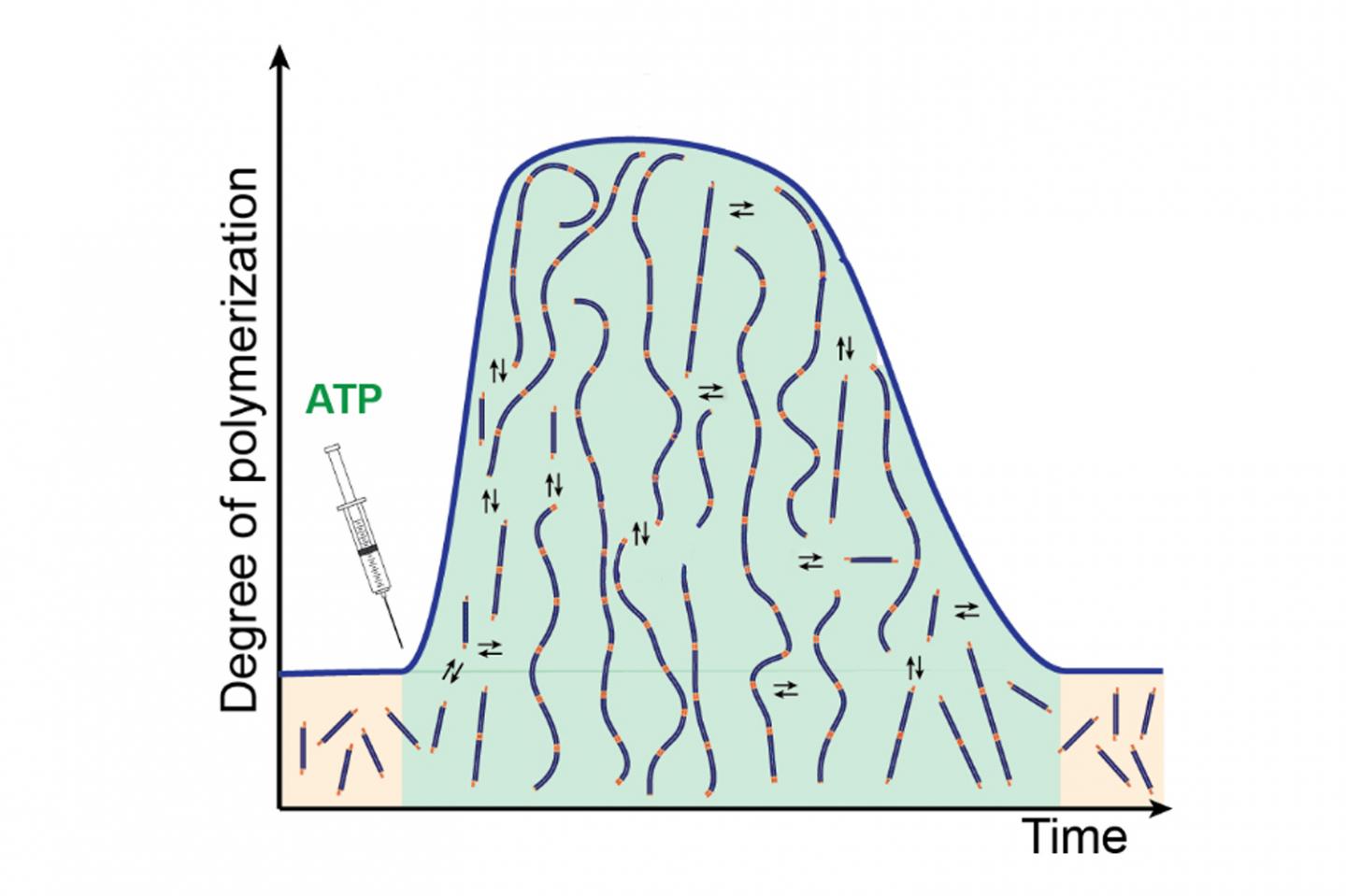
Cells assemble dynamically: their components are continuously exchanging and being replaced. This enables the structures to adapt easily to different situations, and by rearranging the components to respond to stimuli faster, to renew or to form just on demand. The microtubules, a scaffold structure made of protein fibers that can be found in the cytoplasm of the cells of algae, plants, fungi, animals and humans, are one such dynamic mesh. Because of their self-organizing structure, these fibers constantly form and degrade at the same time, thereby actively supporting the cell in complex tasks such as cell division or locomotion. The fibers require energy to form and maintain such dynamic states. Now, for the first time, Prof. Dr. Andreas Walther and Dr. Laura Heinen from the Institute for Macromolecular Chemistry and the Center of Interactive Materials and Bioinspired Technologies (FIT) at the University of Freiburg have succeeded in programming the dynamics of such dissipative, i.e. energy-consuming, structures in an artificial chemical system on the basis of DNA components. The researchers present their results in the latest edition of the journal Science Advances.

The difficulty of programmable structural dynamics in synthetic dissipative systems is the synchronization of the energetic deactivation and activation with the structural build-up and degradation of the components. The Freiburg researchers were able to solve the problem by using an energy-driven, dynamic covalent bond, that is responsible for the firm cohesion of atoms, in the backbone of the DNA sequences. The covalent bond is herein formed through the catalytic activity of the enzyme T4 DNA ligase, and simultaneously split at the very same site by a restriction enzyme, which can recognize and cut DNA at specific positions. This newly-formed system is reversible and results directly in structural dynamics, which distinguishes it from previous artificially-generated dissipative structures.

The study, which took place with the aid of Walther’s ERC Starting Grant “TimeProSAMat”, uses the dynamic synthesis of a polymer of DNA fragments, to show scientists how the lifetime, exchange frequency, or relative bond fraction of the DNA polymers can be controlled in dependence of the chemical fuel adenosine triphosphate and the enzyme concentrations. The Freiburg researchers were able to sustain these dynamic steady states for several days. The chemical modifications of DNA to use it as a construction material are versatile and there are also many available restriction enzymes, explains Heinen, “So our concept enables wide-ranging access to innovative functional materials, which act outside thermodynamic equilibrium. And it does so with so far unique programming possibilities in its dynamic structural characteristics.”

###

Original publication:

Heinen, L., Walther, A. (2019): Programmable dynamic steady states in ATP-driven nonequilibrium DNA systems. In: Science Advances. Vol. 5, no. 7. DOI: 10.1126/sciadv.aaw0590

Contact:

Institute for Macromolecular Chemistry and FIT – Freiburg Center of Interactive Materials and Bioinspired Technologies
University of Freiburg

Media Contact
Prof. Dr. Andreas Walther
[email protected]

Related Journal Article

http://dx.doi.org/10.1126/sciadv.aaw0590

Tags: BiochemistryBiologyCell Biology
Share12Tweet8Share2ShareShareShare2

Related Posts

Fertility benefits may explain why harmful disease genes persist in humans

Fertility benefits may explain why harmful disease genes persist in humans

August 30, 2026
New atlas reveals mesenchymal diversity in human gut and organoids

New atlas reveals mesenchymal diversity in human gut and organoids

August 30, 2026

New spatial transcriptomics method maps RNA isoforms across primate brain cells

August 30, 2026

Transcription factors steer distinct pancreatic cancer cell states and drug dependencies

August 30, 2026
Please login to join discussion

POPULAR NEWS

  • Waldenström’s macroglobulinemia in siblings: 25 years of institutional cases reviewed

    29 shares
    Share 12 Tweet 7
  • Disrupting CDK4/6–RARα–NF-κB axis eases senescence inflammation, improving aging and chemotherapy recovery

    29 shares
    Share 12 Tweet 7
  • NPTN gene variants linked to autism through disrupted brain cell signaling

    29 shares
    Share 12 Tweet 7
  • BEGONIA trial: durvalumab plus trastuzumab deruxtecan for HER2-low metastatic breast cancer

    29 shares
    Share 12 Tweet 7

About

We bring you the latest biotechnology news from best research centers and universities around the world. Check our website.

Follow us

Recent News

Waldenström’s macroglobulinemia in siblings: 25 years of institutional cases reviewed

Disrupting CDK4/6–RARα–NF-κB axis eases senescence inflammation, improving aging and chemotherapy recovery

NPTN gene variants linked to autism through disrupted brain cell signaling

Subscribe to Blog via Email

Enter your email address to subscribe to this blog and receive notifications of new posts by email.

Join 85 other subscribers
  • Contact Us

Bioengineer.org © Copyright 2023 All Rights Reserved.

Welcome Back!

Login to your account below

Forgotten Password?

Retrieve your password

Please enter your username or email address to reset your password.

Log In
No Result
View All Result
  • Homepages
    • Home Page 1
    • Home Page 2
  • News
  • National
  • Business
  • Health
  • Lifestyle
  • Science

Bioengineer.org © Copyright 2023 All Rights Reserved.