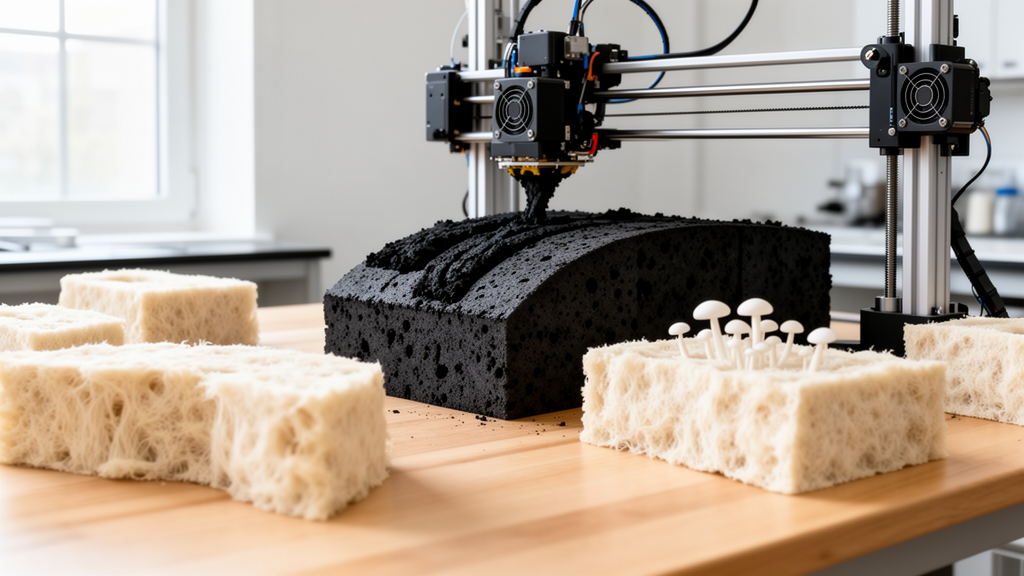
Researchers at the journal Architectural Intelligence report an experimental study in which building components were 3D printed from a paste of fungal mycelium and biochar, then grown and finally fused into a single element by the living organism itself. The study, led by Raffaele Errichiello and Julio C. Diarte Almada and published on 18 June 2026, used Liquid Deposition Modeling, a paste-extrusion form of 3D printing, to fabricate mycelium-based composites reinforced with biochar, a carbon-rich material produced by heating organic waste in the absence of oxygen. The work addresses two persistent weaknesses of mycelium composites in construction: high shrinkage during growth and drying, and low mechanical performance.
Mycelium-based composites form when fungal hyphae colonize and bind lignocellulosic substrates such as sawdust, producing lightweight, foam-like materials that can sequester carbon and offer thermal and acoustic insulation. Printing such pastes is difficult because the material must flow through a nozzle yet retain its shape immediately after deposition, and shrinkage during growth and drying often compromises dimensional accuracy. Reported shrinkage rates for composites incorporating lignocellulosic substrates range from 9 to 20 percent, and characterization studies have compiled compressive strengths between roughly 0.25 and 1.87 megapascals, far below the 17 megapascals typically required for low-density structural applications.
The researchers paired biochar, which had not previously been tested with mycelium in additive manufacturing, with printing toolpaths inspired by the reaction-diffusion geometry visible on brain corals. Reaction-diffusion patterns, first formalized by Alan Turing in 1952, arise when substances that react locally and diffuse spatially spontaneously generate stable spots, stripes, and labyrinths. In the printed elements, these patterns were translated into alternating oxygen-rich corridors, where the material is porous and aerial mycelium can develop, and material-dense regions the authors call densification belts, where overlapping extrusions improve buildability and load transfer.
The experimental program consisted of eight iterative tests in two sequential sets. The first set screened biochar-mycelium mixes for compatibility and printability in small cylinders, compared nutrient sources, integrated the biomimetic toolpath, and added wood fibers to supply lignin. The second set upscaled the approach to a demonstrator 400 millimeters in diameter and height, parameterized the geometry around two design constants, merging point density and porosity, refined the mix with cellulose from recycled cardboard pulp, mapped the printability window for curved overhangs kept below 45 degrees, and finally joined printed segments by bio-welding, a process in which a thin layer of fresh composite paste reactivates the mycelium so its hyphae grow across the interface and fuse the parts into a continuous element.
Printability depended strongly on formulation. In the first test, mixes with lower mycelium content and higher biochar content, roughly 20 to 25 percent biochar by weight, printed most cleanly, consistent with prior literature identifying that range as optimal before particle agglomeration degrades properties. The granular biochar appears to fulfill part of the structural role that gelling agents play in other formulations, contributing to shape retention without the viscosity peaks that cause nozzle clogging. Nutrient choice proved equally consequential: among tapioca, wheat, and rice flour, rice flour delivered the most consistent mycelial growth with no visible contamination, an observation the authors suggest may reflect antimicrobial mechanisms of starch type not yet explored in the literature.
The most striking dimensional result came from specimens combining the coral-inspired geometry with sawdust: vertical shrinkage of only 3 to 5 percent, measured through photographic analysis, below the 9 to 20 percent range typical of lignocellulosic mycelium composites. When cellulose was added in the second test set, shrinkage rose to 5 to 13 percent, suggesting that the cellulose ratio is a primary driver of dimensional change. The authors propose an analogous mechanism to that documented in cementitious materials, where biochar’s porous structure acts as an internal water reservoir moderating moisture loss; in the mycelium composites, its capillary network may similarly buffer drying, though this remains an interpretation rather than a directly measured effect.
Preliminary uniaxial compression tests on selected specimens recorded compressive strengths between 0.66 and 2.13 megapascals and elastic moduli between 12.42 and 37.11 megapascals, with a progressive, foam-like response and no brittle fracture. The authors caution that these values are indicative only: four replicas were tested for two formulations and single specimens for the others, so the sample sizes do not support statistically significant comparisons across formulations. Even the strongest reported compressive strength in the wider 3D-printed mycelium composite literature, 1.03 megapascals, remains two to three orders of magnitude below structural concrete, and the authors frame plausible applications as lightweight, compression-dominated elements such as shells, vaults, and domes whose geometry keeps stresses compressive.
The upscaled demonstrator revealed both the promise and the limits of the method. A first attempt to print the full element in one run collapsed under the weight of the wet composite, so the prototype was segmented into three parts along its height. Each segment printed cleanly, colonized uniformly over 14 days at 24 degrees Celsius, and was bio-welded with a thin layer of fresh paste, producing visually continuous seams and uniform surface colonization. However, dimensional stability remained inconsistent: the segments showed total deformations of 22, 19, and 15 percent respectively across printing, incubation, and drying, and the demonstrator collapsed progressively under self-weight in the wet state, continuing to deform during drying. The overall profile was therefore not preserved, even though material continuity across the seam was.
The authors are explicit about what their observations do and do not establish. The functional roles attributed to oxygen corridors and densification belts are hypothesized architectural features based on macroscopic visual inspection; no finite element analysis, oxygen sensing, or porosity-gradient measurement was performed, so no claim of a functionally graded material in the strict mechanical sense is made. Key material inputs, including the biochar’s feedstock and pyrolysis conditions and the composition of the workshop sawdust and wood-fiber pellets, remain unknown, limiting strict reproducibility. Environmental durability was not addressed, and fire reaction, acoustic attenuation, and hygrothermal performance remain untested, while no building code currently recognizes mycelium composites as construction materials.
Within those limits, the study contributes a documented workflow coupling biochar-mycelium formulations with biomimetic toolpaths, traced from coupon-scale specimens to a bio-welded demonstrator. Because the element was air-dried rather than heat-dried, the seam remains biologically reactivatable, supporting a prefabrication logic in which components are printed, grown, dried, and stored as inert stock, then joined on site with a moist composite bed that triggers biological reactivation. The authors note that such components must be protected from uncontrolled moisture and weathering, restricting near-term applications to interior partitions, insulation panels, acoustic elements, and protected envelope components, and that future work will focus on water regulation for dimensional stability and mechanical analysis of the printed gradients.
Subject of Research: Experimental 3D printing of biochar-mycelium composites via liquid deposition modeling for sustainable building components
Article Title: Experimental study of 3D printed biochar-mycelium composites via liquid deposition modeling for sustainable building components: compatibility, shrinkage control, structural integrity and prefabrication
Article References: Errichiello, R., & Diarte Almada, J. C. (2026). Experimental study of 3D printed biochar-mycelium composites via liquid deposition modeling for sustainable building components: compatibility, shrinkage control, structural integrity and prefabrication. Architectural Intelligence, 5(1), Article 16. https://doi.org/10.1007/s44223-026-00125-7
Image Credits: AI Generated
DOI: 10.1007/s44223-026-00125-7
Keywords: mycelium-based composites, biochar, 3D printing, liquid deposition modeling, biomimetic toolpaths, shrinkage control, bio-welding, prefabrication, compressive strength, sustainable construction, reaction-diffusion geometry, carbon sequestration
News Source: Denise Maddox. (October 29, 2026). Living Bricks: 3D Printed Biochar-Mycelium Composites Grow Into Building Components. Scienmag.