• HOME
  • NEWS
  • EXPLORE
    • CAREER
      • Companies
      • Jobs
    • EVENTS
    • iGEM
      • News
      • Team
    • PHOTOS
    • VIDEO
    • WIKI
  • BLOG
  • COMMUNITY
    • FACEBOOK
    • INSTAGRAM
    • TWITTER
Tuesday, February 3, 2026
BIOENGINEER.ORG
No Result
View All Result
  • Login
  • HOME
  • NEWS
  • EXPLORE
    • CAREER
      • Companies
      • Jobs
        • Lecturer
        • PhD Studentship
        • Postdoc
        • Research Assistant
    • EVENTS
    • iGEM
      • News
      • Team
    • PHOTOS
    • VIDEO
    • WIKI
  • BLOG
  • COMMUNITY
    • FACEBOOK
    • INSTAGRAM
    • TWITTER
  • HOME
  • NEWS
  • EXPLORE
    • CAREER
      • Companies
      • Jobs
        • Lecturer
        • PhD Studentship
        • Postdoc
        • Research Assistant
    • EVENTS
    • iGEM
      • News
      • Team
    • PHOTOS
    • VIDEO
    • WIKI
  • BLOG
  • COMMUNITY
    • FACEBOOK
    • INSTAGRAM
    • TWITTER
No Result
View All Result
Bioengineer.org
No Result
View All Result
Home NEWS Science News Chemistry

Liquid water is more than just H2O molecules

Bioengineer by Bioengineer
July 9, 2020
in Chemistry
Reading Time: 2 mins read
0
IMAGE
Share on FacebookShare on TwitterShare on LinkedinShare on RedditShare on Telegram

IMAGE

Credit: Skoltech

Skoltech scientists in collaboration with researchers from the University of Stuttgart showed that the concentration of short-lived ions (H3O+ and OH-) in pure liquid water is much higher than that assumed to evaluate the pH, hence significantly changing our understanding of the dynamical structure of water.

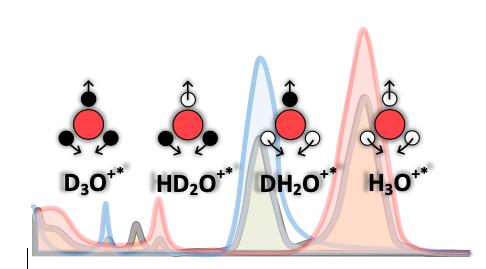
Figure: infrared spectra of light (red), heavy (blue), semiheavy (gray) water, and ionic species that have been identified in the current study. Red, white and black circles depict oxygen, hydrogen and deuterium atoms, respectively. Arrows show the directions of species vibrational deformation.

Intrinsic ionic species of liquid water play an important role in the redox processes, catalytic reactions and electrochemical systems. A low-barrier tunneling of hydrogen atom between the H2O molecules, caused by nuclear quantum effects, is expected to generate short-lived excess proton states. However, to date, there has been no information on the concentration of such excess protons states in pure water.

Skoltech scientists in collaboration with German researchers measured the ion-molecular composition of liquid water on the sub-picosecond time scale. The result surprised scientists as they observed that up to several percent of H2O molecules were temporarily ionized.

“We used water isotopologues: ordinary (H2O), heavy (D2O), and semi-heavy (HDO) water, to identify excess-proton states. By gradually substituting the hydrogen atoms (H) with deuterium (D), we changed the relative concentration of excess-proton-related species, such as HD2O+, DH2O+, H3O+ and D3O+, and identified their contributions to the cumulative infrared absorption. We found concentration-dependent spectral features near molecular bending modes of semi-heavy water spectra that no known model was able to explain. We associated these features with excess protons that may be expected to exist on the picosecond time scale,” said one of the co-authors, Prof. Henni Ouerdane from the Skoltech Center for Energy Science and Technology (CEST).

“While previous studies of water structure were based on crystallographic experiments, and did not reflect the dynamics of water, our research brings new insights into the intricate water structure at ultra-short time scale. The finding anticipates new effects of electric field interaction with water, as well as other anomalous properties of water,” concluded the lead author, Dr. Vasily Artemov, Senior Research Scientist at CEST.

###

Media Contact
Alina Chernova
[email protected]

Related Journal Article

http://dx.doi.org/10.1038/s41598-020-68116-w

Tags: Chemistry/Physics/Materials SciencesIndustrial Engineering/Chemistry
Share12Tweet8Share2ShareShareShare2

Related Posts

Theoretical Insights into Cluster Radioactivity Under Intense Laser Fields

Theoretical Insights into Cluster Radioactivity Under Intense Laser Fields

February 3, 2026
Breakthrough in Highly Selective Asymmetric 1,6-Addition of Aliphatic Grignard Reagents to Unsaturated Carbonyl Compounds

Breakthrough in Highly Selective Asymmetric 1,6-Addition of Aliphatic Grignard Reagents to Unsaturated Carbonyl Compounds

February 2, 2026

Enhancing Efficiency in Robotic Joint Design

February 2, 2026

The Hidden Chemistry of Ozone: Unlocking the Secrets Behind Clean Air

February 2, 2026
Please login to join discussion

POPULAR NEWS

  • Enhancing Spiritual Care Education in Nursing Programs

    157 shares
    Share 63 Tweet 39
  • Robotic Ureteral Reconstruction: A Novel Approach

    81 shares
    Share 32 Tweet 20
  • Digital Privacy: Health Data Control in Incarceration

    63 shares
    Share 25 Tweet 16
  • Study Reveals Lipid Accumulation in ME/CFS Cells

    57 shares
    Share 23 Tweet 14

About

We bring you the latest biotechnology news from best research centers and universities around the world. Check our website.

Follow us

Recent News

Intracortical Microstimulation Leads to Surprising Partial Restoration of Natural Vision in Blind Patient

Magneto-Mechanical Forces Reprogram Macrophages for Tumor Immunity

From Ocean to Earth: Molecular Insights Reveal Algae’s Evolution into Plants

Subscribe to Blog via Email

Enter your email address to subscribe to this blog and receive notifications of new posts by email.

Join 73 other subscribers
  • Contact Us

Bioengineer.org © Copyright 2023 All Rights Reserved.

Welcome Back!

Login to your account below

Forgotten Password?

Retrieve your password

Please enter your username or email address to reset your password.

Log In
No Result
View All Result
  • Homepages
    • Home Page 1
    • Home Page 2
  • News
  • National
  • Business
  • Health
  • Lifestyle
  • Science

Bioengineer.org © Copyright 2023 All Rights Reserved.