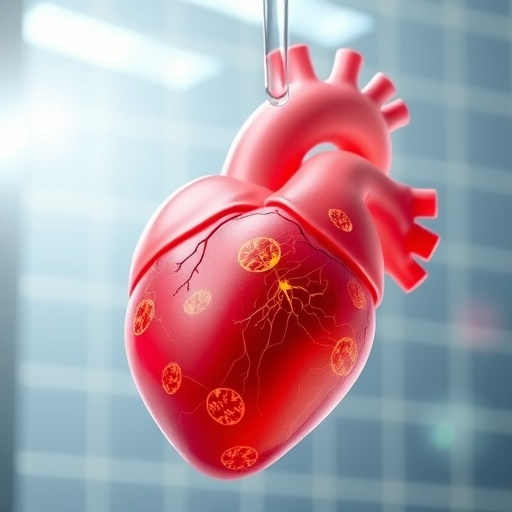
In a groundbreaking development that could reshape the therapeutic landscape of cardiovascular medicine, researchers have unveiled an innovative approach that harnesses the power of active mitochondria condensed within liquid–liquid phase-separated hydrogels to treat myocardial ischemia-reperfusion injury. This novel methodology represents a significant leap forward in addressing one of the most challenging complications following heart attacks, namely the damage caused when blood supply returns to the heart after a period of ischemia. The findings of this pioneering study, conducted by Ai, J., Xiao, Y., Li, Q., and colleagues, and published in Nature Communications in 2026, open new pathways for mitochondrial transplantation strategies that could revolutionize cardiac repair.
Myocardial ischemia-reperfusion injury occurs when oxygen-deprived heart tissue is suddenly re-oxygenated, paradoxically inducing further cellular damage through a cascade of oxidative stress and inflammation. Current treatments have limited efficacy in fully restoring cardiac function or preventing long-term heart failure resulting from such injuries. Recognizing the urgent need for more effective interventions, the researchers sought to exploit the intrinsic bioenergetic and regenerative potentials of mitochondria—the cell’s powerhouse—by transplanting them directly into damaged heart tissue.
The innovative aspect of their research lies in the use of liquid–liquid phase-separated hydrogels as vehicles to deliver active mitochondria to the ischemic myocardium. These hydrogels represent a sophisticated biomaterial system characterized by their ability to separate into two liquid phases without forming solid precipitates, thus mimicking intracellular compartmentalization and providing an optimal microenvironment for mitochondrial stability and function. This phase separation technology ensures that the mitochondria remain metabolically active during and after transplantation, significantly enhancing their therapeutic efficacy.
Mechanistically, mitochondria are double-membrane organelles responsible for producing adenosine triphosphate (ATP), the primary energy currency of the cell. In ischemia-reperfusion scenarios, mitochondria sustain severe damage, impairing ATP production, elevating reactive oxygen species (ROS) generation, and triggering apoptosis. By transplanting exogenous, functionally competent mitochondria embedded in phase-separated hydrogels, the researchers aimed to replenish the pool of healthy mitochondria within cardiac cells, restore bioenergetic balance, and mitigate oxidative damage.
The liquid–liquid phase-separated hydrogels were carefully engineered from biocompatible polymers capable of forming dynamic yet stable compartments that encapsulate mitochondria in a hydrated, nutrient-rich matrix. This matrix not only protects the mitochondria during delivery but also facilitates their gradual release and integration into host cardiomyocytes. The hydrogel’s properties, including shear-thinning behavior and self-healing capacity, allowed minimally invasive administration via injection, making this approach potentially suitable for acute clinical settings.
In preclinical models of myocardial ischemia-reperfusion injury, the transplantation of mitochondria-hydrogel composites led to remarkable improvements in cardiac function. Echocardiographic assessments revealed enhanced ejection fraction and cardiac output compared to control groups, indicating a substantial recovery of contractile activity. Histological analyses further corroborated these findings, showing reduced myocardial infarct size, diminished apoptosis, and attenuated inflammatory infiltrates in treated hearts.
At the cellular level, transplanted mitochondria successfully integrated into host cardiomyocytes, as demonstrated by advanced imaging techniques and mitochondrial-specific markers. This integration restored mitochondrial membrane potential, normalized ATP synthesis, and reduced mitochondrial ROS production. Such bioenergetic restoration was critical in preventing reperfusion-associated tissue necrosis and preserving myocardial integrity.
Beyond the immediate energetic benefits, the study also uncovered that the mitochondrial transplantation modulated key signaling pathways associated with cell survival and inflammation. Notably, the activation of the PI3K/Akt pathway was enhanced, which is known to confer cardioprotective effects by promoting cell proliferation and inhibiting apoptosis. Simultaneously, the production of pro-inflammatory cytokines such as TNF-alpha and IL-6 was significantly suppressed, suggesting that mitochondrial transplantation contributes to creating a more favorable microenvironment for cardiac healing.
The implications of this research extend beyond myocardial ischemia-reperfusion injury. The liquid–liquid phase-separated hydrogel system for mitochondrial delivery could potentially be adapted for other organ systems affected by mitochondrial dysfunction, including neurodegenerative diseases, metabolic syndromes, and muscular disorders. The biomaterial’s versatility and the feasibility demonstrated in cardiovascular models set the foundation for broader translational applications.
Importantly, the safety profile of the mitochondrial transplantation approach was thoroughly evaluated. No significant immune rejection or adverse reactions were observed in animal models, underscoring the biocompatibility of both the hydrogels and the mitochondrial cargo. This paves the way for future clinical trials aimed at assessing therapeutic efficacy and safety in human subjects.
Technical challenges remain, such as optimizing mitochondrial isolation procedures to ensure maximum viability and functionality and fine-tuning hydrogel formulations for controlled release kinetics. Nonetheless, the present study offers a robust proof-of-concept that combining mitochondrial biology with advanced biomaterials can unlock new frontiers in regenerative medicine.
The authors highlight that their method leverages the fundamental principles of liquid-liquid phase separation—a phenomenon increasingly recognized in cellular biology as essential for organizing biochemical reactions spatially and temporally. By mimicking intracellular phase behaviors, the hydrogel system not only stabilizes the mitochondria but also recapitulates aspects of natural cellular microenvironments, enhancing transplant retention and performance.
Future research directions may include exploring synergistic therapies combining mitochondrial transplantation with pharmacological agents targeting mitochondrial biogenesis, antioxidant pathways, or autophagy. Combining such strategies could augment the reparative capacity of the heart, especially in chronic or severe ischemic conditions.
This breakthrough also invites a reevaluation of traditional approaches to mitochondrial replacement therapies. Instead of isolated mitochondrial injections, the integration of phase-separated hydrogels provides a platform for improving delivery precision, mitochondrial viability, and therapeutic outcomes. Such innovations could redefine treatment protocols for acute myocardial infarction and potentially reduce morbidity and mortality associated with ischemic heart disease.
In conclusion, the study by Ai et al. represents a landmark achievement in mitochondrial medicine and biomaterials science. By creatively employing liquid–liquid phase separation hydrogels as carriers for active mitochondria transplantation, the researchers have demonstrated a powerful new modality for ameliorating myocardial ischemia-reperfusion injury. The promising preclinical results lay the groundwork for clinical translation and herald a new era wherein bioenergetic rejuvenation of damaged cardiac tissue becomes a tangible reality.
As ischemic heart disease continues to impose a global health burden, innovative solutions like this mitochondrial-hydrogel transplantation strategy bring hope for more effective, targeted, and durable cardiac therapies. The convergence of cell biology, material science, and clinical medicine embodied in this research exemplifies the interdisciplinary approach necessary to tackle complex cardiovascular challenges. The future of heart repair may very well reside in the precise orchestration of subcellular components within engineered biomaterial frameworks, as elegantly demonstrated in this seminal work.
Subject of Research: Mitochondrial transplantation using liquid–liquid phase-separated hydrogels to treat myocardial ischemia-reperfusion injury
Article Title: Transplantation of active mitochondria condensed in liquid–liquid phase-separated hydrogels ameliorates myocardial ischemia-reperfusion injury
Article References:
Ai, J., Xiao, Y., Li, Q. et al. Transplantation of active mitochondria condensed in liquid–liquid phase-separated hydrogels ameliorates myocardial ischemia-reperfusion injury. Nat Commun (2026). https://doi.org/10.1038/s41467-026-71765-6
Image Credits: AI Generated
Tags: bioenergetic therapy for myocardial damagecardiac repair with mitochondriainnovative hydrogel drug delivery systemsliquid-phase mitochondria transplantationliquid–liquid phase-separated hydrogelsmitochondria-based heart injury healingmitochondrial transplantation strategiesmyocardial ischemia cellular repairmyocardial ischemia-reperfusion injury treatmentnovel cardiovascular therapies 2026oxidative stress in heart attacksregenerative medicine for heart injury