• HOME
  • NEWS
  • EXPLORE
    • CAREER
      • Companies
      • Jobs
    • EVENTS
    • iGEM
      • News
      • Team
    • PHOTOS
    • VIDEO
    • WIKI
  • BLOG
  • COMMUNITY
    • FACEBOOK
    • INSTAGRAM
    • TWITTER
Sunday, June 28, 2026
BIOENGINEER.ORG
No Result
View All Result
  • Login
  • HOME
  • NEWS
  • EXPLORE
    • CAREER
      • Companies
      • Jobs
        • Lecturer
        • PhD Studentship
        • Postdoc
        • Research Assistant
    • EVENTS
    • iGEM
      • News
      • Team
    • PHOTOS
    • VIDEO
    • WIKI
  • BLOG
  • COMMUNITY
    • FACEBOOK
    • INSTAGRAM
    • TWITTER
  • HOME
  • NEWS
  • EXPLORE
    • CAREER
      • Companies
      • Jobs
        • Lecturer
        • PhD Studentship
        • Postdoc
        • Research Assistant
    • EVENTS
    • iGEM
      • News
      • Team
    • PHOTOS
    • VIDEO
    • WIKI
  • BLOG
  • COMMUNITY
    • FACEBOOK
    • INSTAGRAM
    • TWITTER
No Result
View All Result
Bioengineer.org
No Result
View All Result
Home Headlines

Link identified between nerve cell proteins and middle-age onset Dementia

Bioengineer.org by Bioengineer.org
January 27, 2018
in Headlines, Health, Science News
Reading Time: 2 mins read
0
Share on FacebookShare on TwitterShare on LinkedinShare on RedditShare on Telegram
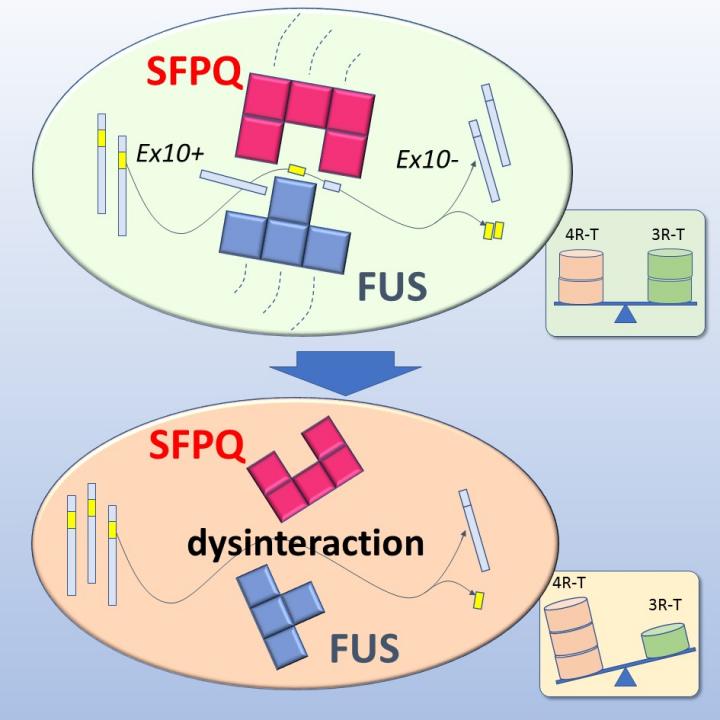
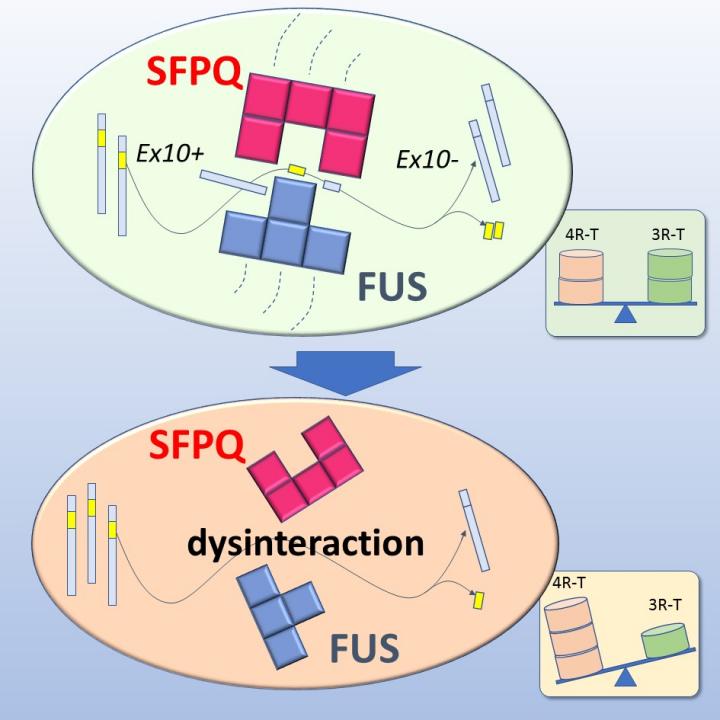
IMAGE

Credit: Yusuke Fujioka, Shinsuke Ishigaki, and Gen Sobue

Nagoya, Japan – Frontotemporal lobar degeneration (FTLD) is a type of dementia characterized by personality changes, language dysfunction, and abnormal behavior. It has an earlier onset than Alzheimer's disease, and is associated with a buildup of the tau protein in affected nerve cells (neurons).

Nagoya University-led Japanese research has now revealed that loss of the interaction between two RNA binding proteins changes the expression ratio of different forms of tau protein, producing the FTLD phenotype in mice, and that this could be rescued by rebalancing the tau ratio. The study was reported in Cell Reports.

The RNA binding protein FUS is linked to both familial and sporadic FTLD/ALS. The researchers investigated other proteins that bind the FUS complex within the nucleus and found another RNA metabolism regulator, SFPQ, to be key to the complex formation.

Both FUS and SFPQ control the process known as alternative splicing by which exons of a gene are joined to other exons or skipped altogether to produce different messenger RNAs and, consequently, different versions (isoforms) of the same protein. FUS/SFPQ-regulated alternative splicing of the Mapt gene at exon 10 produces two different tau isoforms (4R-T and 3R-T) that are usually balanced. However, the team showed that FUS or SFPQ silencing resulted in an excess of 4R-T over 3R-T.

The researchers generated mice lacking expression of FUS or SFPQ in a region of their brain important for memory and spatial navigation; the hippocampus. These mice were observed to have abnormal behaviors that resembled those of FTLD.

"They also had a reduced hippocampal volume, loss of neuronal cells, and less nerve cell growth than control animals," study first author Shinsuke Ishigaki says. "Crucially, the mice showed increased levels of a modified form of tau that is a known hallmark of FTLD and other neurodegenerative diseases."

The team attempted to rescue this disease phenotype in mice by rebalancing the 4R-T/3R-T ratio. "We achieved this by introducing a short sequence of RNA to block 4R-T expression," corresponding author Gen Sobue explains. "This recovered most of the changes associated with FTLD that had been caused by FUS or SFPQ silencing."

The researchers confirmed that the link between FUS/SFPQ and tau isoform regulation also exists in humans using a model from human stem cell-derived neurons and a mini-gene, implying a role for tau isoform imbalance in FTLD development in humans.

###

The article, "Altered Tau Isoform Ratio Caused by Loss of FUS and SFPQ Function Leads to FTLD-like Phenotypes" was published in Cell Reports at DOI: 10.1016/j.celrep.2017.01.013

Media Contact

Koomi Sung
[email protected]

http://www.nagoya-u.ac.jp/en/

Share12Tweet8Share2ShareShareShare2

Related Posts

Tracking Lanthanide-Labeled Microplastics in Plants

June 25, 2026

POSTECH Researchers Slash Cost of Reconstituted Cell-Free Systems by 95%

June 25, 2026

AI and Physics Collaborate to Design Advanced Hydrogen Storage Materials

June 25, 2026

Natural Hallucinogens: Evolution’s Ecological Tools, Not Mere Chemical Byproducts

June 25, 2026
Please login to join discussion

POPULAR NEWS

  • Saying Goodbye to PGY-6: Pediatric Fellowship Realities

    103 shares
    Share 41 Tweet 26
  • Multi-Hospital Study Reveals Long Covid Burden Is Twice as High as Current Estimates

    92 shares
    Share 36 Tweet 23
  • Detection of EDCs in Breast Milk and Infant Urine Up to Six Months Highlights Early Exposure Risks

    77 shares
    Share 31 Tweet 19
  • New Drug Candidate Developed at McMaster Shows Potential for Treating Brain Cancer

    58 shares
    Share 23 Tweet 15

About

We bring you the latest biotechnology news from best research centers and universities around the world. Check our website.

Follow us

Recent News

Tracking Lanthanide-Labeled Microplastics in Plants

POSTECH Researchers Slash Cost of Reconstituted Cell-Free Systems by 95%

AI and Physics Collaborate to Design Advanced Hydrogen Storage Materials

Subscribe to Blog via Email

Success! An email was just sent to confirm your subscription. Please find the email now and click 'Confirm' to start subscribing.

Join 82 other subscribers
  • Contact Us

Bioengineer.org © Copyright 2023 All Rights Reserved.

Welcome Back!

Login to your account below

Forgotten Password?

Retrieve your password

Please enter your username or email address to reset your password.

Log In
No Result
View All Result
  • Homepages
    • Home Page 1
    • Home Page 2
  • News
  • National
  • Business
  • Health
  • Lifestyle
  • Science

Bioengineer.org © Copyright 2023 All Rights Reserved.