Ling Li, associate professor in the Department of Mechanical Engineering, has been awarded $1.05 million over three years to lead a team studying the visual abilities of a unique underwater creature with thousands of eyes.
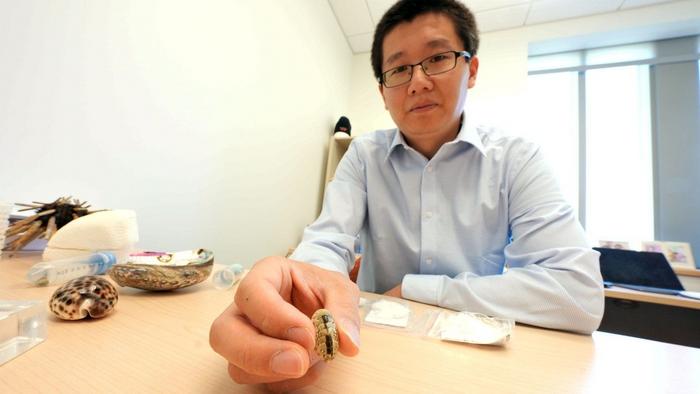
Credit: Photo by Alex Parrish for Virginia Tech.
Ling Li, associate professor in the Department of Mechanical Engineering, has been awarded $1.05 million over three years to lead a team studying the visual abilities of a unique underwater creature with thousands of eyes.
The project reunites Li with a former collaborator, University of South Carolina Associate Professor Daniel Speiser. They also enlisted the expertise of an internationally recognized applied mathematician who specializes in image processing, Daniel Baum of the Zuse Institute in Berlin.
What stony eyes see and what it means
The team’s research will focus on the stony eyes of chitons. These marine creatures have pill-shaped, hard outer shells with overlapping plates and soft inner bodies. Their shells are made of a calcium carbonate material called aragonite, one of the primary ingredients from which pearls are formed. To see its surroundings, a chiton uses thousands of tiny, stony eyes embedded in its shell’s armored plates, all formed from the same rugged material.
Speiser made early discoveries of the makeup of a chiton’s optic system, formulating ideas about the creature’s ability to see images. During Li’s Ph.D. studies at the Massachusetts Institute of Technology and subsequent postdoctoral work at Harvard, Li joined Speiser and collaborators to build off Speiser’s initial work and explore how the eyes work. Together, they devised an experimental setup allowing them to look directly through the chiton’s aragonite lens, seeing blurred but recognizable shapes.
Aragonite eyes are rigid and therefore cannot adjust their focus or viewing directions in the way the soft eyes of many creatures can. While Speiser and Li’s early work demonstrated the working principles and corresponding structural basis for single stony eyes, the animal’s ability to process visual information goes beyond individual eyes. These rigid optical elements are interconnected through a complex microscopic channel network that houses photosensitive cells and neural tissues, forming an integrated neural network. The animal gets visual feedback, but each eye isn’t processing much data. Because a single eye is roughly the width of a human hair, single-eye chiton vision is far from high-definition.
Still, a chiton’s shell has hundreds to thousands of those eyes. Do all the tiny images come back together in the chiton’s nervous system? Is it able to take those fragments and form a full picture? Does the visual information acquired from individual eyes reconstitute as a more high-definition image?
Answering new questions with a new team
Li and Speiser sought out funding opportunities to explore these new questions through their research. They secured a grant from the Human Frontier Science program, a booster of frontier, basic research focused on living organisms. The program provides research funding to support innovative research into fundamental biological problems, particularly projects with novel and interdisciplinary approaches that create international partnerships.
Li and Speiser’s project to uncover the working principles of the unique distributed sensing system of chitons was certainly novel.
Li’s team at Virginia Tech has established a storied history in exploring unique material design strategies from nature, having studied sea urchin-inspired ceramics and starfish microlattices. Speiser built a robust portfolio of projects at South Carolina in animal biology and physiology. The additional years of experience built in their respective labs gave them a deeper well of knowledge from which to draw and revisit their chiton questions.
Li and Speiser met Baum through a colleague and found that the German researcher’s background in image analysis and visualization of biological structures was the critical final piece to the puzzle of interpreting and reporting neural network data.
With backing from the Human Frontier Science program, the team wants to know how a simple marine mollusk processes visual feedback from thousands of eyes and how it pieces together those thousands of points of connected data to make decisions about movement and perceiving danger. A few different species of chiton will be studied so that the researchers can compare results.
Li will use his expertise in biological materials and 3D material characterization to obtain high-resolution 3D data of the chitons’ sensory networks. Baum’s team in Germany will then analyze Li’s dataset to establish digital models and formulate hypotheses about network function. Speiser’s team will pick up from there, testing his colleagues’ theories through animal behavioral experiments. Li will weigh back into that process, providing insight on how the hard and soft materials work together. The team will also investigate how factors such as shell and eye regrowth after damage impact the resilience of this distributed sensing network.
Both Speiser and Baum are eager to begin the project because of its vast potential.
“Learning more about the neural processing underlying vision in chitons is very exciting, as are the opportunities to explore how chitons avoid compromising their armor system by incorporating eyes into it and how they mitigate the metabolic costs incurred by a highly distributed network of hundreds to thousands of sensors,” said Speiser.
“This a wonderful project with two experts in biological materials and visual biological systems,” said Baum. “I’m very much looking forward to starting it, adding my own expertise in image analysis and visualization to help shed light on the fascinating visual system of chitons.”