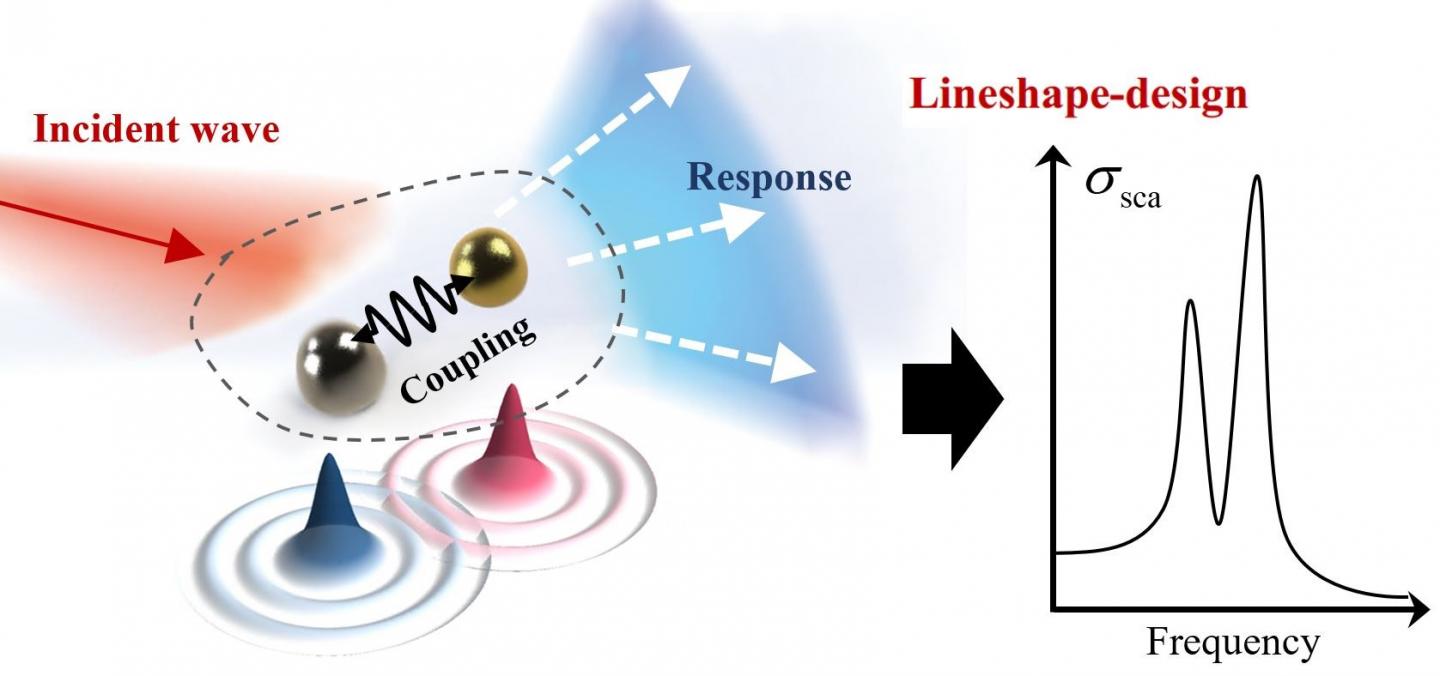
Credit: by Jing Lin, Meng Qiu, Xiyue Zhang, Huijie Guo, Qingnan Cai, Shiyi Xiao, Qiong He, Lei Zhou
Photonic systems consisting of multiple plasmonic/dielectric resonators coupled in different ways attracted immense research interests. Compared to simple photonic systems containing only one resonator, Such coupled systems exhibit more fascinating near-field (NF) properties (e.g., local field enhancement) and far-field (FF) responses manifested by unusual line-shapes dictated ultimately by how the involved resonators are coupled together, making them particularly useful in real applications.
Despite of great advances on experimental side, theoretical understandings on such systems are far from satisfactory. Available theoretical tools either cannot reveal the underlying physics (say, brute-force computations) or are empirical in nature (say, the coupled-mode-theory (CMT)) involving parameters retrieved from simulations, , which also hinders the fast designs of appropriate systems with desired NF and FF properties.
In a newly published paper in Light: Science & Application, Prof. Lei Zhou’s group from Physics Department of Fudan University in China, derived a formal theoretical framework from first principles (i.e., Maxwell’s equations), with all involved parameters directly computable via wave-function integrations without fitting procedures, to predict the fascinating properties of coupled photonic systems before having numerically simulated them (as always needed in previous parametrized models). To illustrate the powerfullness of their theory, they illustrate how to employ it to freely “design” the line-shape of a coupled system through modulating the couplings between resonators. In particular, they successfully construct a completely “dark” mode with vanishing radiative loss (i.e. a bound state in continuum), which have many applications in photonics. All theoretical predictions are verified by our experiments at near-infrared frequencies with excellent accuracies.
The established theoretical framework opens an alternative avenue to design the couplings, which have offered such complex photonic systems more opportunities to control NF and FF light environments as desired, making them particularly useful in applications such as nano-lasers, fluorescence enhancements and information transport. These scientists summarize their theory derived from first principles:
“…resemble the two equations in coupled mode theory, but our theory is different and processes the following merits. In the empirical CMT, the key parameters defined are usually obtained by fitting with numerical simulations, while the remaining ones can be derived by energy-conservation and time-reversal arguments. In contrast, here in our theory all parameters can be unambiguously evaluated, and therefore one can use it to predict the line-shapes of coupled systems before performing numerical simulations on them. Moreover, the empirical CMT cannot explicitly consider the NF couplings between resonators, while in our approach NF couplings can be unambiguously determined and explicitly included in determining the line-shape.”
“Once the leaky eigen modes of every single scatter are obtained, we can predict the line-shapes of the coupled systems without necessarily performing simulations on them.” They added.
“The significances of our work are clear: 1) On practical side, researchers (especially experimentalists) now have a powerful tool to “design” the coupled systems meeting their desires before performing simulations on a series of “trial” systems to search the best one; 2) On theoretical side, our theory provides a solid mathematics/physics basis for the empirical CMT widely used in the community, and more importantly, uncovers the clear physical meanings of those empirical parameters defined in the CMT; 3) The theory can be easily extended to study other wave systems (e.g., phononic systems). We believe that the general significance of this research and the new opportunities created by it should trigger intensive interests to a wide range of scientists.” the scientists forecast.
###
Media Contact
Lei Zhou
[email protected]
Related Journal Article
http://dx.