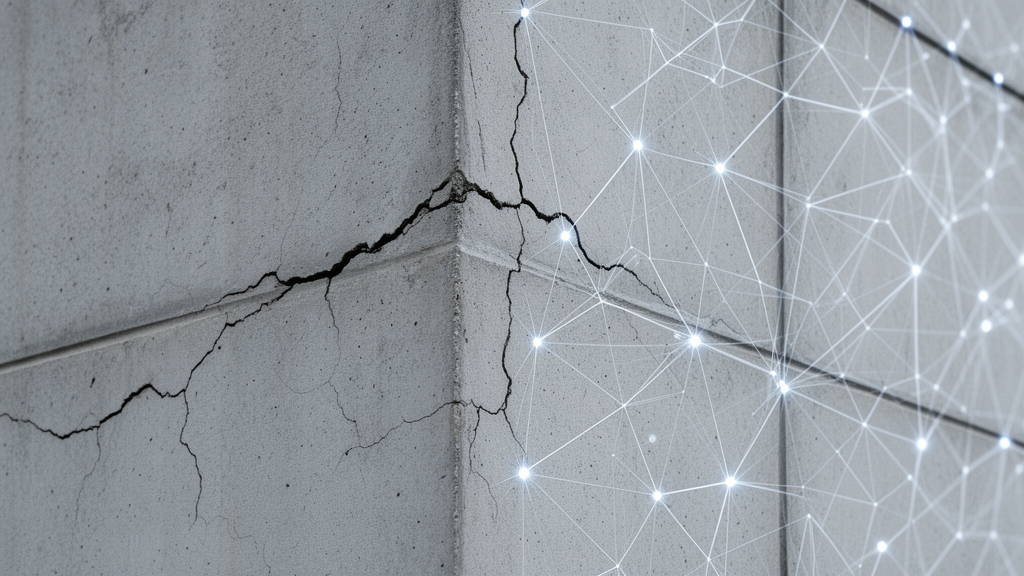
Civil engineering structures require continuous monitoring to ensure safety and prevent structural failure, with crack detection representing an essential component of modern infrastructure maintenance programs. Researchers Yongchang Zhang and Panpan Geng have introduced an end-to-end automated framework designed to identify surface fissures and evaluate their physical geometry under demanding real-world conditions. Published in the Journal of Engineering and Applied Science, their method combines lightweight neural network architectures with multi-scale feature fusion and dual attention mechanisms. This design addresses several persistent bottlenecks in automated structural health inspection, notably the excessive computational demands of deep networks, susceptibility to fluctuating illumination, and the technical disconnect between visual segmentation and engineering quantification. By consolidating data preprocessing, feature extraction, cross-layer fusion, and dual-branch geometric regression into a unified pipeline, the authors demonstrate that high-precision diagnostic assessments can operate efficiently on resource-constrained computing hardware.
Traditional inspection practices have historically depended on visual surveys and manual measurement tools operated by field technicians on site. These conventional approaches are labor-intensive, time-consuming, and prone to individual subjectivity, producing discrepancies in crack width evaluations and danger ratings across different human observers. Manual surveys also present serious occupational hazards when personnel must inspect elevated curtain walls, bridge understructures, or seismically damaged buildings. Furthermore, human sensory limits make it challenging to identify micro-cracks below 0.1 millimeters in width or systematically log complex branching crack networks over extended operational timelines. Early digital image processing techniques attempting to replace manual work utilized threshold segmentation and edge detection filters, but these algorithms remained dependent on handcrafted rules. Under variable ambient lighting, stain interference, and surface roughness, conventional image processing frequently suffered measurement errors ranging between 15% and 20% in crack width estimation, while entirely lacking the semantic comprehension needed to assess damage severity or structural risks.
To overcome these engineering limitations, the research team developed the LWN-MFF framework, an integrated deep learning architecture engineered specifically for pixel-level localization and precise morphological parameter quantification. The framework processes standard surface images through an adaptive illumination compensation algorithm known as AICA before neural feature extraction begins. Field inspection photographs often suffer from shadows, uneven sunlight exposure, and low visual contrast between concrete surfaces and fine fracture boundaries. The AICA pipeline resolves these lighting imbalances across three progressive computational stages. Initially, the system applies guided filtering with a smoothing radius of 15 and a regularization parameter of 0.01 to estimate ambient illumination components, while deploying a Difference of Gaussian operator to prevent the loss of fine crack textures. Next, nonlinear illumination correction isolates reflection and lighting components using an improved Retinex formulation alongside an adaptive Gamma correction routine governed by regional brightness means. Finally, the image is converted to the HSV color space, where contrast-limited adaptive histogram equalization and non-local means filtering suppress surface noise while preserving structural crack continuity.
The underlying feature extraction backbone modifies the classic ResNet-50 network to balance computational efficiency against spatial sensitivity. Deep convolutional neural networks repeatedly downsample intermediate feature representations, which frequently leads to the loss of subtle boundary cues and micro-crack information. To counteract this degradation, Zhang and Geng introduced a detail-preserving branch directly following the initial stem layer, constructing three cascaded 3 by 3 convolutions with batch normalization and LeakyReLU activation functions utilizing a negative slope of 0.1. The output maps from this parallel path concatenate directly with the first residual stage of the primary network, injecting rich high-resolution texture back into deeper processing stages. Furthermore, standard convolutions within the middle and upper residual stages were replaced with deformable convolution kernels possessing eight offset channels, allowing sampling grids to adapt flexibly to irregular, winding fracture paths. A Squeeze-and-Excitation channel attention block with a compression ratio of 16 was embedded into the final residual stage, while redundant ImageNet classification layers were removed to eliminate unnecessary computational overhead.
Multiscale representations extracted from the backbone are subsequently aggregated through a specialized cross-layer feature pyramid known as CLFP. Crack formations exhibit extreme scale variations, extending from hair-thin surface lines to prominent open ruptures that span broad structural regions. Standard feature pyramids typically struggle to maintain spatial alignment across such disparate dimensions. The proposed CLFP structure resolves this through bidirectional feature calibration, combining top-down semantic distribution paths with bottom-up spatial feedback routes. Low-level features undergo channel reduction through 1 by 1 convolutions followed by depthwise separable filtering, while intermediate and deep layers are iteratively calibrated and recombined. To refine high-level context, the authors introduced a feature importance reweighting mechanism that applies global average and max pooling across feature channels to modulate critical response areas. A cross-level attention module normalizes weights via Softmax across pooled vectors from multiple pyramid depths, enabling the neural network to dynamically balance fine spatial coordinates against deep categorical features based on the visual complexity of the input scene.
The system completes its analysis through a dedicated multi-task detection head that departs from traditional binary segmentation models. Standard semantic segmentation architectures generate pixel masks but cannot extract physical measurements without complex external post-processing steps. The LWN-MFF design splits into two coordinated functional branches sharing the fused pyramid representations. The localization branch employs convolutional operations, batch normalization, and rectified linear unit activations to generate high-resolution crack heatmaps, applying non-maximum suppression to resolve definitive structural coordinates. Operating in parallel, the regression branch integrates a spatial attention mechanism formed through parallel pooling operations to focus directly on fracture bodies. This branch computes Euclidean distances across identified boundary edges to calculate crack width, extracts cumulative centerline paths to determine total length, and analyzes directional gradient histograms to establish orientation angles. Pixel measurements convert into calibrated physical millimeter dimensions by calculating spatial scaling factors derived from camera focal geometry and surface working distances.
Model training and evaluation were conducted on two recognized benchmark datasets, namely Concrete Crack Images for Classification and SDNET2018. Because both datasets originally provided only binary image-level labels designating crack presence, the researchers manually produced comprehensive pixel-level ground truth masks, structural centerlines, and bounding boxes across all training, validation, and testing splits. The experimental corpus was partitioned into training, validation, and test subsets following a strict 7 to 2 to 1 ratio. All input samples were scaled to 448 by 448 pixels, and data augmentation routines including random rotation, horizontal and vertical flipping, and brightness adjustments were applied during training. The network was implemented in PyTorch and trained across 300 epochs on a dedicated workstation equipped with an Intel Xeon i7 processor, Ubuntu 20.2 operating system, and an NVIDIA RTX 3090 graphics card, utilizing the Adam optimizer with an initial learning rate of 0.001 and a cosine annealing learning rate scheduler.
Quantitative evaluations confirmed that the proposed architecture delivers high diagnostic precision while drastically curbing computational footprint. The complete LWN-MFF model contains 4.2 million parameters and requires 8.9 billion floating-point operations per inference pass. When benchmarked against the modern lightweight single-stage detector YOLOv11s, the proposed model reduced total parameter counts by 41 percent and floating-point operations by 45 percent. On the Concrete Crack Images for Classification test set, the framework attained an average precision at an intersection-over-union threshold of 0.5 of 84.3 percent, surpassing YOLOv11s by 6.3 percentage points, while improving the broader multi-threshold metric by 7.3 percentage points. During practical hardware runtime tests on the workstation graphics processing unit, the system registered an average throughput of 76 frames per second and an inference latency of 13.2 milliseconds per image, demonstrating its computational feasibility for deployment on robotic inspection platforms, aerial drones, and portable edge monitoring devices.
Ablation experiments conducted on the concrete benchmark isolates the specific performance enhancements provided by individual network modifications. A baseline network lacking multi-scale fusion and attention mechanisms achieved an average precision of 72.1 percent. Incorporating the cross-layer feature pyramid alone raised detection precision to 77.5 percent and increased the corresponding harmonic F1-score by 5.4 percentage points, confirming that bidirectional multi-scale pathways enhance the recovery of broken and slender crack segments. Introducing attention mechanisms in isolation improved baseline precision to 75.8 percent by suppressing irrelevant surface noise, including cosmetic concrete stains and shadow gradients. Combining both modules produced an overall detection precision of 81.6 percent, reflecting a net gain of 9.5 percentage points over the baseline. This integrated outcome exceeded the purely additive sum of their individual performance increments, demonstrating a synergistic interaction wherein multi-scale aggregation generates diverse feature candidates that attention modules refine into focused structural predictions.
To evaluate the real-world precision of automated physical parameter extraction, the investigators analyzed 30 challenging inspection samples selected through stratified sampling across both public benchmark datasets. These samples captured six difficult engineering conditions: micro-cracks, wide fissures, curved trajectories, fragmented fractures, uneven lighting distributions, and surface stain contamination. Automated dimensional predictions were directly compared against manually annotated millimeter ground truth measurements. The framework achieved a mean relative error of 4.21 percent for crack width and 3.87 percent for crack length, keeping estimation errors below the 5 percent threshold demanded by standard engineering maintenance protocols. Despite these favorable metrics, the authors acknowledged several operational boundaries, noting that performance diminishes under extreme debris obstruction, dense shadowing, or low visual contrast. Furthermore, because the architecture currently evaluates two-dimensional surface photographs, it cannot determine crack depth profiles or structural cavity volume, highlighting future development pathways focused on multimodal sensor fusion and three-dimensional structural health evaluation.
Subject of Research: Lightweight neural network framework for automated building crack detection and morphological parameter assessment
Article Title: Artificial intelligence based approaches for detection and assessment of building cracks
Article References: Zhang, Y., & Geng, P. (2026). Artificial intelligence based approaches for detection and assessment of building cracks. Journal of Engineering and Applied Science, 73(1), Article 435. https://doi.org/10.1186/s44147-026-01304-z
Image Credits: AI Generated
DOI: 10.1186/s44147-026-01304-z
Keywords: building crack detection, structural health monitoring, lightweight neural networks, multi-scale feature fusion, cross-layer feature pyramid, attention mechanism, deformable convolution, adaptive illumination compensation, ResNet-50, YOLOv11s, crack width estimation, crack length measurement, SDNET2018, Concrete Crack Images dataset, edge computing, computer vision, civil engineering inspection
News Source: Cassandra Pierce. (November 20, 2026). Lightweight Neural Network Detects Building Cracks With Reduced Computational Cost. Scienmag.