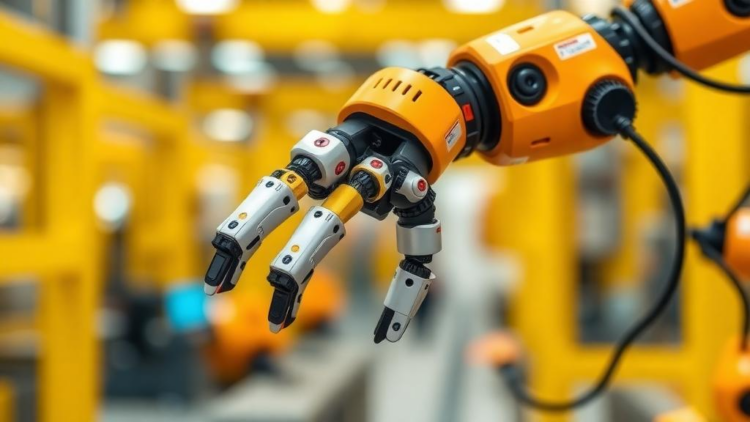
Industrial robots have become the workhorses of modern manufacturing, assembling electronics, sorting packages, palletizing goods and moving materials through warehouses at speeds no human crew could match. Yet for all their mechanical precision, these machines still stumble over one deceptively simple task: seeing what they are about to pick up. A new study published in Discover Artificial Intelligence by Haisheng Li of Zhengzhou Railway Vocational and Technical College tackles that perception bottleneck head-on, presenting a lightweight vision system built on the YOLOv10 object detection algorithm that promises to make robotic grasping faster, more accurate and far more robust in the messy, dimly lit and cluttered conditions of real factory floors.
The core problem Li set out to solve is a familiar one in robotics: the tension between accuracy and speed. Traditional vision models that detect and locate objects well tend to be computationally heavy, making them difficult to deploy on the edge devices that sit next to robot arms on production lines. Earlier approaches, from sliding-window detectors with hand-crafted features to early convolutional neural networks, either generalized poorly or demanded more processing power than an embedded system could spare. Prior YOLO-based grasping systems improved matters, but studies cited in the paper show they still struggled with high resource overhead, degraded accuracy in dark or occluded scenes, and difficulty adapting to complex, changeable environments. Li’s answer is a two-part architecture: an improved, slimmed-down YOLOv10 for detecting targets, paired with a generative grasping convolutional network that refines the robot’s actual grip posture.
The detection side of the system is where most of the engineering ingenuity lies. Li replaced YOLOv10’s original backbone with FasterNet, a network built around Partial Convolution, or PConv, which applies convolution only to a subset of a feature map’s channels rather than all of them. The mathematics is elegant: because floating-point operations scale with the square of the channel ratio, restricting convolution to one quarter of the channels cuts the computation to exactly one sixteenth of a standard convolution. To make that saving task-aware, Li added a channel attention mechanism that reweights channel responses according to the depth gradient distribution of the scene, prioritizing channels carrying object-surface and edge information while suppressing flat background regions. The result is a backbone that spends its limited compute budget where it matters most.
Lightweighting a network usually costs accuracy, so the design compensates in the neck of the network, where features are fused across scales. Li introduced a Context Guided Block, which combines local and atrous convolution to enlarge the effective receptive field and sharpen the capture of occluded targets, and a dynamic upsampling module called DySample, which generates a dynamic point-sampling set to restore spatial detail lost by the compressed backbone. The detection head also gained a rotated bounding box, parameterized as a five-dimensional vector including an angle, together with a dedicated angle-prediction branch trained with Smooth L1 loss. This matters because industrial components tilt and stack; an axis-aligned box cannot describe a screw lying at forty-five degrees, and the resulting positioning errors cascade into failed grasps. A combined loss function integrating bounding box, classification, confidence and angle terms trains the whole system to be simultaneously accurate in position, class, confidence and orientation.
The second half of the framework addresses what happens after detection: deciding exactly how the gripper should approach the object. For this, Li turned to the Generative Grasping Convolutional Network, or GGCNN, and upgraded it with two modules. An improved Inception block extracts multi-scale spatial features in parallel through branching convolutions, using stacked pairs of three-by-three convolutions in place of five-by-five kernels to preserve the receptive field while trimming computation. A Weighted Feature Fusion module then tackles a subtle but important problem: shallow features carry precise edge localization but high-frequency noise, while deep features carry semantic meaning but spatial offset. Directly adding them produces misaligned features, so the WFF module learns trainable channel weights that minimize the alignment error between the two feature spaces, filtering out contradictory noise. The network outputs, for every pixel, a grasp success probability, a gripper rotation angle between minus ninety and plus ninety degrees, and an opening width, from which the system selects the highest-confidence grasp and maps it into the robot’s world coordinates.
The hardware pipeline behind the software is equally concrete. An Intel RealSense D455 depth camera captures synchronized color and depth streams, with color at 1280 by 800 pixels at 30 frames per second and depth at 1280 by 720 at 90 frames per second, covering a detection range from 0.4 to 10 meters. Pinhole imaging mathematics converts three-dimensional world points into two-dimensional image coordinates, and hand-eye calibration establishes the transformation between the camera frame and the base of a UR5 six-degree-of-freedom collaborative manipulator, modeled through Denavit-Hartenberg parameters. A priority scoring model weighs each candidate object’s depth distance and the gap between its center of gravity and the proposed grasp point, so the robot grabs the nearest, most stable targets first. Each grasp is described by four parameters: the projected center position, the gripper rotation angle, and the pre-opening width converted to physical units through the depth data.
The experimental results are striking. Trained and tested on a self-built dataset of 15,000 images spanning 423 industrial and everyday object types, plus the public GraspNet-1Billion benchmark with its billion-scale grasp annotations, the improved YOLOv10 achieved a precision of 0.971, a recall of 0.955 and a mean average precision at the 0.5 intersection-over-union threshold of 0.942. That mAP50 figure comfortably outperformed standard YOLOv10 at 0.918, YOLOv8 at 0.909 and Faster R-CNN at 0.875. Against dedicated grasping systems on GraspNet-1Billion, the method exceeded the GraspNet baseline by 8.0 percent, GG-CNN by 10.1 percent and a YOLOv8-based detector by 3.3 percent, while running at 192 frames per second with only 26.8 gigafloating-point operations, a computation reduction of 82.9 percent compared with GraspNet and 60.8 percent compared with GG-CNN. Ablation tests confirmed the division of labor: FasterNet drove the efficiency gains, while the CG-Block and DySample modules recovered and then surpassed the baseline accuracy, lifting mAP50 by 0.027 over the unmodified network.
Robustness under adverse conditions may be the most eye-catching result. In multi-scenario tests, the model detected 100 percent of target objects in dim lighting, in occluded scenes, in multi-background settings and among visually similar items, where comparison models faltered. In one dark test scene, Faster R-CNN could barely identify two people in a corner while the improved detector found all six people in a bus with the highest accuracy. In occlusion tests with vehicles, it identified five cars where Faster R-CNN managed three. Channel pruning added further efficiency: at a pruning rate of 0.4, the model reached its best mAP50 of 0.937 while shrinking its parameter count and accelerating inference. In a 100-minute real-robot experiment across three scenarios, from metal parts larger than three centimeters to everyday objects to screws and electronic components smaller than three centimeters, posture optimization via the improved GGCNN raised the detector’s mAP50 in the first scenario from 0.850 to 0.921, with similar gains for the comparison models. Across ten complex scenarios combining dimness, occlusion and dust, the full system achieved a minimum grasping success rate of 92.3 percent and held positioning angle deviation within minus 0.04 degrees, far tighter than the 0.23 and 0.27 degree deviations of YOLOv8 and Faster R-CNN.
The improved GGCNN itself earned its place through ablation. On GraspNet-1Billion, the full model with Inception and WFF modules reached an area under the curve of 0.951, versus 0.892 for GGCNN with WFF alone, 0.883 with Inception alone and 0.841 for the baseline network. Detailed validation showed the baseline GGCNN’s grasp angle error of 6.2 degrees falling to 4.5 degrees with Inception, then to 2.3 degrees with WFF added, while the grasp success rate climbed to 95.1 percent with only a marginal increase in inference time. These numbers matter against a backdrop of staggering industrial scale: the paper notes that China alone had more than two million industrial robots in operation in 2024, over half the world’s total, with a manufacturing robot density of 392 units per ten thousand people. Even small gains in grasping reliability translate into enormous productivity differences at that scale.
Li is candid about the limits. The improved YOLOv10 struggles with extremely small targets under one centimeter, and real-time performance can fluctuate under extreme interference during edge deployment. Future work, the paper suggests, could add super-resolution reconstruction modules to enhance micro-target features and further optimize the lightweight architecture for smoother edge inference. Even so, the study demonstrates a coherent design philosophy: rather than piling modules together, it couples a mathematically grounded efficiency mechanism in the backbone with context-aware feature repair in the neck and angle-aware detection at the head, then hands off to a posture network that bridges the semantic gap between edges and meaning. For factories racing toward Industry 4.0, that combination of precision, speed and resilience in the face of darkness, clutter and occlusion could be exactly what robots need to finally grasp the world as reliably as they move through it.
Subject of Research: Lightweight deep learning for robotic grasping detection and grasp posture optimization
Article Title: Robot grabbing detection based on lightweight YOLOv10 algorithm
Article References: Li, H. (2026). Robot grabbing detection based on lightweight YOLOv10 algorithm. Discover Artificial Intelligence, 6(1), Article 1310. https://doi.org/10.1007/s44163-026-02228-6
Image Credits: AI Generated
DOI: 10.1007/s44163-026-02228-6
Keywords: robotics, YOLOv10, object detection, robotic grasping, GGCNN, lightweight neural networks, computer vision, industrial automation, deep learning, grasp posture estimation, edge deployment, intelligent manufacturing
Cite Scienmag News
APA
MLA
Chicago
Denise Maddox. (October 1, 2026). Lightweight AI Gives Factory Robots Sharper Eyes for Grabbing Objects. Scienmag. https://scienmag.com/lightweight-ai-gives-factory-robots-sharper-eyes-for-grabbing-objects/
Denise Maddox. “Lightweight AI Gives Factory Robots Sharper Eyes for Grabbing Objects.” Scienmag, 1 October 2026, https://scienmag.com/lightweight-ai-gives-factory-robots-sharper-eyes-for-grabbing-objects/. Accessed 1 October 2026.
Denise Maddox. “Lightweight AI Gives Factory Robots Sharper Eyes for Grabbing Objects.” Scienmag. October 1, 2026. https://scienmag.com/lightweight-ai-gives-factory-robots-sharper-eyes-for-grabbing-objects/
Copy citation
Download RIS
Tags: cluttered environment object recognitioncomputer visioncomputer vision advancements for manufacturingdeep learningdimly lit factory floor perceptionedge deploymentedge device deployment in factory automationGGCNNgrasp posture estimationimproving robotic object grasping robustnessindustrial automationIndustrial robot vision systemsintelligent manufacturinglightweight AI for factory automationlightweight neural networkslightweight neural networks for roboticsobject detectionperception challenges in industrial robotsreal-time object detection for manufacturingrobotic graspingrobotic grasping accuracy and speedroboticsYOLOv10YOLOv10 object detection in robotics