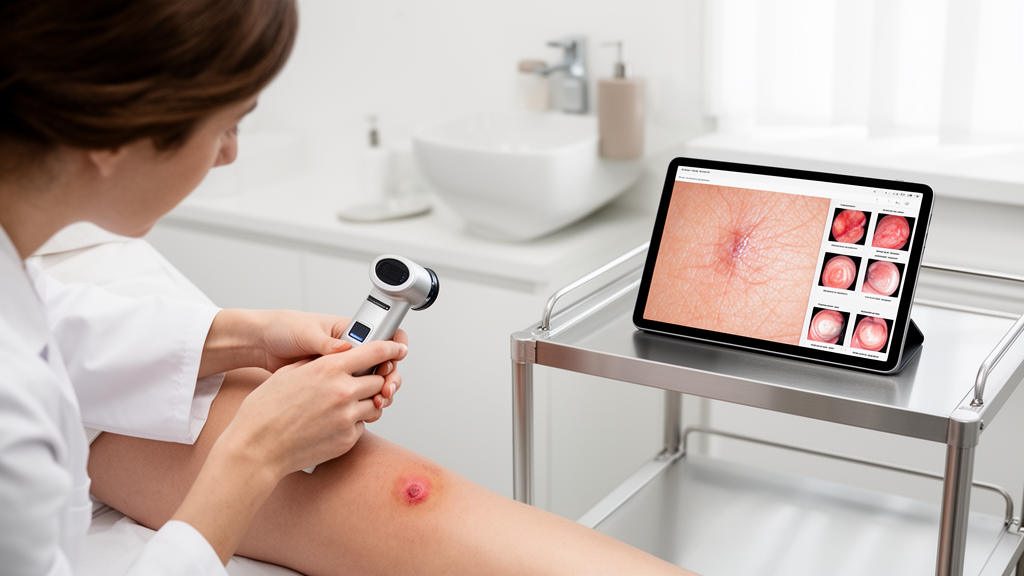
Researchers from Egypt and Saudi Arabia have developed a unified, lightweight framework for classifying skin lesions that integrates deep learning, ensemble methods, and semantic image retrieval into a single web-based system. The study, published in Frontiers in Bioengineering and Biotechnology, addresses the challenge of early-stage skin disease diagnosis, which is complicated by the visual similarity of different lesion types and variations in imaging conditions. By combining multiple artificial intelligence techniques, the proposed architecture aims to provide a practical, interpretable, and stable tool for medical imaging analysis without the need for high-end hardware.
The research team integrated deep learning models with stacking ensemble learning to improve prediction stability. Specifically, they utilized a Convolutional Neural Network (CNN) and a hybrid CNN–Long Short-Term Memory (LSTM) model as base classifiers. To further enhance performance, a XGBoost meta-model was employed within the stacking ensemble structure. This approach allows the system to reduce variance and improve generalization, even if the absolute improvement in accuracy over individual models is modest.
Experimental results demonstrated that the individual deep learning models performed strongly on the dataset. The standard CNN achieved an accuracy score of 0.9700, with an Area Under the Curve (AUC) score of 0.9987. The hybrid CNN–LSTM model recorded an accuracy of 0.9500 and an AUC of 0.9888. When these models were combined using the stacking ensemble with the XGBoost meta-model, the system achieved a slightly higher accuracy of 0.9733 and an AUC of 0.9968.
A distinctive feature of this framework is the integration of feature embedding-based semantic image retrieval. This component allows the system to find similar images that share the same lesion features as the input case. This capability serves as supporting evidence for the classification prediction, providing a form of case-based reasoning. The semantic retrieval component achieved a mean Average Precision at 5 (mAP@5) of 0.981, indicating that the feature representations generated by the model are robust and capable of accurately identifying visually similar lesions within the dataset.
The architecture is designed for practical deployment, featuring a lightweight structure with only 489,096 parameters. This low parameter count enables real-time inference on standard Central Processing Units (CPUs), eliminating the requirement for expensive Graphics Processing Units (GPUs). The system is deployed via a web-based interface, making it accessible without specialized local hardware.
The study emphasizes the integration of classification, semantic retrieval, visual explanation, and deployment into a single cohesive framework. The semantic retrieval provides context, the explainable AI provides transparency, and the ensemble learning provides stability.
The research was conducted by a team including Botheina Hussein Ali, Nora El-Rashidy, Ahmed I. Taloba, Hela Elmannai, Aishah Alsehaim, and Marghany Hassan Mohamed, representing institutions in Egypt and Saudi Arabia. The work was published in the Biosensors and Biomolecular Electronics section of Frontiers in Bioengineering and Biotechnology. The findings suggest that lightweight, interpretable AI systems can achieve high performance in medical image classification while maintaining the practicality needed for real-world web-based deployment.
Subject of Research: Development of a lightweight, explainable deep learning framework for skin lesion classification with semantic image retrieval.
Article Title: Explainable ensemble deep learning with semantic searching for skin disease classification: a web-based system
Article References: Hussein, B., El-Rashidy, N., Taloba, A., Elmannai, H., Alsehaim, A., & Mohamed, M. (2026). Explainable ensemble deep learning with semantic searching for skin disease classification: a web-based system. Frontiers in Bioengineering and Biotechnology, 14, Article 1885944. https://doi.org/10.3389/fbioe.2026.1885944
Image Credits: AI Generated
DOI: 10.3389/fbioe.2026.1885944
Keywords: skin disease, deep learning, ensemble learning, semantic search, explainable AI, medical imaging, CNN, web deployment, ISIC 2019, Explainable, ensemble, deep
News Source: Gregory Coleman. (November 9, 2026). Lightweight AI Framework Classifies Skin Lesions with Semantic Search. Scienmag.