• HOME
  • NEWS
  • EXPLORE
    • CAREER
      • Companies
      • Jobs
    • EVENTS
    • iGEM
      • News
      • Team
    • PHOTOS
    • VIDEO
    • WIKI
  • BLOG
  • COMMUNITY
    • FACEBOOK
    • INSTAGRAM
    • TWITTER
Thursday, May 21, 2026
BIOENGINEER.ORG
No Result
View All Result
  • Login
  • HOME
  • NEWS
  • EXPLORE
    • CAREER
      • Companies
      • Jobs
        • Lecturer
        • PhD Studentship
        • Postdoc
        • Research Assistant
    • EVENTS
    • iGEM
      • News
      • Team
    • PHOTOS
    • VIDEO
    • WIKI
  • BLOG
  • COMMUNITY
    • FACEBOOK
    • INSTAGRAM
    • TWITTER
  • HOME
  • NEWS
  • EXPLORE
    • CAREER
      • Companies
      • Jobs
        • Lecturer
        • PhD Studentship
        • Postdoc
        • Research Assistant
    • EVENTS
    • iGEM
      • News
      • Team
    • PHOTOS
    • VIDEO
    • WIKI
  • BLOG
  • COMMUNITY
    • FACEBOOK
    • INSTAGRAM
    • TWITTER
No Result
View All Result
Bioengineer.org
No Result
View All Result
Home NEWS Science News Chemistry

Lighting it up: Fast material manipulation through a laser

Bioengineer by Bioengineer
April 21, 2021
in Chemistry
Reading Time: 2 mins read
0
IMAGE
Share on FacebookShare on TwitterShare on LinkedinShare on RedditShare on Telegram

IMAGE

Credit: © Beaulieu

Making the speed of electronic technology as fast as possible is a central aim of contemporary materials research. The key components of fast computing technologies are transistors: switching devices that turn electrical currents on and off very quickly as basic steps of logic operations. In order to improve our knowledge about ideal transistor materials, physicists are constantly trying to determine new methods to accomplish such extremely fast switches. Researchers from the Fritz Haber Institute of the Max Planck Society in Berlin and the Max Planck Institute for the Structure and Dynamics of Matter in Hamburg have now figured out that a novel type of ultrafast switch can be accomplished with light.

The physicists involved in the project are studying how to best get materials to change their properties – to make magnetic metals non-magnetic, for example, or to change the electric conductivity of a crystal. A material’s electrical properties are strongly related to the arrangement of the electrons in the crystal. Controlling the electrons’ arrangement has been a key topic for decades. Most control methods, however, are fairly slow. “We knew that external influences like temperature or pressure variations work”, says Dr. Ralph Ernstorfer, Group Leader at the Department of Physical Chemistry at the Fritz Haber Institute, “but that takes time, at least a few seconds.” Those who regularly use a smart phone or computer know that a few seconds can feel like eternity. So Dr. Ernstorfer’s group explored how to switch material properties much faster by means of light.

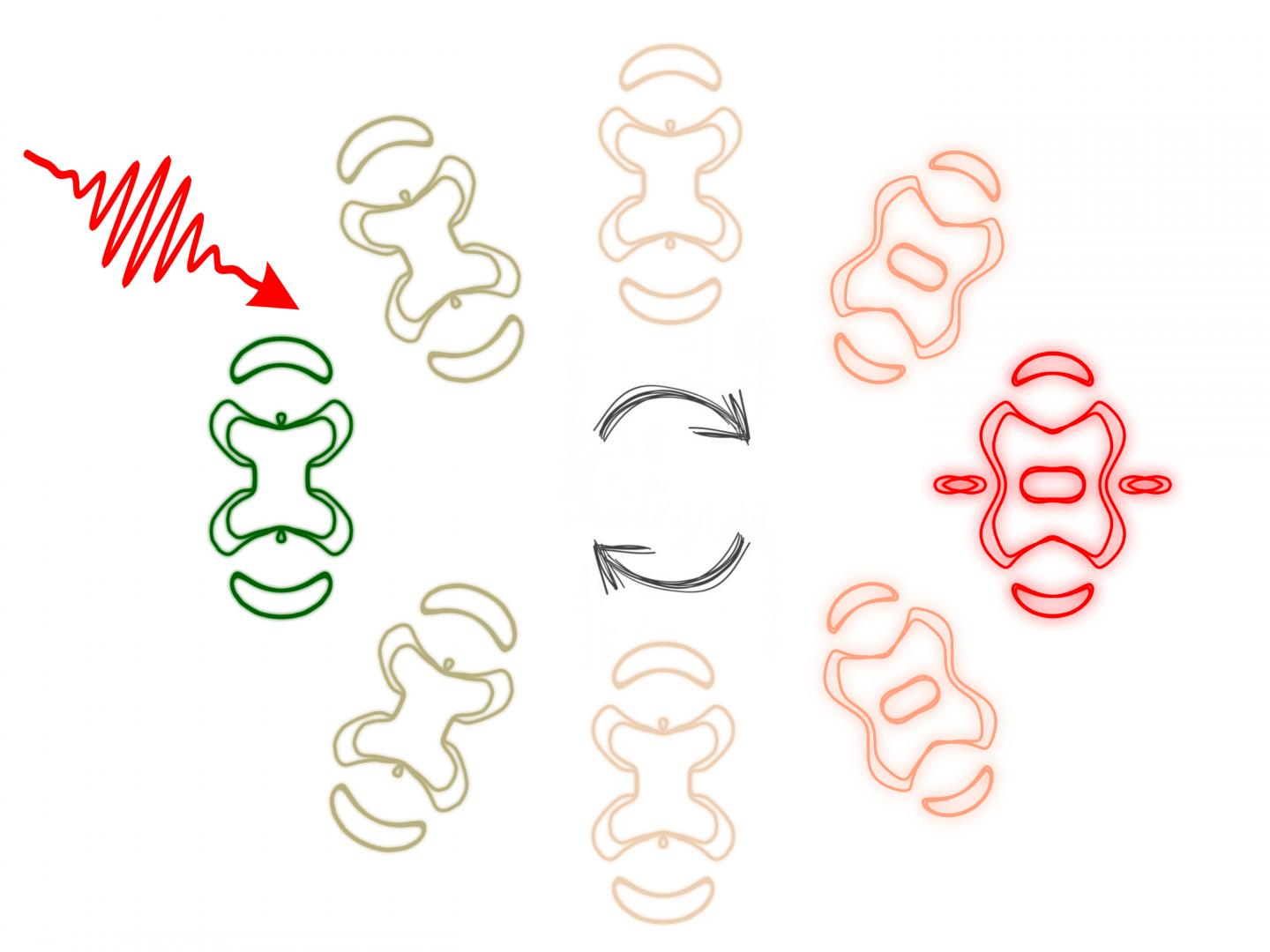
Using brand new equipment at the Fritz Haber Institute, the researchers have massively cut down the switching time to only 100 femtoseconds – 0,000 000 000 000 1 of a second – by shooting ultrashort optical laser pulses at their chosen material, a semi-metallic crystal composed of tungsten and tellurium atoms. Shining light on the crystal encourages it to re-organize its internal electronic structure, which also changes the conductivity of the crystal. In addition, the scientists were able to observe exactly how its electronic structure changed. “We used a new instrument to take pictures of the transition every step of the way”, explains Dr. Samuel Beaulieu, who worked as a postdoctoral fellow with Ralph Ernstorfer at the Fritz-Haber-Institut (2018-2020) and who is now a permanent researcher at the Centre Lasers Intenses et Applications (CELIA) at CNRS-Bordeaux University. “This is amazing progress – we used to only know what the electronic structure of the material looked like after, but never during the transition,” he adds. Moreover, state-of-the-art modeling of this new process by Dr. Nicolas Tancogne-Dejean, Dr. Michael Sentef, and Prof. Dr. Angel Rubio from Max the Planck Institute for the Structure and Dynamics of Matter has revealed the origin of this novel type of ultrafast electronic transition. The laser pulse impinging on the materials changes the way electrons interact with each other. That is the driving force of this exotic transition, known as a Lifshitz transition.

This method is bound to generate a great deal of knowledge about possible future transistor materials. The fact alone that light can drive ultrafast electronic transitions is a first step towards even quicker and more efficient technology.

###

Media Contact
Agatha Frischmuth
[email protected]

Tags: Chemistry/Physics/Materials SciencesMaterials
Share12Tweet8Share2ShareShareShare2

Related Posts

Advancing In Vivo and In Situ Monitoring: Science Bulletin Highlights Host-Based Antifouling Gold Nanotube Sensor for Selective Detection of Mechanically Sensitive Serotonin Release in Intestinal Mucosa — Chemistry

Advancing In Vivo and In Situ Monitoring: Science Bulletin Highlights Host-Based Antifouling Gold Nanotube Sensor for Selective Detection of Mechanically Sensitive Serotonin Release in Intestinal Mucosa

May 20, 2026
How Magnetic Orientation Could Influence the Building Blocks of Life — Chemistry

How Magnetic Orientation Could Influence the Building Blocks of Life

May 20, 2026

Breaking a 200-Year-Old Belief: Novel Surface Design Achieves Two Distinct Wetting States on One Substrate

May 20, 2026

Unveiling Sound Waves: Scientists Discover Hidden Behaviors in Acoustic Phenomena

May 20, 2026
Please login to join discussion

POPULAR NEWS

  • blank

    New Study Reveals Plants Can Detect the Sound of Rain

    733 shares
    Share 292 Tweet 183
  • ESMO 2025: mRNA COVID Vaccines Enhance Efficacy of Cancer Immunotherapy

    302 shares
    Share 121 Tweet 76
  • Research Indicates Potential Connection Between Prenatal Medication Exposure and Elevated Autism Risk

    846 shares
    Share 338 Tweet 212
  • Breastmilk Balances E. coli and Beneficial Bacteria in Infant Gut Microbiomes

    58 shares
    Share 23 Tweet 15

About

We bring you the latest biotechnology news from best research centers and universities around the world. Check our website.

Follow us

Recent News

How Regional Traits Shape Europe’s Human Mobility

Essential Initialization in Biological Neural Networks

Smart Non-Invasive System Revolutionizes Breast Ultrasound

Subscribe to Blog via Email

Enter your email address to subscribe to this blog and receive notifications of new posts by email.

Join 82 other subscribers
  • Contact Us

Bioengineer.org © Copyright 2023 All Rights Reserved.

Welcome Back!

Login to your account below

Forgotten Password?

Retrieve your password

Please enter your username or email address to reset your password.

Log In
No Result
View All Result
  • Homepages
    • Home Page 1
    • Home Page 2
  • News
  • National
  • Business
  • Health
  • Lifestyle
  • Science

Bioengineer.org © Copyright 2023 All Rights Reserved.