• HOME
  • NEWS
  • EXPLORE
    • CAREER
      • Companies
      • Jobs
    • EVENTS
    • iGEM
      • News
      • Team
    • PHOTOS
    • VIDEO
    • WIKI
  • BLOG
  • COMMUNITY
    • FACEBOOK
    • INSTAGRAM
    • TWITTER
Monday, October 5, 2026
BIOENGINEER.ORG
No Result
View All Result
  • Login
  • HOME
  • NEWS
  • EXPLORE
    • CAREER
      • Companies
      • Jobs
        • Lecturer
        • PhD Studentship
        • Postdoc
        • Research Assistant
    • EVENTS
    • iGEM
      • News
      • Team
    • PHOTOS
    • VIDEO
    • WIKI
  • BLOG
  • COMMUNITY
    • FACEBOOK
    • INSTAGRAM
    • TWITTER
  • HOME
  • NEWS
  • EXPLORE
    • CAREER
      • Companies
      • Jobs
        • Lecturer
        • PhD Studentship
        • Postdoc
        • Research Assistant
    • EVENTS
    • iGEM
      • News
      • Team
    • PHOTOS
    • VIDEO
    • WIKI
  • BLOG
  • COMMUNITY
    • FACEBOOK
    • INSTAGRAM
    • TWITTER
No Result
View All Result
Bioengineer.org
No Result
View All Result
Home NEWS Science News

Lighter, more efficient, safer lithium-ion batteries

Bioengineer by Bioengineer
March 30, 2017
in Science News
Reading Time: 3 mins read
0
Share on FacebookShare on TwitterShare on LinkedinShare on RedditShare on Telegram
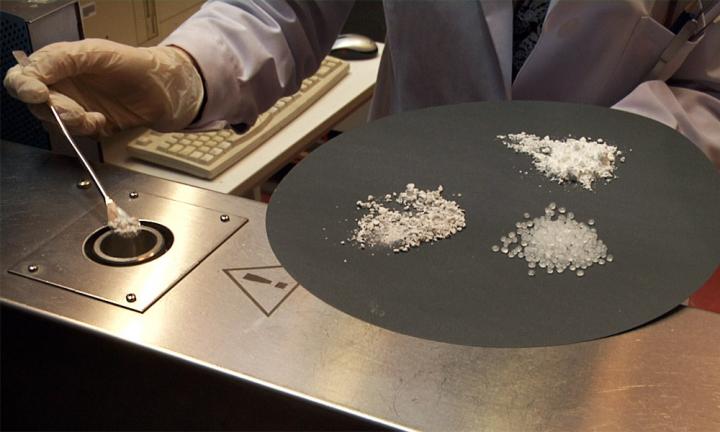
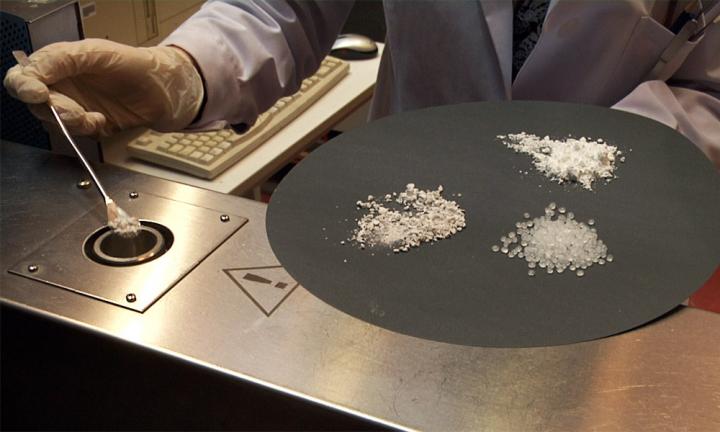
IMAGE

Credit: UC3M

Electric batteries are electrochemical devices that convert chemical energy stored in electricity. They consist of one or several electrochemical cells, and each cell is made up of one positive (cathode) electrode and one negative (anode) electrode, separated by an electrolyte which allows the ions to move between the electrodes. Currently, lithium-ion batteries are the main electrochemical storage systems in electronic devices and the area of transportation. "What we have patented are new ceramic electrodes that are much safer and can work in a wider temperature interval," explained Professor Alejandro Várez, one of the inventors from the UC3M Materials Synthesis and Processing research group.

It is a method of making ceramic sheets by way of a thermoplastic extrusion mold. "This technique allows making electrodes that are flat or tube-shaped, and these electrodes can be applied to any type of lithium-ion battery," said Várez. Moreover, the cost of production is relatively low, and, according to its creators, it is easy to adapt to the current process of production, so the next step to industrialization would be immediate.

These ceramic electrodes consist only of active material, which reduces the risk of degradation and inflammation at high temperatures (greater than 100? C). "This is especially important in the case of electric vehicles, because if there is an accident and fire, conventional batteries can catch fire, and it is very difficult to extinguish," said Jean Yves Sanchez, another inventor of the patent and UC3M CONEX researcher from the Université Grenoble Alpes (France). "These new solid electrodes can't burn, which contributes to improving the safety of the batteries," he added.

When there are major electrical consumption peaks, commercial lithium-ion batteries tend to overheat and, in some cases, even explode. The reason is that the electrolytes normally used contain organic liquid solvents that can ignite, like the additives used for the fabrication of electrodes. "With our technology, however, solvents are not used during the fabrication process," said Sanchez. "In addition, if you compare them with conventional electrodes, the ones we obtain with this fabrication process are very hard and can't be cut, which contributes to improving the solidity of the battery."

Another advantage of batteries that integrate these new electrodes is their efficiency, according to tests done by the researchers. These tests show an increase of specific capacity that is nearly triple the capacity of commercial electrodes with the same density. And as this technique permits the fabrication of high-density electrodes (between 450 and 1000 microns), the storage capacity by area increases up to ten times the capacity of current technology.

###

The inventors of the patent applied for are Alejandro Várez, Belén Levenfield, Jean-Yves Sanchez, Mª Eugenia Sotomayor and Wilmer Bucheli, from the Materials Synthesis and Processing research group, and José Manuel Amarilla, a researcher from the CSIC Madrid Institute of Materials Science. "The participation of the UC3M Science Park has been key because it has supported us in both the processing and commercialization of the patent," said Várez.

Video: https://youtu.be/Z_lxsLbXL88

Contact: [email protected]

Media Contact

Javier Alonso
[email protected]
@uc3m

http://www.uc3m.es

############

Story Source: Materials provided by Scienmag

Share12Tweet8Share2ShareShareShare2

Related Posts

How Sugar Rules the Tea Plant: New Review Reveals Carbon Secrets of the World's Favorite Drink

How Sugar Rules the Tea Plant: New Review Reveals Carbon Secrets of the World’s Favorite Drink

October 5, 2026
Soil pH Emerges as Master Switch Governing Legume Farming Performance Across China

Soil pH Emerges as Master Switch Governing Legume Farming Performance Across China

October 5, 2026

Laser Scans Turned Into 3D Models in Under a Minute to Track Cracking Concrete Beams

October 5, 2026

AI System Aims to Speed Personalized Cancer Care for Children With $200,000 Cloud Award

October 5, 2026
Please login to join discussion

POPULAR NEWS

  • Alloys That Shrink Their Own Grains: New PIX Mechanism Refines Metals With Heat Alone

    Alloys That Shrink Their Own Grains: New PIX Mechanism Refines Metals With Heat Alone

    29 shares
    Share 12 Tweet 7
  • Endurance Exercise Reshapes the Liver in Males and Females Through Distinct Molecular Routes

    29 shares
    Share 12 Tweet 7
  • Single Transcription Factor PU.1 Rapidly Converts Fibroblasts into Macrophage-Lineage Cells

    29 shares
    Share 12 Tweet 7
  • New Scale Measures How Ready Nurse Educators Really Are for the AI Era

    29 shares
    Share 12 Tweet 7

About

We bring you the latest biotechnology news from best research centers and universities around the world. Check our website.

Follow us

Recent News

Alloys That Shrink Their Own Grains: New PIX Mechanism Refines Metals With Heat Alone

Endurance Exercise Reshapes the Liver in Males and Females Through Distinct Molecular Routes

Single Transcription Factor PU.1 Rapidly Converts Fibroblasts into Macrophage-Lineage Cells

Subscribe to Blog via Email

Success! An email was just sent to confirm your subscription. Please find the email now and click 'Confirm' to start subscribing.

Join 85 other subscribers
  • Contact Us

Bioengineer.org © Copyright 2023 All Rights Reserved.

Welcome Back!

Login to your account below

Forgotten Password?

Retrieve your password

Please enter your username or email address to reset your password.

Log In
No Result
View All Result
  • Homepages
    • Home Page 1
    • Home Page 2
  • News
  • National
  • Business
  • Health
  • Lifestyle
  • Science

Bioengineer.org © Copyright 2023 All Rights Reserved.