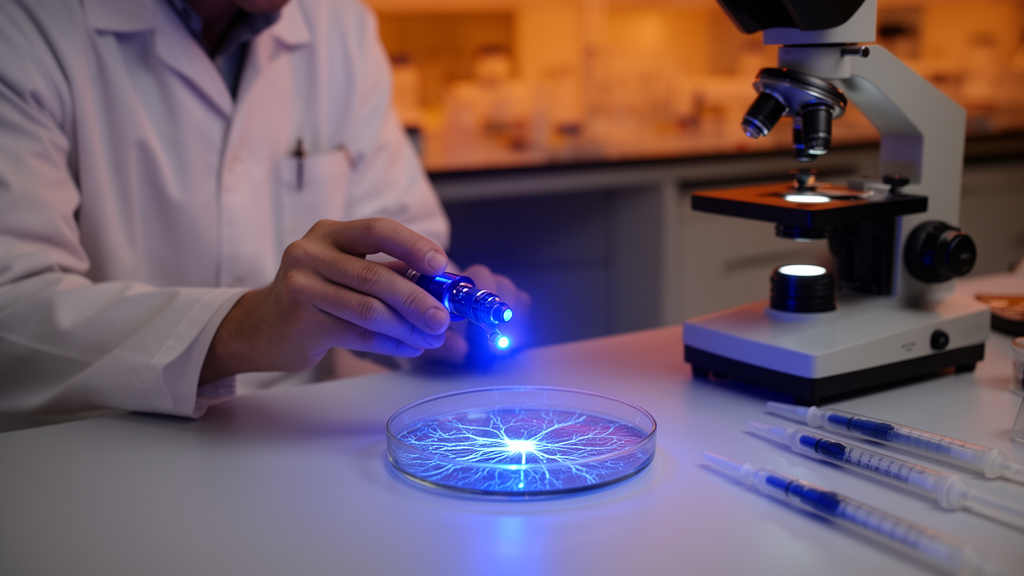
Three scientists whose work taught neurons to obey light have been awarded the 2026 Nobel Prize in Physiology or Medicine. Karl Deisseroth of the Howard Hughes Medical Institute and Stanford University, Peter Hegemann of the Humboldt University of Berlin, and Georg Nagel of the University of Würzburg in Germany received the prize for their discoveries concerning light-gated ion channels and optogenetics, a technology that has fundamentally transformed how neuroscientists investigate the brain. Two of the laureates, Deisseroth and Hegemann, are longtime members of the Society for Neuroscience, with Deisseroth having belonged to the organization for 33 years and Hegemann for 15 years.
The story of this year’s prize begins with a humble algal protein. Hegemann and Nagel discovered channelrhodopsin, a light-sensitive protein found on the surface of single-celled algae. The protein possesses remarkable properties: when illuminated by blue light, a channel opens through its structure, allowing charged ions to flow into the cell. This influx of ions generates an electrical impulse, the fundamental currency of cellular communication. What made the discovery so extraordinary was its universality. The researchers found that regardless of which type of cell they placed the protein in, those cells became light sensitive, effectively converting any cell into a remotely controllable switch.
This universality proved to be the key that unlocked an entirely new field of neuroscience. If a protein could make any cell respond to light, then scientists could, in principle, take control of specific cells simply by shining light on them. The implications for brain research were staggering, because the brain’s billions of neurons communicate through precisely the kind of electrical impulses that channelrhodopsin could now trigger on command.
Deisseroth built on the discovery in a way that would change experimental neuroscience forever. He introduced the gene for channelrhodopsin into nerve cells from rats, and by illuminating those cells with blue light, he was able to trigger a nerve signal at will. He published this breakthrough in 2005, a paper that is now regarded as the founding moment of optogenetics. Two years later, he pushed the technique even further, making the light-controlled switch for nerve cells work in the brains of living mice. The jump from isolated cells to living animals meant that researchers could now manipulate neural activity inside a functioning brain, observing the consequences in real time.
The power of optogenetics lies in its precision. Traditional methods of studying the brain, such as electrical stimulation or lesion studies, activate or destroy broad regions of tissue and cannot distinguish between different cell types. Optogenetics, by contrast, allows researchers to activate individual types of nerve cells within the brain while leaving neighboring cells untouched. By inserting the channelrhodopsin gene selectively into specific populations of neurons, scientists can shine light through implanted optical fibers and switch those neurons on or off with millisecond precision, all while the animal is awake and behaving.
Using this toolkit, neuroscientists around the world have identified the neural circuits governing an astonishing range of behaviors and states. Research teams have mapped the circuits that control pain, social behaviors, thirst, reward, and attention, among others. Each of these discoveries followed the same logic: identify the cells suspected of driving a behavior, engineer them to respond to light, and then switch them on or off to observe what changes. The results have turned long-standing hypotheses about brain function into testable, reversible experiments, and have revealed causal relationships between specific circuits and specific behaviors that correlation-based methods could never establish.
The impact of the technology extends beyond fundamental research into the realm of medicine. Optogenetics has opened the door to new ways of understanding the brain that will inform both research and therapeutic efforts into the future. Because the technique allows researchers to isolate the neural mechanisms underlying disorders such as Parkinson’s disease, depression, addiction, and epilepsy, it provides a rational basis for developing targeted treatments. Clinical trials exploring optogenetic approaches to restoring vision and controlling neural activity in neurological disease are already underway, and the knowledge generated by circuit-level studies continues to guide the design of brain stimulation therapies used in the clinic today.
The Nobel Assembly, consisting of 50 professors at Karolinska Institutet in Stockholm, awards the Nobel Prize in Physiology or Medicine, with its Nobel Committee evaluating the nominations submitted each year. Since 1901, the Nobel Prize has been awarded to scientists who have made the most important discoveries for the benefit of humankind, and the 2026 laureates join a lineage that includes some of the most celebrated figures in the history of medicine and biology. The Nobel Prize amount for 2026 is set at Swedish kronor 12.0 million, approximately 1.2 million US dollars, per full Nobel Prize, which the three laureates will share for their joint contribution to the field.
The recognition of Deisseroth, Hegemann, and Nagel also highlights the collaborative and cross-disciplinary nature of modern science. The prize-winning work required expertise in photobiology, molecular genetics, and neuroscience, fields that rarely intersected before the channelrhodopsin discoveries. Hegemann and Nagel provided the biological raw material, a protein that converts light into electricity, while Deisseroth demonstrated how that raw material could be deployed inside the mammalian brain to dissect neural circuits. The trajectory from an algal protein to a technology used in thousands of laboratories worldwide illustrates how curiosity-driven research into obscure organisms can yield tools of transformative power.
For the Society for Neuroscience, an organization of nearly 35,000 basic scientists and clinicians who study the brain and the nervous system, the awarding of the prize to two of its members is a moment of celebration for the entire community. The technique they pioneered is now a standard fixture in neuroscience laboratories on every continent, and the circuits it has revealed continue to reshape our understanding of how the brain produces thought, emotion, and behavior. As the field moves forward, the light-gated ion channels discovered by this year’s laureates will remain among the most consequential tools ever introduced to biology, ensuring that the 2026 Nobel Prize in Physiology or Medicine will be remembered as recognition of a genuine revolution in how science interrogates the brain.
Subject of Research: Optogenetics and light-gated ion channels in neuroscience research
Article Title: SfN members awarded the 2026 Nobel Prize in Physiology or Medicine
Article References: SfN members awarded the 2026 Nobel Prize in Physiology or Medicine. (n.d.). Original publication
Image Credits: AI Generated
DOI: Not provided
Keywords: Nobel Prize 2026, optogenetics, channelrhodopsin, Karl Deisseroth, Peter Hegemann, Georg Nagel, light-gated ion channels, neuroscience, Society for Neuroscience, neural circuits, Karolinska Institutet, brain research
News Source: Cassandra Pierce. (October 18, 2026). Light-Switching Brain Proteins Earn 2026 Nobel Prize in Physiology or Medicine. Scienmag.