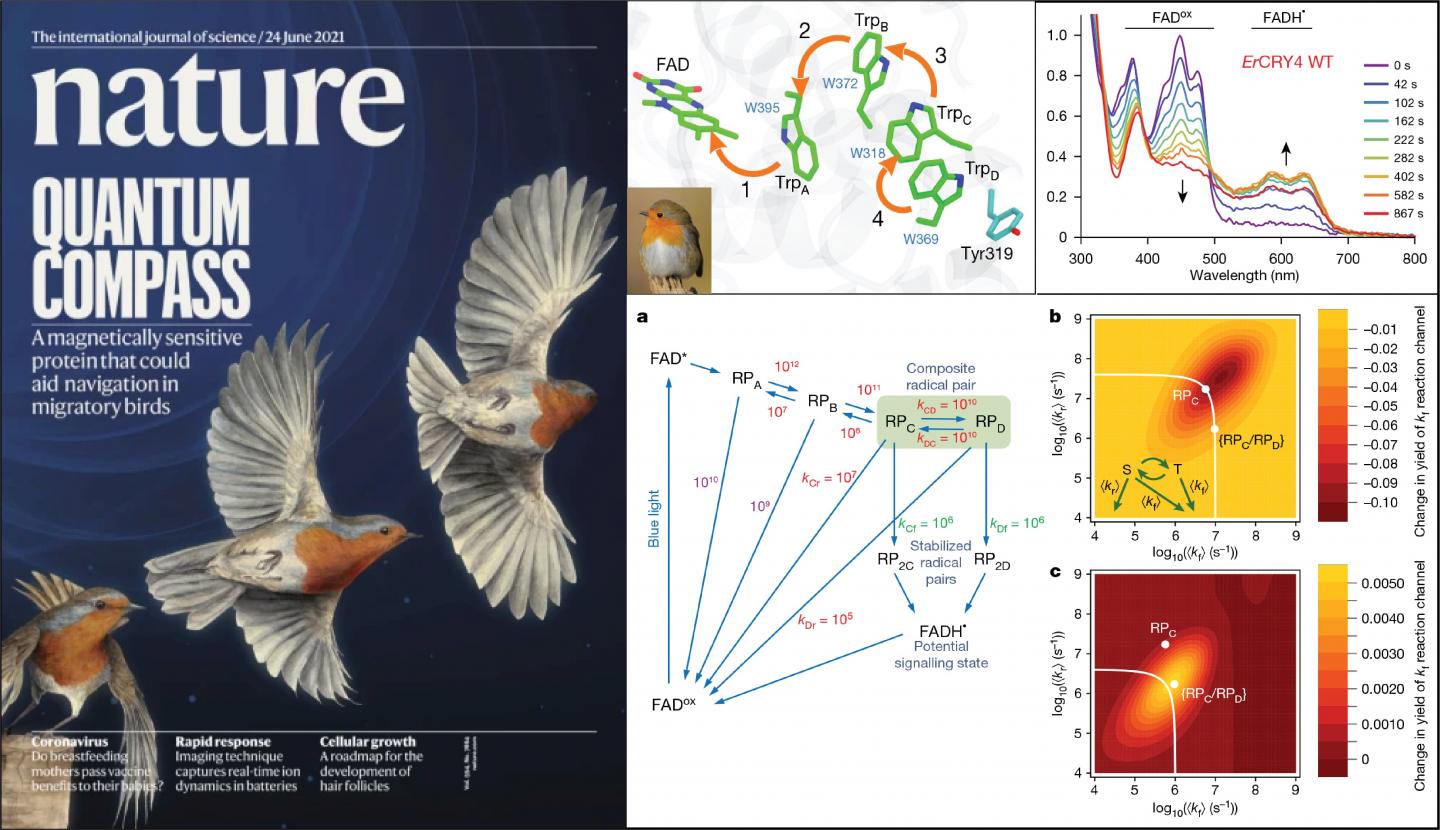
Recently, a collaboration of researchers from the Hefei Institutes of Physical Science (HFIPS), Universities of Oldenburg (Germany) and Oxford (UK) have been gathering evidence suggesting that a specific light-sensitive protein in the eye named cryptochrome 4 is sensitive to magnetic fields and plays essential roles in magnetic sensing in migratory birds such as European robins. The results have been published in Nature (https:/
For the first time, first author XU Jingjing, a doctoral student in Mouritsen’s research group at Oldenburg, with the help of XIE’s group, produced cryptochrome 4 in night-migratory European robins in large quantities using bacterial cell cultures. “The expression of bird cryptochromes with the FAD incorporated was a major achievement and served as a crucial first step in this project,” said Mouritsen.
The Oxford labs of Christiane Timmel and Stuart Mackenzie used a wide range of magnetic resonance and novel optical spectroscopy techniques to study the protein and demonstrate its pronounced sensitivity to magnetic fields.
The international team deciphered the mechanism by which this sensitivity arises. “Electrons that can move within the molecule after blue-light activation play a crucial role,” said Mouritsen. Proteins like cryptochrome consist of chains of amino acids: robin cryptochrome 4 has 527 of them. Four of the 527 – known as tryptophans – are essential for the magnetic properties of the molecule. The idea was supported by Hore and Ilia Solov’yov (Oldenburg), who performed quantum mechanical calculations in this project.
According to their calculations, electrons hop from one tryptophan to the next generating so-called radical pairs which are magnetically sensitive. To prove this experimentally, the team from Oldenburg produced slightly modified versions of the robin cryptochrome, in which each of the tryptophans in turn was replaced by a different amino acid to block the movement of electrons. Using these modified proteins, the Oxford team demonstrated experimentally that electrons move within the cryptochrome as predicted in the calculations – and that the generated radical pairs are essential to explain the observed magnetic field effects.
Hore said, “if we can prove that cryptochrome 4 is the magnetic sensor we will have demonstrated a fundamentally quantum mechanism that makes animals sensitive to environmental stimuli a million times weaker than previously thought possible”. But, the researchers admited this is not definitive proof that cryptochrome 4 was the magnetic sensor they were looking for.
In all experiments, they examined isolated proteins in the laboratory. The magnetic fields used were also stronger than the Earth’s magnetic field. “We think these results are very important because they show for the first time that a molecule from the visual apparatus of a migratory bird is sensitive to magnetic fields.” said Mouritsen. “But it still needs to be shown that this is happening in the eyes of birds.” Unfortunately, such studies are not yet technically possible.
They believed the proteins involved could be significantly more sensitive in their native environment. In cells in the retina, the proteins are probably fixed and aligned, increasing their sensitivity to the direction of the magnetic field. Moreover, they were also likely to be associated with other proteins that could amplify the sensory signals.
“We are still looking for other proteins that may participate in this complicated machinery, including but certainly not limited to MagR. We are open-minded and would not exclude any possible partners at this stage”, said XIE.
MagR is an iron-sulfur cluster protein discovered by XIE’s group five years ago as a putative magnetoreceptor, though the exact mechanism is still to be answered. It is suggested to interact with cryptochrome 4 to form a nanoscale ‘needle’ in vitro: a rod-like core of MagR polymer with an outer layer of cryptochromes (DOI: 10.1038/nmat4484).
###
The work was funded by the National Natural Science Foundation of China and the Presidential Foundation of Hefei Institutes of Physical Science, Chinese Academy of Sciences to XIE’s group, and a 6-year Synergy Grant from the European Research Council with the title ‘QuantumBirds’ to the Oldenburg and Oxford teams.
Media Contact
ZHAO Weiwei
[email protected]
Original Source
http://english.
Related Journal Article
http://dx.