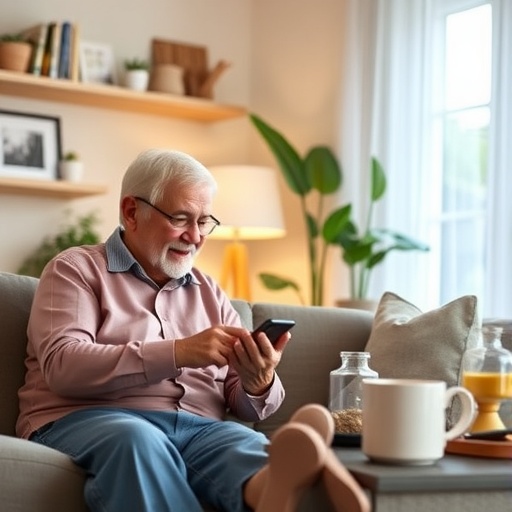
As the global population continues its rapid shift toward older demographics, the quest to maintain independence in later life has led to a surge in interest around smart home technologies. Traditionally heralded as a panacea for aging-in-place challenges, these digital environments promise enhanced safety, comfort, and social connectivity for seniors. However, a groundbreaking study conducted by researchers from the Universidad Politécnica de Madrid casts a critical eye on this one-size-fits-all approach, illustrating that the adoption of smart home technologies among older adults is far more nuanced than previously assumed.
The research, recently published in JMIR Aging, delves into the complex interplay between an older person’s daily life patterns and their readiness to embrace smart home innovations. Unlike prior studies which primarily relied on chronological age as a predictor of technology acceptance, this investigation pivots toward “residentially based lifestyles” — a composite framework that incorporates an individual’s living environment, habitual practices, and social engagement. By dissecting these lifestyle segments, the study exposes distinct behavioral clusters that significantly influence technology adoption preferences and perceived benefits.
A critical revelation of the study is that age alone is an insufficient variable to forecast who will integrate smart technologies effectively. Instead, an older adult’s social connectivity and routine activities emerge as far more potent indicators of their openness to these tools. This paradigm shift emphasizes the importance of understanding the context in which seniors live—the architecture of their homes, the dynamics of their neighborhoods, and the rhythm of their daily interactions. Technology designed without this context risks not only underutilization but outright rejection.
The research team employed an extensive survey methodology across diverse residential settings throughout Spain, compiling robust data that depicted a spectrum of lifestyle archetypes: tech-savvy urban dwellers accustomed to constant connectivity, traditional residents with limited experience in digital tools, and isolated individuals for whom technology may present both promise and apprehension. This stratification underscores that the ‘elderly’ cannot be considered a homogeneous market, thereby necessitating tailored smart home solutions.
One of the study’s compelling insights concerns privacy perceptions. The deployment of sensors or monitoring systems, often integral to smart homes, is variably accepted across different lifestyle segments. For instance, highly social and technologically engaged individuals demonstrated a greater willingness to share personal data for the sake of enhanced functionality, whereas those in more isolated or traditional settings frequently expressed concerns about intrusiveness and privacy infringement. This divergence suggests that developers must meticulously calibrate the balance between benefit and intrusiveness to avoid alienating target users.
Another technical dimension highlighted involves specific technological interventions such as fall detection systems, automated lighting, and social robotics. The researchers note that effectiveness and adoption rates hinge on matching these tools with compatible lifestyle segments. For example, automated lighting may be enthusiastically adopted by active urban seniors who navigate their homes frequently at night, but it might be irrelevant or disruptive to individuals with a more sedentary lifestyle or different living arrangements.
Moreover, the study advocates for a dynamic, empathetic design framework where technology integration is not merely about hardware sophistication but about harmonizing with existing social and daily habits. Such an approach requires multidisciplinary collaboration spanning engineers, behavioral scientists, healthcare providers, and policymakers, to ensure that solutions respond authentically to the lived realities of older adults.
This granular segmentation challenges current industry approaches that often lean on broad demographic profiles, pushing the innovation frontier toward more personalized smart home ecosystems. Adopting this methodology could curb high rates of technology abandonment, a notorious issue in gerontechnology, thereby extending the utility and lifespan of interventions designed to foster independent living.
Furthermore, the implications for public health and social care systems are profound. Tailoring smart home technologies to resident lifestyles could optimize resource allocation, prevent accidents such as falls, and reduce social isolation by promoting meaningful engagement through assistive digital instruments. In effect, technology becomes a bridge rather than a barrier.
The study’s authors emphasize that future research should continue to refine lifestyle segmentation models and explore culturally diverse contexts beyond Spain to enhance the generalizability of findings. Moreover, longitudinal studies would be instrumental in assessing how lifestyle changes over time affect technology acceptance and utility.
In conclusion, this pioneering research heralds a new era for gerontechnology—one that transcends the simplistic metrics of age and delves deeply into the lived experience of older adults. By embracing the intricate tapestry of lifestyle factors, developers and healthcare providers have the opportunity to craft smart home solutions that are not only technologically advanced but genuinely impactful in empowering seniors to live independently with dignity and confidence.
Subject of Research: People
Article Title: Segmentation of Older People’s Needs and Readiness for Smart Homes by Residentially Based Lifestyles in Spain: Survey Study
News Publication Date: 5-May-2026
References: Yu J, de Antonio A, Villalba-Mora E. Segmentation of Older People’s Needs and Readiness for Smart Homes by Residentially Based Lifestyles in Spain: Survey Study. JMIR Aging 2026;9:e75110 DOI: 10.2196/75110
Keywords: Gerontology, Aging populations, Smartphones, Telecommunications, Electronics, Information technology, Tools, Caregivers, Home care
Tags: aging-in-place smart home solutionsbehavioral clusters in elderly technology usedigital independence for older adultsenhancing comfort with smart home deviceslifestyle impact on technology useolder adults social connectivity and smart homespersonalized smart home systems for seniorsresidential lifestyle and technology acceptancesmart home safety features for seniorssmart home technology adoption among seniorssocial engagement and smart home benefitstechnology adoption barriers in aging populations